Key takeaways
- ChatGPT is accurate on most common questions but not reliable enough to use unchecked. GPT-5 scores 94.6% on AIME 2025 math problems and 87% on the MMLU knowledge test.
- GPT-5 makes 45% fewer factual errors than GPT-4, but it can still state invented facts, such as studies that don't exist, with full confidence.
- Accuracy depends heavily on the topic. On medical questions it was 86.6% accurate for common conditions but only 16.6% for rare disorders.
- Always verify ChatGPT on current events, company facts, legal, medical or financial advice, statistics and regulations. It has a training cutoff and only knows your business if you give it the data.
- For more accurate answers, paste the source documents into your prompt, ask it to show its reasoning and cite sources, and check every number against the original source.
Ask an AI about this article
Related reading: customer service automation.
You've probably relied on ChatGPT for everything from writing emails to solving coding problems. But there's a question keeping business owners awake at night:
Can you actually trust those confident-sounding answers?
OpenAI themselves slap a warning on every ChatGPT conversation: "ChatGPT can make mistakes. Check important info." That's not exactly a confidence booster when you're considering deploying AI for customer support or business-critical tasks.
The reality? ChatGPT is remarkably accurate for most queries, but it's not infallible. The latest models show dramatic improvements, yet understanding exactly when and why it fails can save you from costly mistakes.
What Is ChatGPT's Actual Accuracy Rate?
Let's cut through the marketing fluff and look at real performance data:
How Accurate Is GPT-5 Compared to Previous Versions?
GPT-5 (2025) Performance:
• 94.6% accuracy on challenging math problems (AIME 2025)
→ 87% correct on broad knowledge tests (MMLU)
• 45% fewer factual errors compared to GPT-4
→ 6x less likely to make up answers
Recent benchmarks show GPT-5 performing at near-human expert levels across multiple domains. When comparing different AI models, GPT-5 significantly outperforms Claude and Gemini in accuracy metrics.
ChatGPT Accuracy Rates: GPT-3.5 vs GPT-4 vs GPT-5
The accuracy journey has been dramatic:
Model | Year | Overall Accuracy | Key Limitation |
|---|---|---|---|
GPT-3.5 | 2022 | ~70-75% | High hallucination rate (39.6%) |
GPT-4 | 2023 | ~85-88% | 40% more factual than GPT-3.5 |
GPT-5 | 2025 | ~87-94% | 45% fewer errors than GPT-4 |
But what do these percentages really mean for your business?

Can You Trust ChatGPT for Professional Work?
ChatGPT isn't just good at trivia. It's achieving professional-grade results:
• Legal: GPT-4 scored in the top 10% on simulated Bar exams (GPT-3.5 was bottom 10%)
• Medical: Physicians rated ChatGPT's medical answers "completely or mostly correct" 84.8% of the time
• Technical: GPT-4 outperformed human doctors 64% vs 60.2% on neurology specialty assessments
But accuracy varies dramatically by topic.
Common conditions? 86.6% accurate.
Rare disorders? Only 16.6%.
Why Does ChatGPT Give Wrong Answers Sometimes?
Understanding when ChatGPT fails helps you use it smarter. The accuracy drops aren't random; they follow predictable patterns.
Why ChatGPT Doesn't Know Current Events
Your biggest frustration with ChatGPT probably stems from this: it doesn't know what happened yesterday.
Default ChatGPT models have training cutoffs:
- GPT-3.5: September 2021
- GPT-4: September 2021 (April 2023 for Turbo)
- GPT-5: More recent, but still has limits
Ask about current events after its knowledge cutoff, and it'll either admit ignorance or (worse) make up a plausible-sounding answer.
The business impact? If you're using vanilla ChatGPT for customer support, it might confidently give outdated product information or policy details. This is why businesses increasingly turn to specialized chatbot training on their own data.

What Are ChatGPT Hallucinations and Why Do They Happen?
Critical insight: Even GPT-5 occasionally presents fiction as fact with complete confidence.
"Hallucination" in AI terms means generating believable but false information. GPT-4's hallucination rate dropped to 28.6% for citation accuracy (down from GPT-3.5's 39.6%), but it hasn't disappeared entirely.
Real example: ChatGPT might confidently cite a study that doesn't exist, complete with realistic journal names and publication dates. This is why chatbot best practices emphasize training on verified data sources.
How Your Questions Affect ChatGPT's Accuracy
Providing more context dramatically improves accuracy. Compare these approaches:
Prompt Type | Example | Result Quality |
|---|---|---|
Vague | "What's the best treatment?" | Generic, potentially inaccurate |
Detailed | "What's the best treatment for seasonal allergies in children under 12, according to 2024 pediatric guidelines?" | Focused, more reliable |
What Topics Is ChatGPT Most Likely to Get Wrong?
ChatGPT excels at common topics but struggles with:
• Niche technical subjects outside mainstream training data
• Languages beyond English and major European languages
• Specialized terminology in emerging fields
• Company-specific information (unless explicitly provided)
What Happens When ChatGPT Makes Mistakes in Business?
Here's what's at stake. When ChatGPT gets it wrong in a business context, the consequences multiply.
Customer Support Scenarios:
→ Wrong product recommendations lose sales
→ Incorrect policy information creates legal issues
→ Outdated pricing confuses customers
→ Made-up feature claims damage credibility
Content Creation Risks:
• Fabricated statistics undermine authority
• Incorrect technical details harm reputation
• Outdated information makes you look unprofessional
• Legal claims without verification create liability
The solution isn't avoiding AI. It's using AI intelligently. This is where automated customer service platforms that train on your specific business data prove invaluable.

How to Make ChatGPT More Accurate for Business Use
The most successful AI implementations don't rely on ChatGPT's memory alone. They combine AI's conversational abilities with verified data sources.
How to Give ChatGPT Your Company's Real Data
Instead of asking ChatGPT to remember your product details, feed relevant documents directly into prompts. This grounds the AI in your actual information.
Example approach:
"Here's our current pricing from our website: [paste pricing table]
Based on this information, what plan would you recommend for a customer with 50 employees?"
This eliminates guesswork and hallucinations about your specific business.
Why Custom AI Beats Generic ChatGPT for Business
Generic ChatGPT might achieve 85% accuracy overall, but specialized AI systems can reach 95%+ accuracy in their specific domains.
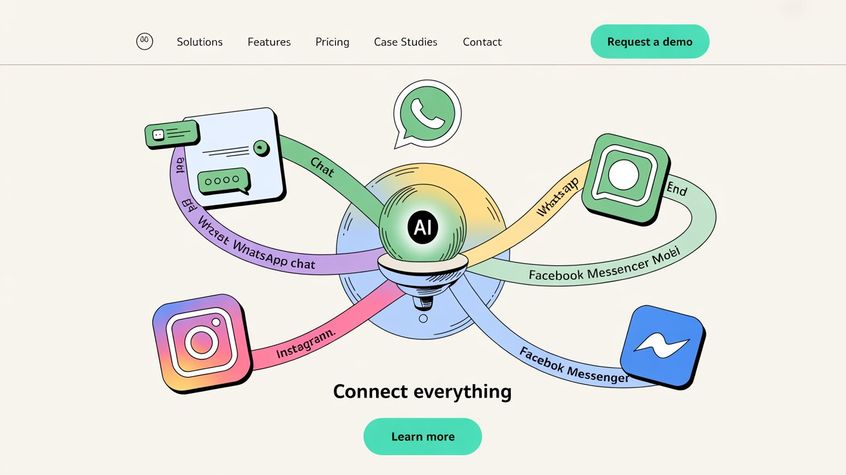
This is where platforms like Spur excel. Instead of relying on ChatGPT's general training, Spur's AI agents:
• Train directly on your knowledge base (eliminating hallucinations about your products)
• Access real-time data (no outdated information)
• Take actionable steps (check order status, update records, book appointments)
• Integrate with your systems (pull accurate info from your CRM, inventory, etc.)
The result? Customer support that's both conversational and trustworthy, because it's backed by your actual business data.
How to Let ChatGPT Access Current Information
When you need current information, give ChatGPT the ability to look things up. Using retrieval tools dramatically improves factual accuracy.
ChatGPT Plus offers:
- Browse with Bing for current information
- Plugins for specialized data sources
- Code interpreter for accurate calculations
GPT-5's "thinking mode" with web access shows huge drops in hallucination rates.
How to Get More Accurate Answers from ChatGPT
Whether you're using ChatGPT directly or through business platforms, these tactics increase reliability:
How to Ask ChatGPT Questions That Get Better Answers
✓ Be specific with context:
"Based on our Q4 2024 financial report, what were our top revenue drivers?"
✓ Ask for step-by-step reasoning:
"Show your calculation methodology for this ROI analysis."
✓ Request source verification:
"Cite specific sources for each statistic you mention."
Implementing these chatbot best practices ensures more reliable AI interactions.
How to Fact-Check ChatGPT's Responses
Use Case | Verification Process |
|---|---|
Critical Information | 1. Get ChatGPT's initial response |
Customer-Facing Content | 1. Generate draft responses with AI |
Which ChatGPT Setup Works Best for Different Business Needs
Basic approach: Use ChatGPT with manual fact-checking
Better approach: Integrate ChatGPT with your knowledge management system
Best approach: Deploy AI specifically trained on your business data
How Spur Eliminates ChatGPT's Accuracy Problems for Business
While generic ChatGPT is impressive for general tasks, businesses need something more reliable for customer interactions.
Spur's AI platform solves the accuracy problem by design.
Why AI Trained on Your Data Is More Accurate
Unlike tools that rely on general training, Spur trains AI agents directly on your website data, FAQs, and policies. No more guessing about your products or services.
How Spur's AI Gets Current Information Without Guessing
Spur's AI doesn't just answer questions; it takes real actions like checking order status or updating customer records. This provides genuinely accurate, current information instead of AI-generated guesses.
Where You Can Deploy Accurate AI Customer Support
Deploy the same accurate AI agent across:
The result? Consistent, accurate customer support that scales without the reliability concerns of generic AI.
How Easy Is It to Set Up Accurate AI for Your Business?
Unlike complex technical tools, Spur offers user-friendly setup that doesn't require a development team. You get enterprise-grade AI accuracy with small business simplicity.
This is particularly valuable compared to alternatives that require extensive technical knowledge for implementation.
When Is ChatGPT Reliable vs When Should You Double-Check?
Based on current performance data, here's a practical framework:
What Can You Trust ChatGPT to Get Right?
- General knowledge questions
- Common coding problems
- Well-documented topics
- Creative writing assistance
- Brainstorming and ideation
Understanding these chatbot use cases helps you deploy AI more strategically.
When Should You Fact-Check ChatGPT's Answers?
• Professional advice (legal, medical, financial)
• Technical specifications
• Historical facts and dates
• Statistical claims
• Process explanations
What Should You Never Trust ChatGPT About?
• Current events and news (no real-time data access)
• Company-specific information (unless explicitly provided)
• Rare or niche topics (limited training data)
• Regulatory compliance details (laws change frequently)
• Critical business decisions (too much at stake)
Is ChatGPT Getting More Accurate Over Time?
ChatGPT's accuracy has improved dramatically in just three years. The trajectory suggests continued advancement:
Year | Model | Key Achievement |
|---|---|---|
2022 | GPT-3.5 | ~70-75% accuracy with significant limitations |
2023 | GPT-4 | 40% better factual accuracy |
2025 | GPT-5 | 45% fewer errors than GPT-4 |
2026+ | Next Gen | Likely continued exponential improvement |
But even as general AI improves, specialized business applications will maintain accuracy advantages by training on specific, verified datasets. This is why business process automation increasingly focuses on domain-specific solutions.
Should You Use ChatGPT or Specialized AI for Your Business?
The choice isn't whether to use AI; it's which AI approach serves your business best.
For internal productivity: ChatGPT Plus with careful verification workflows
For customer-facing applications: Specialized platforms that train on your data and integrate with your systems
For mission-critical accuracy: Domain-specific solutions with real-time data access
The businesses winning with AI aren't just using the most advanced models; they're using the most appropriate AI for each specific use case.
Frequently Asked Questions
ChatGPT and Google serve different purposes. Google retrieves current information from the web with high accuracy for factual queries. ChatGPT generates comprehensive, conversational responses but may include outdated or incorrect information. For factual accuracy, Google search is more reliable. For explanation and synthesis, ChatGPT excels when combined with fact-checking.
Never rely solely on ChatGPT for medical or legal decisions. While it shows 84.8% accuracy on medical questions and performs well on legal exams, it lacks current regulations knowledge and cannot consider your specific situation. Always consult qualified professionals for health and legal matters.
ChatGPT uses probabilistic generation, meaning it doesn't retrieve fixed answers from a database. Each response is generated based on patterns in training data, leading to natural variation. Also, model updates can change performance over time. For consistency, provide detailed context and use specific prompts.
The most effective approach is using AI platforms that train on your specific data rather than relying on general models. Tools like Spur eliminate hallucinations by grounding AI responses in your actual knowledge base and real-time business data. For generic ChatGPT use, provide relevant documents in prompts and enable web browsing features.
Overall trend is toward higher accuracy. GPT-5 shows 45% fewer factual errors than GPT-4, and each model generation significantly outperforms previous versions. But individual model updates can sometimes cause temporary performance changes in specific areas. Long-term accuracy trajectory is strongly positive.
For business use, ChatGPT Plus is essential. The free version uses GPT-3.5, which has significantly higher error rates and more hallucinations. GPT-4 and GPT-5 (available in Plus) provide 40-45% better accuracy, web browsing capabilities, and access to plugins. For customer-facing applications, consider specialized business AI platforms.
Context matters enormously. ChatGPT now matches or exceeds human performance on standardized tests in law, medicine, and technical fields. But humans excel at judgment, context interpretation, and handling novel situations. The most effective approach: Combine AI's broad knowledge with human oversight and verification.
Multi-source verification is key:
- Check specific claims against authoritative sources (official websites, academic papers, government data)
- Look for recent information that might contradict AI's potentially outdated training
- Verify statistics and numerical claims through original sources
- For business use, cross-reference against your own documentation and policies
- When in doubt, consult subject matter experts
The goal isn't perfect accuracy from AI; it's leveraging AI's speed and comprehensiveness while maintaining verification standards appropriate for your use case.
Sources
The pages this article links out to, in the order they appear.
- top 10% on simulated Bar exams openai.com
Was this article useful?