Key takeaways
Real estate agents using AI chatbots see 3× higher conversion rates and 35% lower cost per lead. Instant qualification across all channels.
Ask an AI about this article
Real estate agents lose 78% of buyers to competitors who respond first (often within minutes). AI chatbots solve this by qualifying leads instantly across WhatsApp, Instagram, and website chat, asking the right questions 24/7 while you sleep. Teams using Spur for AI lead qualification see 3× higher conversion rates, 35% lower cost per lead, and never miss another hot prospect again.
Why Do Real Estate Agents Lose 78% of Leads to Faster Competitors?
If you're searching for "AI chatbot for real estate lead qualification," you're not just trying to add a chatbot to your website.
You're trying to solve five very specific, expensive problems:
- Reply instantly so leads don't bounce to faster competitors
- Separate serious buyers from tire-kickers without wasting agent time
- Route hot leads to the right agent before they cool off
- Book site visits and calls automatically while interest is peak
- Feed clean data back into your CRM and ads so cost per qualified lead drops over time
This matters more in real estate than almost any other industry. Buying or renting a property is an urgent, high-stakes decision, and your prospects won't wait around.
How Fast Should Real Estate Agents Respond to Leads?
The numbers are stark:
Consumer preference:
- 53% of buyers would rather contact an agent via text or messaging than any other method
Agent reality:
- 94% of realtors prefer communicating with clients via text message
Translation: Your lead qualification layer has to live where people already chat. Not buried in a contact form that sits unanswered for hours.
The speed advantage compounds fast. Research from Chili Piper found that teams responding within one minute saw 391% more conversions than those responding in five minutes. Real estate is even more "race-to-respond" because listings are time-sensitive and people message multiple agents simultaneously.
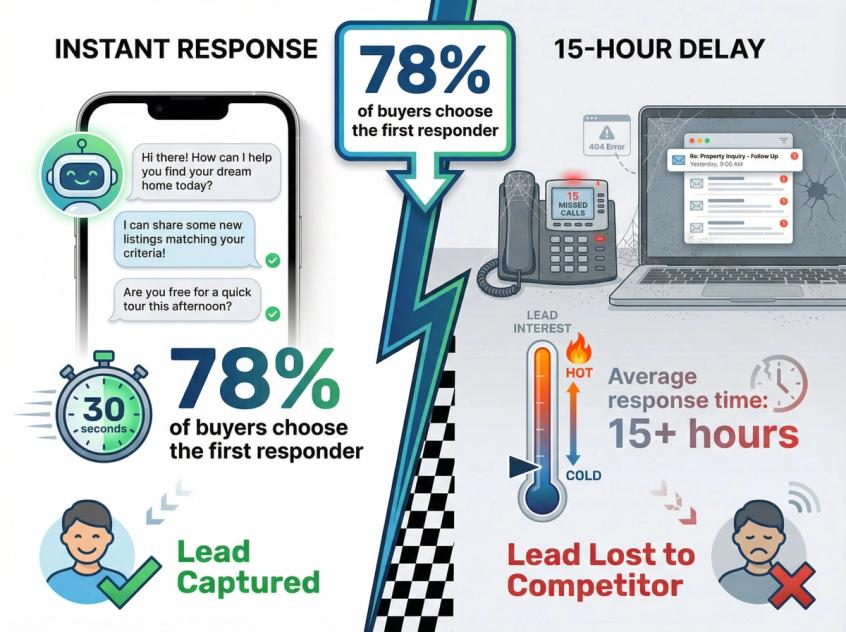
The knockout stat: 78% of buyers go with the first agent who responds to them.
Not the most qualified. Not the one with the best listings. The first one.
And yet, the average response time for online real estate leads is over 15 hours. By the time you call them back the next day, they've already booked three viewings with someone else.
What Does Every Missed Real Estate Lead Cost You?
Consider the modern buyer's journey:
- 90% of home buyers start their search online
- 62% of inquiries hit outside normal 9-5 business hours
If you rely solely on contact forms or voicemails, a majority of your leads slip through the cracks unseen. And the cost is staggering: each unaddressed lead can represent over $7,500 in potential commission on average.
Multiply that across dozens of leads per month, and the revenue loss from slow follow-up becomes devastating.
Why Traditional Real Estate Lead Qualification Methods Fail
Traditional lead qualification is inefficient and frustrating for everyone involved. A typical scenario: a buyer fills out a "Contact me" form about a property, waits hours or days for a callback, then endures phone tag to answer basic qualifying questions. By the time an actual conversation happens, the lead's excitement has cooled.
Or worse, the agent spends time calling leads who never pick up at all. Industry data shows only 5-10% of cold calls are answered, and less than 1% of voicemails get a response.
89% of consumers prefer text or messaging over phone calls for business communication.
Real estate leads want quick, convenient answers via chat. Not endless rounds of phone tag.
This is the gap that AI chatbots are now filling. An AI-powered chatbot can engage every website visitor or ad respondent immediately, 24/7. It can handle the initial Q&A and data capture in seconds, when the lead is hot. And it never gets tired or busy.
What Is an AI Chatbot for Real Estate Lead Qualification?
An AI real estate chatbot is a smart virtual assistant that chats with your prospects in real time and guides them through the early stages of your sales funnel. It uses artificial intelligence (especially Natural Language Processing or NLP) to understand inquiries and respond conversationally.
Unlike basic autoresponders or scripted bots of the past, modern AI chatbots can:
- Handle open-ended questions
- Recognize intent (buying vs. selling, for example)
- Adapt their dialogue based on the user's answers
- Learn from conversation patterns
How Do AI Chatbots Discover Buyer Intent and Fit?
For lead qualification, the chatbot's job is to discover how serious and suitable a prospect is, just like a skilled sales associate would. It asks the right questions to determine if the person is a qualified lead or just a casual browser.
In real estate, this means asking things like:
- What type of property are you looking for?
- What's your budget range?
- Preferred location or neighborhood?
- Are you a first-time buyer?
- When do you need to move or close?
By gathering these key details, the bot gauges the prospect's needs, urgency, and readiness to transact. It's performing a quick version of the classic BANT framework (Budget, Authority, Need, Timeline). But in a friendly chat instead of a formal form or phone interview.
Which Channels Can Real Estate Chatbots Cover 24/7?
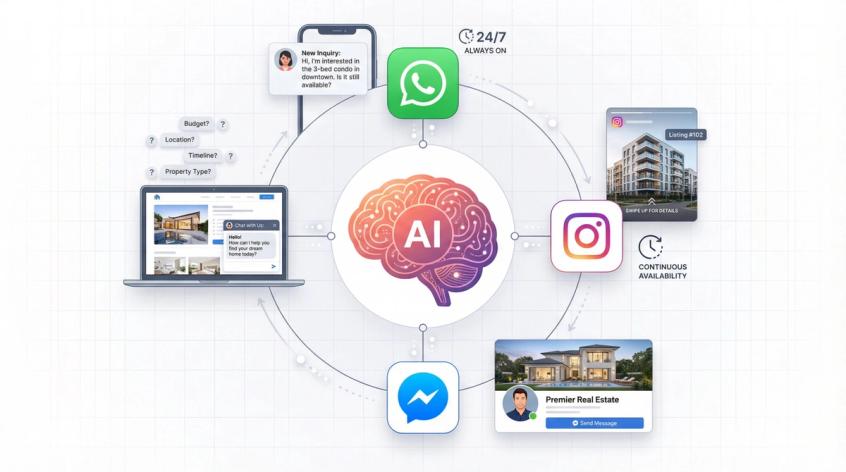
Importantly, an AI chatbot is always-on and multi-channel. It can:
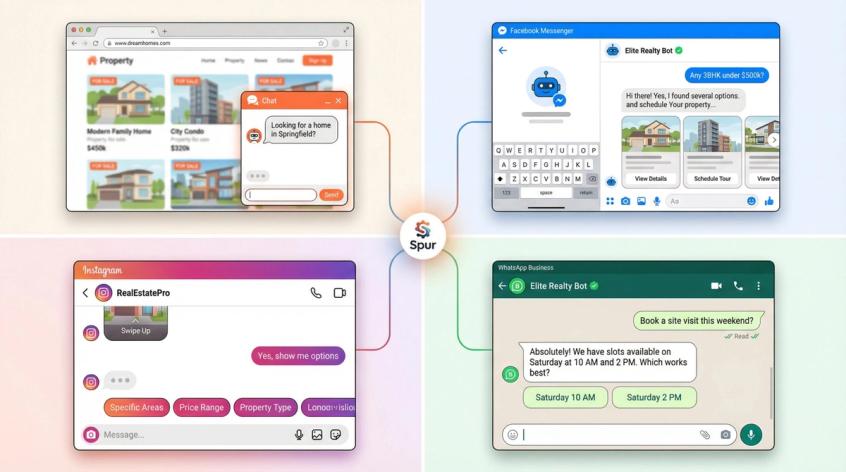
- Sit on your website as a live chat widget
- Live in your Facebook Messenger or Instagram DMs, engaging users who click your social media ads
- Work over WhatsApp or SMS, which is crucial in markets where texting is the norm for business chats
Wherever your leads come from (your Zillow listings, your own site, an Instagram ad, a yard sign with a QR code), the chatbot can be there to capture and qualify them instantly.
This means you're not limited to office hours or waiting for someone to manually respond. Every inquiry gets an immediate conversational response, whether it comes in at noon or midnight.
Do AI Chatbots Replace Real Estate Agents?
Think of it this way: the chatbot is your tireless first-line sales assistant. It welcomes the prospect, asks initial questions to understand what they want, answers basic queries, and decides what the next step should be (mark them as a hot lead and notify an agent, or nurture them further if they're not ready).
All of this happens via simple text chat that feels natural to the user. From the prospect's perspective, it's like messaging with a helpful agent who's extraordinarily responsive and knowledgeable.
AI chatbots don't replace real estate agents. They augment them. The chatbot handles the initial engagement and qualification at scale, then hands off the high-value leads to your human team to close the deal.
It's about using AI for what it does best (instant responses, data collection, consistent follow-up) so your agents can do what humans do best (building relationships, negotiating, closing).
How Does AI Lead Qualification Work? (4-Layer Mental Model)
Think of your AI chatbot like an engine with four distinct layers. This framework helps you understand exactly what needs to happen to turn a random website visitor into a qualified lead ready for your sales team.
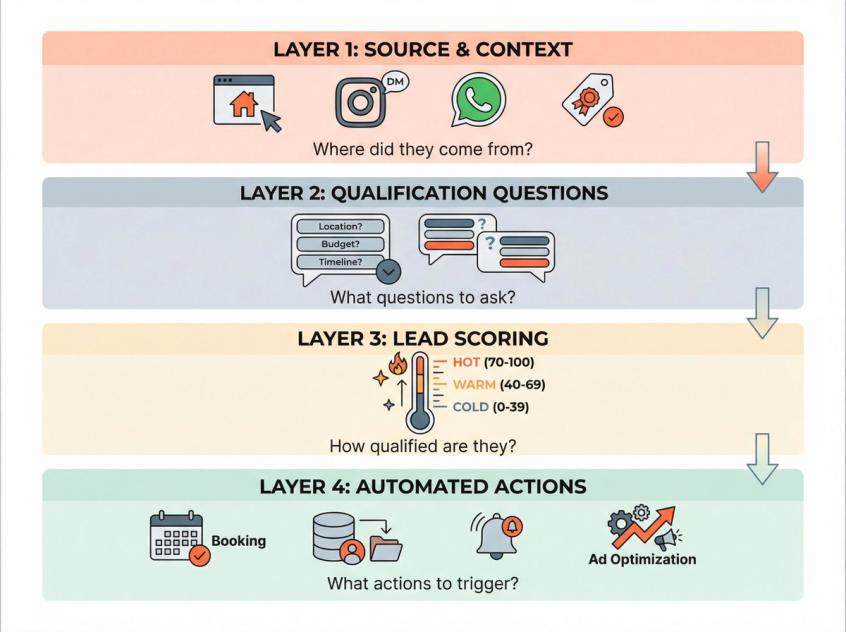
Layer 1: Where Did This Lead Come From and What Were They Looking At?
Where did they come from, and what were they looking at?
- Source tracking: Did they land from a listing page, a click-to-DM ad, an Instagram comment, or a WhatsApp link?
- Behavioral context: What did they view? Property ID, locality, price band?
- Campaign attribution: Which ad or organic post drove them?
This layer captures the intent signals before the conversation even starts. Someone viewing a specific $500K listing in Midtown has very different intent than someone browsing your homepage.
Layer 2: What Questions Should Your Chatbot Ask to Qualify Leads?
A short, guided flow that collects key qualification fields.
- Buttons and quick replies to reduce drop-off on mobile
- One question at a time to maintain engagement
- Progressive disclosure of information needs
- Natural language understanding for flexibility when users type instead of click
This is where the chatbot asks the right questions in the right order (more on this in the next section).
Layer 3: How Do You Score Real Estate Lead Quality?
A simple points model that outputs a clear qualification level.
- No black box AI (at least not initially). Use transparent rules
- Outputs: Hot (70-100 points) / Warm (40-69) / Cold (0-39)
- Reason codes stored with the score so agents know why someone qualified
For example:
- Timeline 0-30 days = +30 points
- Budget matches inventory = +25 points
- Pre-approved for financing = +15 points
- Asked to book a visit = +15 points
Layer 4: What Actions Should AI Trigger for Qualified Leads?
The chatbot triggers real business outcomes.
- Assign to specific agent or team based on territory, property type, or language
- Auto-book a site visit or call using calendar integration
- Sync to CRM with all collected data and conversation transcript
- Push conversion signals back to ad platforms (Meta, Google) to optimize campaigns
This is what transforms your chatbot from a "cute FAQ widget" into an actual lead qualification engine that drives revenue.
What Questions Should You Ask to Qualify Real Estate Leads?
You don't need 25 questions to qualify a real estate lead. You need the right 8-10 questions that reveal fit and intent.
Here's what to ask for different lead types:
How to Qualify Buyers (Purchase Intent Questions)
- Preferred location(s) (micro-market beats broad city: "Whitefield" > "Bangalore")
- Budget range (use ranges, don't ask exact numbers: "Under 50L / 50L-1CR / 1-2CR")
- Property type (1BHK, 2BHK, 3BHK, villa, plot, commercial)
- Purpose (end-use vs. investment)
- Timeline (0-30 days / 1-3 months / 3-6 months / 6+ months)
- Financing readiness (cash / loan pre-approved / exploring / not sure)
- Must-haves (parking, balcony, pets allowed, Vastu compliance, etc.)
- Contact preference (call vs. WhatsApp, best time to reach)
- Name (for personalization)
- Phone or email (capture only when there's momentum)
How to Qualify Renters (Rental Lead Questions)
- Move-in date
- Monthly budget range
- Furnishing preference (unfurnished / semi-furnished / fully furnished)
- Lease term (6 months / 1 year / 2+ years)
- Pet ownership
- Preferred locality
- Contact details
How to Qualify Sellers or Landlords (Listing Lead Questions)
- Property location
- Property type and size
- Expected price or rent band
- Timeline to list
- Current occupancy status
- Willingness to offer exclusivity
- Contact details for specialist callback
What Order Should You Ask Qualification Questions In?
The psychological principle that matters: micro-commitment first, contact info later.
A proven sequence:
- "What are you looking for?" (buy / rent / sell)
- "Which area(s)?"
- "Budget range?"
- "When do you want to move or close?"
- "Any must-haves or deal-breakers?"
- "Want to book a call or site visit?"
- "Share your number so I can confirm the slot"
Notice how contact information comes after the prospect has already engaged with multiple questions and received value. By the time you ask for their phone number, they're invested in the conversation and more willing to share it.
How Do AI Chatbots Qualify Real Estate Leads Step by Step?
Every effective real estate chatbot follows a structured playbook to turn inquiries into qualified opportunities. This is exactly how the process works:
Step 1: How Do Chatbots Engage Leads Instantly 24/7?
Imagine a potential buyer lands on your website at 9 PM to look at listings, or clicks a Facebook ad for your new development. Instead of hoping they fill out a form, an AI chatbot proactively says hello within seconds.
It might pop up with: "Hi there! Looking for a home in Springfield? I can help 🙂. Are you interested in buying or renting?"
This immediate reach-out keeps the prospect engaged on your site longer and prevents them from bouncing away to competitors.
Speed is everything. By responding instantly, the bot stops the lead from wandering off to the next thing.
Whether it's midnight or midday, the chatbot is awake and friendly. This 24/7 availability alone can dramatically boost lead capture. In high-urgency industries, having a chatbot answering after hours can increase captured leads by as much as 60%.
Real estate is no exception. With a chatbot, you're able to engage 62% of inquiries that happen outside business hours instead of missing them entirely.
The instant engagement also gives an ultra-responsive brand impression. You're effectively saying, "We're here right now to help you." In a business where 78% of clients go with the first responder, being immediately available via chatbot creates a huge competitive advantage.
Step 2: What Qualifying Questions Should AI Chatbots Ask Prospects?
Once the chat is initiated, the chatbot starts gathering details in a conversational way. It asks a series of targeted questions to understand the lead's needs and motivation.
Crucially, it asks one question at a time, like a natural dialogue, rather than bombarding the user with a long form.
For example, a typical buyer conversation might flow like this:
- "Great, I can assist with buying. What type of property are you looking for (a house, condo, land)?"
- "Got it. Any specific location or neighborhoods you prefer?"
- "Thanks! And about what price range are you considering?"
- "Are you already working with a lender for financing, or will you need loan information?"
- "Lastly, when are you looking to make a move or purchase by?"
Each question maps to a core qualifying dimension: property type/need, location preference, budget, financing readiness (which hints at seriousness), and timeline.
The chatbot is effectively performing a BANT check (without using that jargon with the consumer). If the user's answers indicate strong intent (say they want a 3-bedroom in a specific area, have a $500K budget, and need to move in 3 months), you've got a hot lead on your hands.
One big advantage of the chatbot approach is personalization and tone. The bot can incorporate the user's name and previous answers as it goes, making the conversation feel human and personalized.
For instance: "Okay John, a 3 BHK in downtown around $500k. Thanks! Are there any must-have features you're looking for?"
This feels like a helpful assistant, not a survey. Contrast that with a long web form asking for budget, location, and timeline all at once (most people would abandon it).
The chatbot's progressive questioning keeps engagement high. In fact, businesses find that interactive chat interfaces can convert 3× more visitors into leads than static forms. It's a chat, not a chore.
While asking questions, a good AI chatbot will also provide value on the fly, not just interrogate the user. If the prospect asks a question back ("Is financing required to buy in that area?" or "Do you have any homes in Lakeside suburb?"), the bot can answer or acknowledge it before continuing.
This makes it a two-way exchange, not just the bot quizzing the user.
Step 3: How Do Chatbots Provide Instant Property Information?
A powerful feature of real estate chatbots is their ability to serve up relevant info in real time.
As the chatbot learns what the lead wants, it can immediately share resources: links to matching property listings, images, virtual tour videos, or PDF brochures of a project.
For example, if a user says "I'm looking for 2BHK apartments under $300k in Midtown," the bot could reply with: "Here are a couple of listings that fit your criteria:" and display a carousel of two or three homes with images, price, and a link for details.
This transforms the chatbot from just a questionnaire into a property concierge. It helps the buyer see options right in the chat, which can increase their interest and trust.
Real estate chatbots integrated with your listings database or MLS can do on-the-fly property searches. They use the user's inputs (location, budget, bedrooms) to query the database and return results.
The ability to answer FAQs is also key. Common questions like "Is this property still available?", "What are the HOA fees?", or "Can I schedule a viewing on Saturday?" can all be answered by a well-trained bot pulling from your data.
Some AI bots are trained on your knowledge base or website content, so they can provide details about amenities, school districts, or financing options when asked.
This saves your team tons of repetitive typing and ensures the lead gets immediate gratification.
Speedy answers keep leads engaged. Remember, modern buyers expect immediacy. 49% of buyers expect an instant response from agents.
If your bot can tell them within seconds that Unit 5B has an open house this Sunday at 3pm and send a registration link, you've delighted that prospect. Meanwhile, an agent who gets back the next day with the same info might already be too late.
This real-time info delivery can meaningfully improve conversion. Meta has reported that interactive chat experiences can drive 61% higher conversion rates than follow-up emails for leads. The richer, two-way dialogue simply produces more qualified opportunities than a static lead capture followed by delayed outreach.
Step 4: How Do AI Chatbots Score and Qualify Leads in Real Time?
As the conversation progresses, the AI chatbot isn't just collecting information. It's evaluating the lead's quality beneath the surface.
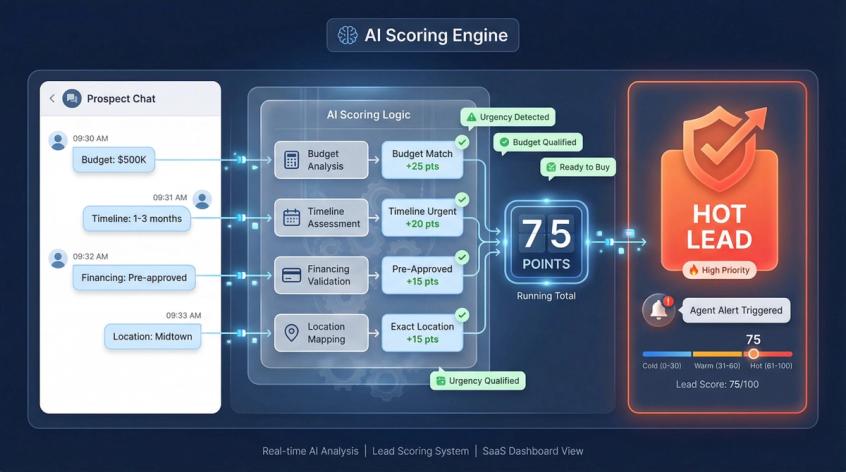
Behind the scenes, the chatbot can apply your qualification criteria to the answers. For example, it might assign points or flags for certain responses:
- A budget above a threshold gets a high score
- A short move-in timeline indicates urgency
- Mentioning "pre-approved for a mortgage" is a big positive signal
By the end of the Q&A, the bot has essentially scored the lead or categorized them (Hot, Warm, or Cold). All of this happens instantly, without any human analysis.
Advanced chatbots even use AI to interpret the tone and language of responses. Say the prospect types: "I need to move ASAP because of a new job, but I'm worried about finding a place in time."
This sentence reveals urgency, a clear need, and even a concern the bot could address (perhaps by offering to connect with an agent who's a relocation specialist).
An AI bot will catch those nuances, whereas a simple rule-based bot might not. The result is more accurate qualification.
In fact, businesses using AI-powered lead qualification report that AI-qualified leads convert at a 40% higher rate than those that came through manual filtering. The chatbot essentially weeds out the tire-kickers and surfaces the gems.
If the bot finds the lead meets your criteria (say, high intent and ready to buy), it can tag them as a priority. This trigger will be crucial for the next step (handoff).
On the other hand, if the lead's answers suggest they're not ready (maybe they say "just browsing" or their budget is far below anything in your inventory), the chatbot knows not to immediately hand them to sales.
But it still won't discard them; a good bot will move those leads into a nurture track.
The key is, every lead is handled appropriately according to its quality. This automated triage ensures your sales team focuses energy where it matters most, without letting lesser leads vanish entirely.
Throughout this qualification stage, all the data is being saved: name, contact info (if provided), requirements, etc. Many chatbots will politely ask for a phone or email at some point if the user hasn't given it: "Can I grab your email in case we get disconnected? I'll send the property details there too."
Because the conversation is interactive and providing value, users are generally willing to share contact details by this stage.
The bot can automatically push this info into your CRM or lead management system, creating a lead profile with a full chat transcript attached. This means when a human agent gets involved, they have all the context (what the lead wants, what was already answered, how the lead feels (excited, cautious, etc. as evident from chat)).
That context makes the eventual human follow-up far more effective than a cold call would have been.
Step 5: When Should AI Chatbots Hand Off Leads to Human Agents?
Now comes the critical moment: what to do when a lead is qualified right now.
Top-performing chatbots will immediately attempt to convert a hot lead into the next action while you have the prospect's full attention.
Often, the bot will say something like: "It sounds like we've got some great options for you. Would you like to talk to a live agent for more details or to schedule a viewing?"
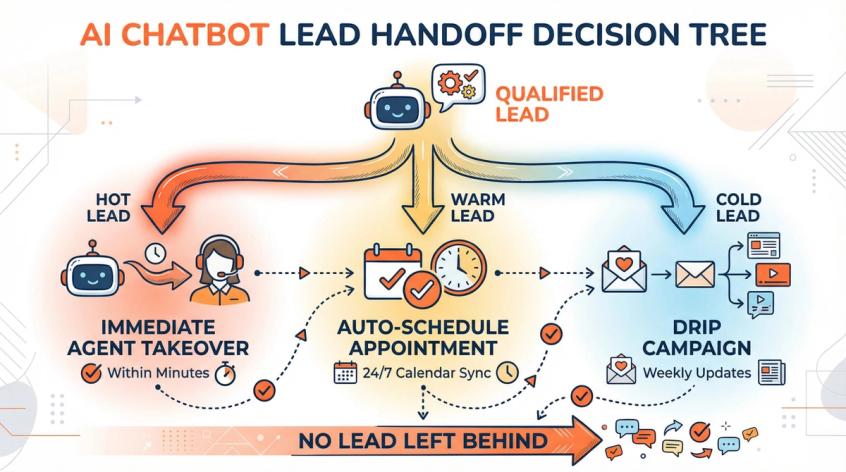
If the user says yes, the chatbot can seamlessly hand over the conversation to a human. This might mean alerting an on-call agent or inside sales rep, who can then join the chat or call the customer right away.
Many systems have a live chat takeover feature where a human agent can literally jump into the same chat thread the bot was in, so the customer hardly notices the switch.
The result: your salesperson is talking to the lead within minutes of their inquiry, while their interest is red-hot, which is exactly when conversion likelihood is highest.
If no human is immediately available (say the lead comes in at 2 A.M. and you don't have 24/7 staff), the chatbot can offer to schedule a meeting or tour for a later time.
It might say: "Our agents are offline at the moment, but I can book you an appointment. Does tomorrow at 10:00 AM for a call or a home tour work?"
Integrated bots can tie into your calendaring system so that available slots are offered and once the user picks one, it's confirmed on the calendar with an invite sent.
This kind of automation ensures the lead is locked in for next steps before they wander off. Rather than a lead submitting a form and waiting, here they have already booked a meeting or home viewing in one continuous interaction.
For leads that aren't sales-ready (for example, they said their timeline is next year or they're just researching), the chatbot shifts into nurture mode.
It will conclude the chat warmly and keep the door open. It might offer something helpful like: "No problem. Buying a home is a big step. How about I send you a weekly update of new listings in Greenwood under $400K? And here's a first-time buyer guide that might be useful. I'll save your info, and if you have any questions later, just message here and I'll be happy to help."
In doing this, the chatbot accomplishes two things: it captures their contact (if not already done) for future follow-ups, and it leaves a positive impression rather than just saying "bye."
Many chatbots will send a follow-up message or email with the promised info (like a list of current homes or a guide PDF). They can also tag these colder leads in your CRM for inclusion in drip campaigns or retargeting ads.
No lead goes completely unattended. Everyone either gets an appointment, an immediate human chat, or some content and a plan to follow up later.
This systematic approach means every single inquiry is acknowledged and progressed in some way. Hot leads talk to your team right away or get an appointment scheduled; warm leads are nurtured with content and captured for future follow-up.
No one gets ignored. Compare that to a typical manual process where agents often cherry-pick a few "promising" form fills to call and may ignore the rest (especially if they're busy or the leads came in at odd hours).
The chatbot doesn't get overwhelmed or lazy. It will diligently talk to 100% of your leads, 24/7, with perfect consistency. This kind of consistent engagement can easily triple your conversion rate just by ensuring every lead is followed up within minutes.
Copy-Paste Chatbot Scripts for Real Estate Lead Qualification
Below are production-grade scripts you can paste into your bot builder and customize for your market.
Flow 1: How to Qualify Buyer Leads (Short, High-Converting Script)
Bot: Hey! Quick one. Are you looking to buy or rent?
Buttons: Buy / Rent / Sell / Just Browsing
User: Buy
Bot: Nice. Which area(s) are you considering?
Buttons (examples): Whitefield / Sarjapur / Bellandur / Indiranagar / Other (type)
Bot: What budget range should I keep in mind?
Buttons: Under 50L / 50L-1CR / 1-2CR / 2CR+ / Not Sure
Bot: When are you looking to finalize?
Buttons: 0-30 days / 1-3 months / 3-6 months / 6+ months
Bot: Got it. What type are you looking for?
Buttons: 1BHK / 2BHK / 3BHK / Villa / Plot / Commercial
Bot: Perfect. Want me to share options or book a site visit/call first?
Buttons: Share Options / Book Visit/Call
If Book:
Bot: What's the best number to confirm the slot on? (We'll only use it for this)
Input: Phone
Bot: Thanks, [name]. I'll share 2-3 matching options + slots in a minute.
Flow 2: How to Qualify Rental Leads (Fast Qualification Script)
Bot: Looking to rent. What move-in timeline?
Buttons: This Month / Next Month / 2-3 Months / Exploring
Bot: Budget range?
Buttons: <20K / 20-35K / 35-60K / 60K+
Bot: Furnishing?
Buttons: Unfurnished / Semi-Furnished / Fully Furnished
Bot: Preferred area(s)?
Input or Buttons
Bot: Want viewings this week?
Buttons: Yes / Not Yet
Flow 3: How to Qualify Seller Leads (Get Listing-Ready Data)
Bot: Are you looking to sell or rent out your property?
Buttons: Sell / Rent Out
Bot: Which locality is it in?
Input
Bot: Property type?
Buttons: Apartment / Villa / Plot / Commercial
Bot: Expected price/rent range?
Buttons: [Ranges] + "Not Sure"
Bot: Timeline to list?
Buttons: ASAP / 1-4 Weeks / 1-3 Months / Later
Bot: Share your number. I'll have a specialist reach out with a pricing/marketing plan.
Input: Phone
How to Score Real Estate Leads (Transparent Points System)
Don't build a "black box AI score" first. Start with a transparent points system you can understand, tweak, and explain to your team.
Example Lead Scoring Model (0-100 Point Scale)
Timeline:
- 0-30 days: +30 points
- 1-3 months: +20 points
- 3-6 months: +10 points
- 6+ months: +5 points
Budget Fit (matches your inventory):
- Exact band match: +25 points
- Stretch budget: +10 points
- Mismatch: +0 points
Location Fit:
- Exact match to available inventory: +15 points
- Nearby/adjacent area: +8 points
- Unknown or no fit: +0 points
Financing Readiness:
- Cash buyer or pre-approved: +15 points
- Loan in progress/exploring: +8 points
- Unknown: +0 points
Engagement Level:
- Asked for visit or call: +15 points
- Asked for property options: +10 points
- Passive responses: +0 points
What Actions to Take Based on Lead Score
| Score Range | Category | Action |
|---|---|---|
| 70-100 points | HOT | Instant agent assignment + book visit immediately |
| 40-69 points | WARM | Share shortlist + nudge for booking + follow-up sequence |
| 0-39 points | COLD | Nurture campaign + capture preferences + monthly broadcast |
Critical: Always store why someone is scored at a certain level (timeline = soon, budget match confirmed, etc.). This helps agents follow up like humans, not robots reading a number.
What 6 Automations Actually Drive Real Estate ROI?
Lead qualification is useless if it doesn't trigger action. Here are the automations that actually make money:
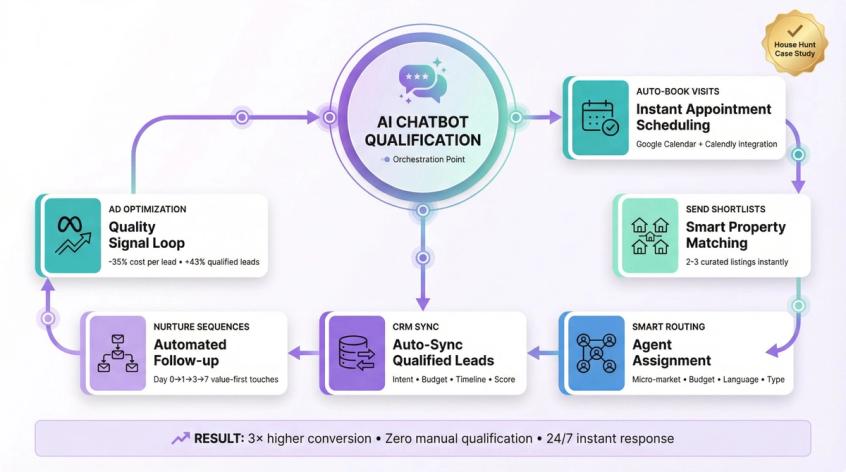
1) How to Auto-Book Site Visits or Calls with AI Chatbots
Connect your calendar (Google Calendar, Calendly, etc.) and let the bot book appointments inside the chat. This isn't "nice to have." It's the conversion event you want.
When someone says they're ready to view a property, the bot should immediately offer: "I can book a visit this week. What days work (weekday or weekend)?"
2) How to Send Property Shortlists Instantly via Chatbot
When a lead qualifies, automatically send 2-3 matching properties. Never dump 20 listings (decision paralysis).
Include:
- Price band + location
- 3 key features
- "Want a visit this weekend?" CTA
3) How to Route Leads to the Right Real Estate Agent Automatically
Route leads based on:
- Micro-market (agent specializes in that neighborhood)
- Budget band (luxury specialist vs. first-time buyer specialist)
- Property type (commercial vs. residential)
- Language (buyer prefers Hindi, Tamil, etc.)
This targeted routing improves conversion because the lead gets someone who truly understands their needs.
4) How to Auto-Sync Qualified Leads to Your CRM
Every qualified lead should automatically sync to your CRM with custom fields:
- Intent (buy/rent/sell)
- Budget band
- Locality preference
- Timeline
- Lead score
- Source channel (website/IG/WhatsApp)
- Full chat transcript
5) How to Nurture Warm and Cold Real Estate Leads Automatically
Not every lead is ready to buy today. Set up a value-first nurture sequence:
- Day 0: Shortlist + "Want to visit?"
- Day 1: "2 new matches in your budget"
- Day 3: "Price drop / inventory update"
- Day 7: "Are you still looking or should I pause notifications?"
This keeps you top-of-mind without manual effort.
6) How to Send Lead Quality Signals Back to Your Ad Platform
This is the lever most real estate teams miss, and it's pure gold.
Meta supports optimization toward higher-quality leads, like using the performance goal "maximize number of conversion leads."
For messaging-based acquisition, Meta also provides a performance goal to "maximize number of leads through messaging" for ads that click to WhatsApp, with eligibility requirements.
And the Conversions API is designed to accept business messaging events as well as web/app/offline events.
Real-world example: House Hunt, a real estate business, ran Instagram ads to generate buyer leads. They integrated an AI chatbot via Spur to qualify leads within the Instagram DM itself.
The bot asked each user about their budget, location preference, and intent, and only counted someone as a qualified lead if they met the criteria (serious buyer with matching budget).
Spur's system then sent a custom "Lead Submitted" event back to Meta's ad network for those qualified leads.
The effect was game-changing: within days, the Facebook/Instagram algorithm learned to find more users who would become qualified leads (not just any chat).
Over the next two weeks, House Hunt's cost per qualified lead dropped ~35% while the number of qualified leads jumped 43%.
They actually spent slightly less on ads and got far better results. This is the power of closing the loop between qualification and advertising.
What Results Can Real Estate Chatbots Deliver? (By the Numbers)
ROI. Adopting an AI chatbot for lead qualification isn't just a tech gimmick. It delivers measurable improvements to your bottom line.
How Many More Leads Can Chatbots Capture for Real Estate?
The always-on nature of chatbots means you capture leads you used to lose.
We saw that 62% of inquiries happen after business hours. With a chatbot covering nights and weekends, those leads are now engaged instead of silently bouncing.
Agents using AI chatbots report 40%+ increases in lead capture rates versus manual methods.
Even during the workday, instant responses keep prospects on your site. One industry stat found that companies responding within 5 minutes boost lead acquisition so much that they have 21 to 100 times higher chance of converting the lead compared to companies that wait longer.
More conversations started = more leads for your pipeline.
How Fast Can AI Chatbots Respond to Real Estate Leads?
Speed matters immensely in sales.
By using an AI chatbot, average lead response time can drop from nearly 40 minutes to under 30 seconds. That's essentially real-time.
No human team, no matter how dedicated, can consistently achieve that across hundreds of inquiries.
This speed pays off: one brokerage saw a 35% increase in qualified leads within 3 months of using a 24/7 chatbot, largely due to instant engagement of every website visitor.
Another real estate team found that just by responding faster (within a few minutes), their rate of converting leads to appointments tripled, contributing to a 25-40% boost in closed transactions over the quarter.
How Much Do AI Chatbots Increase Real Estate Conversion Rates?
Chatbot-qualified leads tend to convert at a higher rate because the tire-kickers are filtered out and the serious buyers get white-glove treatment.
We mentioned a source citing ~40% higher conversion for AI-qualified leads.
More evidence: According to McKinsey, only ~22% of real estate companies are using AI for lead qualification so far.
Yet those early adopters are seeing outsized returns, with up to 3× more sales conversions compared to firms relying on traditional web forms and slow follow-ups.
For example, a mid-sized brokerage in Texas found their conversion rate from inquiry to sale jumped from 14% to 39% (nearly 3 times higher) within 90 days of launching an AI chatbot to handle initial outreach.
That's a massive uplift, essentially turning more website visitors into closed deals without increasing ad spend.
The ROI can be illustrated simply: if your average commission is $5K-$15K, just one extra deal closed thanks to faster follow-up can pay for the chatbot service many times over. And it's rarely just one extra deal. Companies are seeing dozens more conversions over a year.
How Do AI Chatbots Lower Cost Per Real Estate Lead?
Beyond raw conversion rate, chatbots make your marketing spend more efficient.
When you capture and qualify leads better, you get more value from each advertising dollar.
For instance, House Hunt reduced their cost per qualified lead by ~35% and increased the volume of qualified leads by 43% using Spur's AI DM chatbot for their Instagram ads.
Essentially, the ad platform learned to find more buyers instead of just casual clickers, because the chatbot was signaling which conversations turned into true leads.
Even if you're not using conversions API optimization, just the fact that a bot weeds out low-quality leads means your sales team spends less time (and money) chasing duds. It's the classic efficiency gain: spend time on the right leads.
How Do AI Chatbots Improve Customer Experience for Buyers?
Today's consumers value convenience highly. A chatbot that provides instant answers and service gives a better experience to prospects.
They don't have to wait on hold or wonder when their email will get a reply. The consistency of replies (no missed questions, no "I'll get back to you on that") builds trust.
According to surveys, 69% of consumers feel satisfied with well-designed chatbot interactions (often because they got what they needed quickly).
In real estate, buying a home is an emotional, significant process. A chatbot that is always attentive and helpful can make a lead feel taken care of from the first touch.
That often translates into them sticking with your agency. Remember the stat that 70-78% of buyers go with the first agent they connect with. If your chatbot gave them a great first touch (and your human team follows through just as professionally), you've likely won their business before they even talk to competitors.
How Do AI Chatbots Improve Real Estate Agent Productivity?
From the agent/broker perspective, chatbots dramatically reduce the workload of your team on low-value tasks.
Realtors can easily spend hours a day just responding to initial inquiries, repeating the same info about listings, or chasing down unresponsive leads.
An AI chatbot handles those repetitive FAQs and the initial screening automatically.
One analysis found that deploying chatbots and automation could save businesses 2.5 billion hours by 2025 in handling routine sales and support questions.
On an individual level, a real estate agent might save 4+ hours per week that were previously spent on qualifying leads, which can now be used for showings or negotiations.
Some studies claim 300% increases in agent productivity (effectively doing the work of three people) when using AI assistants, by freeing agents from the grunt work.
Agents are happier too. They get to focus on serious buyers and sellers, the parts of the job that actually generate commissions.
As noted in one guide, many sales teams see improved morale when a bot "does the drudge work," and the human team can do the more rewarding parts of the job.
How Do AI Chatbots Ensure Consistent Real Estate Data Capture?
A side benefit: chatbots never forget to ask a question or log the data.
Every lead conversation gets documented. No more missing phone numbers or scribbling notes from a call. The chatbot automatically records all responses and even sentiment.
This consistent data collection means you can analyze your leads better. You might find, for example, that 30% of your inquiries are for a certain neighborhood or that most unqualified leads drop off when asked about budget (indicating perhaps your marketing is attracting a lower budget segment).
These insights can inform your strategy.
Plus, the chatbot can integrate with your CRM, email marketing, or IDX. So a new qualified buyer can automatically be added to a "hot leads" list, trigger an email from an agent, and be tagged for monthly market updates.
It's seamless, whereas in manual systems an inquiry might languish in someone's inbox unseen.
Where Should You Deploy Your Real Estate Chatbot? (Multi-Channel Strategy)
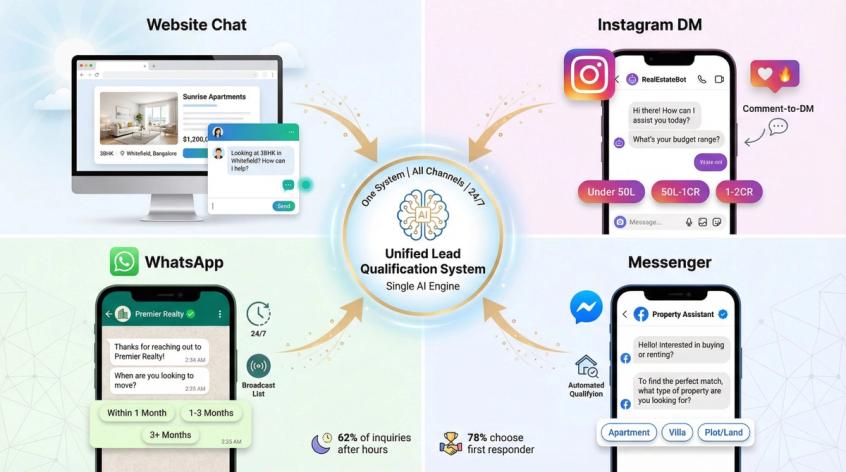
Your leads don't all come from one place. They browse Instagram, land on your website, message you on WhatsApp, and comment on Facebook posts.
The key is to meet them wherever they already are.
How to Use Live Chat for High-Intent Real Estate Website Visitors
Website chat is where you have the most context. You can see exactly which listing page they're on.
Spur's AI live chat is trained on your knowledge base and enables "AI actions" like booking meetings and capturing leads into a CRM.
Best practice for real estate website chat:
- Detect page context (listing vs. homepage vs. pricing page)
- Change the opening message accordingly
- If it's a listing page: start with "Want a visit for this property?"
- If it's a generic page: start with buy/rent/sell intent question
This context-aware approach dramatically improves engagement.
How to Qualify Real Estate Leads via Instagram DMs
DMs are brutal in volume if you're running ads. This is where structured qualification shines.
Spur's Instagram automation handles comment-to-DM flows, story reactions, and Click-to-DM ads.
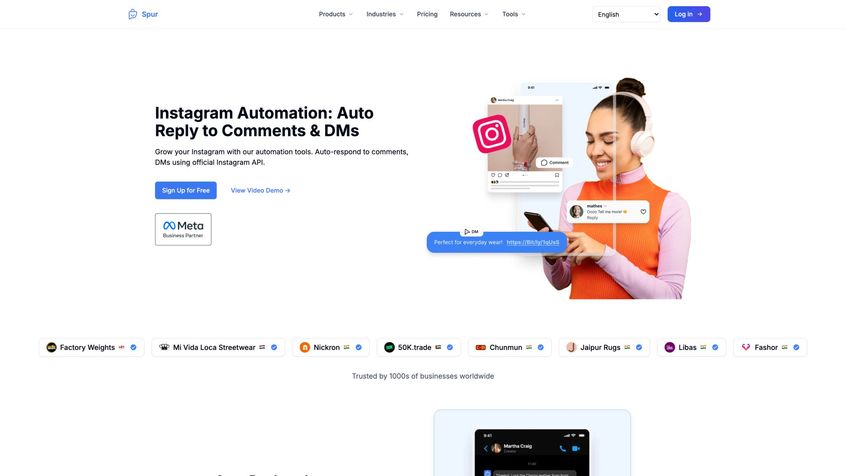
Spur's explainer on using Conversions API with Instagram Click-to-DM describes the loop: DM → qualify → send signal back to improve targeting.
This is powerful for real estate because you can run hyper-targeted ads ("Looking for 3BHK in Whitefield under 1CR?") and instantly qualify anyone who responds.
How to Use WhatsApp for Real Estate Lead Follow-Up and Confirmations
WhatsApp is where people actually reply (especially in markets like India, Middle East, Latin America, and parts of Europe).
But you must respect cost and policy.
WhatsApp Cost Mechanics (2026):
WhatsApp Business Platform pricing is per delivered message, in four categories: Marketing, Utility, Authentication, Service.
Two things matter a lot for real estate:
- Service messages are free for the first 1,000 a month per business phone number inside the 24-hour customer service window (triggered when the user messages you), then charged.
- Free entry points: If a customer starts a chat from an "ad that clicks to WhatsApp," there's a window of up to 7 days where your messages are not charged.
That means: drive user-initiated chats (Click-to-WhatsApp ads, website button, QR codes) and do qualification + scheduling inside those windows when possible.
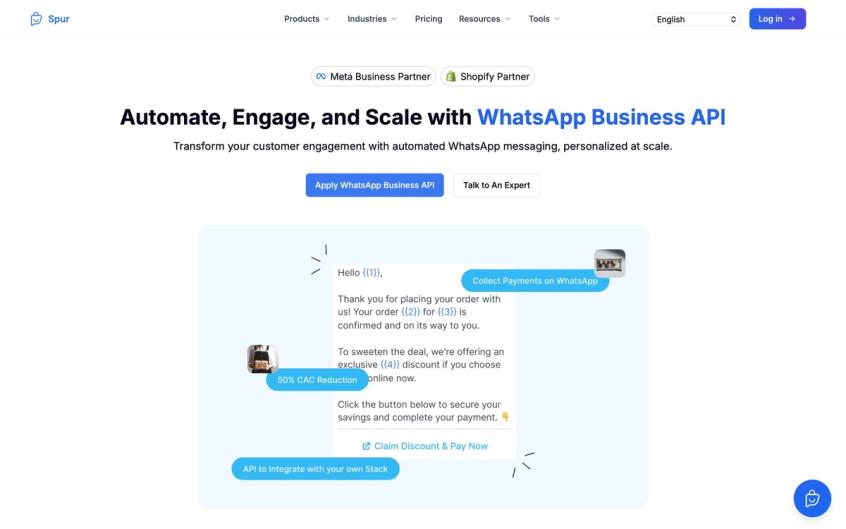
Spur's WhatsApp Business API product handles broadcasts, drip campaigns, shared inbox, and e-commerce flows, all optimized for deliverability and compliance.
How to Integrate Facebook Messenger for Real Estate Lead Capture
Integrate Messenger with your other channels through a unified inbox. This way, whether someone reaches you via website chat, IG DM, FB Messenger, or WhatsApp, you see it all in one place.
Spur provides this multi-channel unified inbox, so your agents never miss a message and context is preserved across platforms.
What Real Estate Chatbot Compliance Rules Can't Be Ignored in 2026?
This section is short on purpose. It's the stuff that gets numbers banned and brands fined. So pay attention.
Is WhatsApp Opt-In Required for Real Estate Marketing?
The WhatsApp Business Messaging Policy is explicit: if you violate policies, access can be limited or removed.
Meta's November 2024 opt-in update (widely summarized by vendors) effectively moved from "WhatsApp-specific consent" to allowing broader messaging consent. But you still need consent + phone number + local law compliance.
Copy-paste opt-in language:
"By sharing your number, you agree to receive updates and follow-ups about property options and site visits via WhatsApp/SMS/call. You can opt out anytime."
What Are India's DPDP Rules for Real Estate Chatbots?
For teams operating in India: the Digital Personal Data Protection Rules were notified in November 2025.
Don't overthink it. Do the basics right:
- Clear notice ("We'll contact you about this inquiry")
- Collect only what you need
- Retention limits (don't store forever)
- Deletion requests path
What Is WhatsApp's 2026 AI Policy for Real Estate Chatbots?
This is big and current.
WhatsApp Business Solution Terms show last modified January 15, 2026, and include restrictions targeting "AI providers" who use the platform to distribute general-purpose assistants as the primary product.
News coverage (late 2025) has emphasized that general-purpose assistants like ChatGPT-style bots were impacted, while business customer-service style bots remain allowed.
Real estate takeaway: You're fine if your bot is task-based (qualify leads, book visits, answer project FAQ) and you're not using WhatsApp as a distribution channel for a generic "talk about anything" assistant.
What's the Safest AI Chatbot Architecture for Real Estate?
The hard truth:
- Pure AI is great at conversation
- Pure AI is dangerous at availability, pricing, and commitments
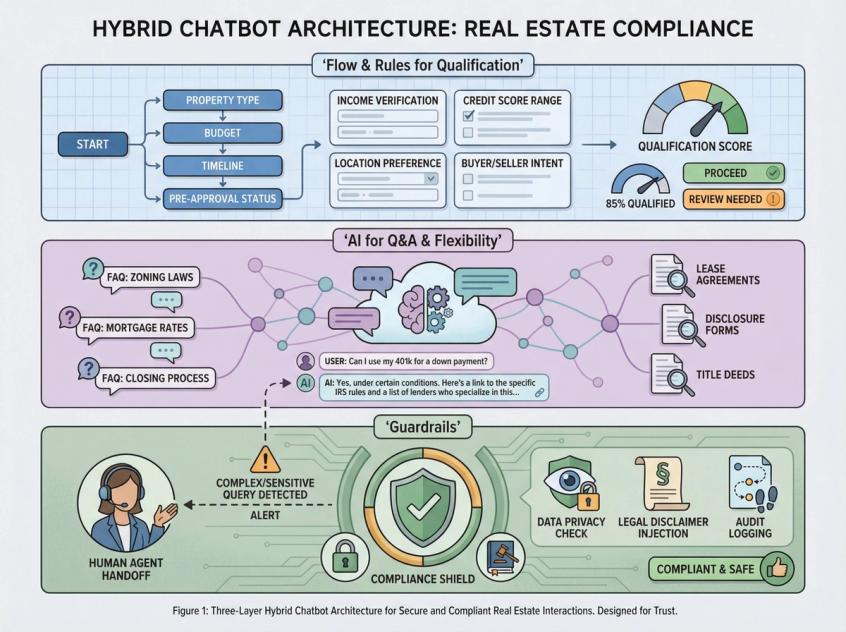
So the best architecture is hybrid:
- Flow/rules for qualification (buttons, fixed fields, scoring)
- AI for Q&A and flexibility (project FAQ, amenities, docs)
- Guardrails: If unsure → handoff or "I'll confirm with an agent"
This keeps you compliant, accurate, and conversion-focused.
How to Build AI Lead Qualification with Spur (Step-by-Step Implementation)
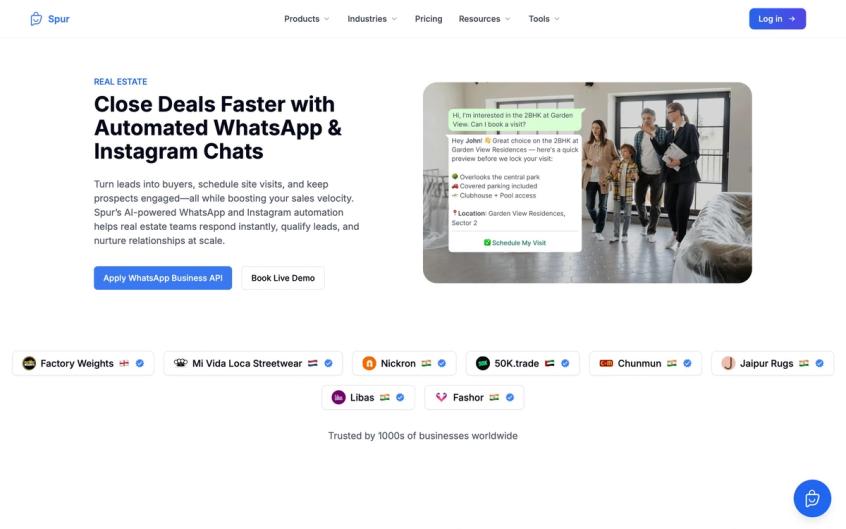
Make this real. Exactly how you set up AI lead qualification using Spur (the platform we use for our own real estate clients).
Step 1: What Qualification Criteria Should You Define First?
Before you touch any software, write these definitions on one page:
- Hot lead = Meets fit (budget + location match) + timeline (0-3 months) + wants visit/call
- Warm lead = Meets fit but timeline uncertain or financing not ready
- Cold lead = Unclear fit or long timeline (6+ months)
Be specific. What budget range matters to you? Which neighborhoods? This clarity makes everything downstream easier.
Step 2: What Custom Fields Should You Create in Spur for Real Estate?
In Spur, set up these custom fields for lead tracking:
intent(buy / rent / sell)locality(dropdown or text)budget_band(ranges)timeline_band(0-30 days / 1-3 months / etc.)property_type(1BHK / 2BHK / villa / etc.)financing_readiness(cash / pre-approved / exploring)lead_score(calculated field)source_channel(web / IG / WhatsApp / FB)
These fields will populate automatically from chatbot conversations.
Step 3: How to Build Real Estate Qualification Flows (Buy, Rent, Sell)
Use the scripts from earlier in this post. Keep each flow under 90 seconds of user time.
In Spur's visual automation builder:
- Add trigger (user starts chat or sends specific keyword)
- Add message nodes with buttons for each question
- Save responses to custom fields
- Branch logic based on answers (if buy intent → buyer flow, if sell → seller flow)
- Calculate score at the end
- Route based on score threshold
No coding required. It's drag-and-drop.
Step 4: How to Train AI on Your Real Estate Knowledge Base
Spur's live chat can be trained on your knowledge base.
For real estate, upload:
- Project brochure PDFs
- Amenities list
- Price band ranges (with "subject to change" disclaimers)
- Location map + connectivity highlights
- Visit process + documents needed
- FAQ (possession date, maintenance, parking, pet policy, etc.)
This way, when someone asks "Does this building allow pets?" or "What are the schools nearby?", the AI can answer instantly from your knowledge base, without requiring agent intervention.
Step 5: What Automated Actions Should You Set Up in Spur?
In Spur, set up these actions to trigger automatically:
For Hot Leads:
- Create/update lead in CRM (via webhook or native integration)
- Book a calendar slot (Google Calendar, Calendly integration)
- Notify assigned agent in shared inbox
- Send shortlist (pull from your listings based on budget/location tags)
For Warm Leads:
- Tag in CRM for nurture sequence
- Add to drip campaign list
- Send initial value content (first-time buyer guide, neighborhood report)
For Cold Leads:
- Capture preferences for future inventory match
- Add to monthly broadcast list
Step 6: How to Close the Real Estate Ads Feedback Loop with Spur
This is advanced but incredibly powerful.
Spur's House Hunt case study shows exactly how this works:
- Define what "qualified" means (e.g., phone + budget match + timeline < 3 months)
- When a lead meets that criteria, send a custom event to Meta's Conversions API
- Switch your campaigns toward conversion-quality goals when you have enough events
- Watch your cost per qualified lead drop while volume increases
Spur's IG Conversions API guide walks through the technical setup.
Step 7: How to Set Up Real Estate Lead Nurture Sequences
Don't let warm leads rot in the inbox. Create a simple drip sequence in Spur:
- Day 0: Shortlist + "Want to visit?"
- Day 1: "2 new matches in your area"
- Day 3: "Any updated preferences?"
- Weekly: 1 helpful update (inventory, rates, area guide)
This keeps you top-of-mind without manual effort.
12 Real Estate Chatbot Message Templates You'll Use Forever
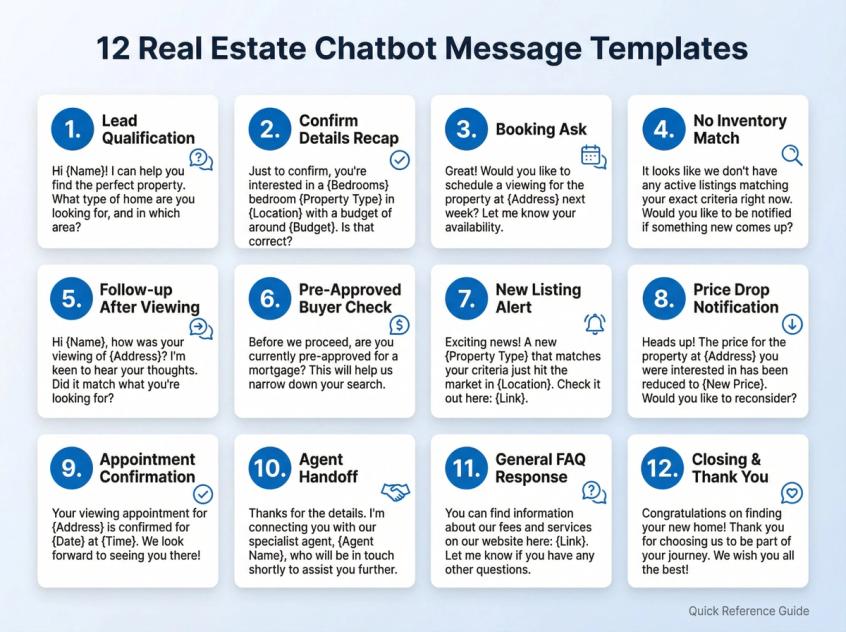
Copy-paste templates for common scenarios:
1) Confirm Details Recap
"Quick recap: area = {area}, budget = {budget}, timeline = {timeline}. Want options or a site visit first?"
2) Booking Ask
"I can book a visit this week. What days work (weekday or weekend)?"
3) No Inventory Match
"Honest update: I don't have a perfect match in {area} under {budget} right now. Want nearby areas that usually fit?"
4) Loan Readiness Question
"Are you planning cash or loan? If loan, are you pre-approved or still exploring?"
5) Ghost Follow-Up (After 3-5 Days of Silence)
"Still looking in {area}? If yes, tell me your latest budget/timeline and I'll update options."
6) Seller Lead Response
"Share your locality + expected price range and I'll send a quick pricing plan + next steps."
7) After-Hours Greeting
"Hi! I'm the virtual assistant. Agents are offline now but I can help. Looking to buy, rent, or sell?"
8) Hot Lead Human Handoff
"You're a great fit for {property}. Let me connect you with {agent name} who specializes in this area. One moment!"
9) Warm Lead Nurture
"Not ready to visit yet? No worries. I'll send you new {area} listings every Friday. Sound good?"
10) Cold Lead Value Offer
"Totally understand. Buying is a big decision. Here's a free guide on {topic}. I'll check in next month!"
11) Visit Confirmation
"Perfect! Your site visit for {property} is confirmed for {date} at {time}. I'll send a reminder the day before."
12) Follow-Up Reminder
"Hey {name}, your viewing is tomorrow at {time} for {property}. Still on? Reply YES to confirm."
What KPIs Should You Track for Real Estate Chatbot Success?
Track these metrics weekly to know if your chatbot is working:
Core Real Estate Chatbot KPIs
- Median time to first response (by channel: website / IG / WhatsApp / FB)
- Qualification completion rate (started flow → finished minimum viable questions)
- Hot lead rate (hot leads / total leads)
- Appointment set rate (appointments booked / qualified leads)
- Show-up rate (actual show-ups / appointments)
- Lead-to-site-visit time (hours or days from first contact to visit)
- Cost per qualified lead (CPQL) by campaign
- Agent follow-up SLA for handoffs (minutes until human touches hot lead)
What Does "Good" Look Like for Real Estate Chatbot Performance?
Your bot is doing its job if:
- Qualification completion rate is rising (people finishing the flow)
- Agent time wasted on unqualified leads is dropping
- CPQL is dropping (after ads have enough signals)
- Show-up rate is stable or increasing (you're booking the right people)
How to Choose the Right Real Estate Chatbot Platform
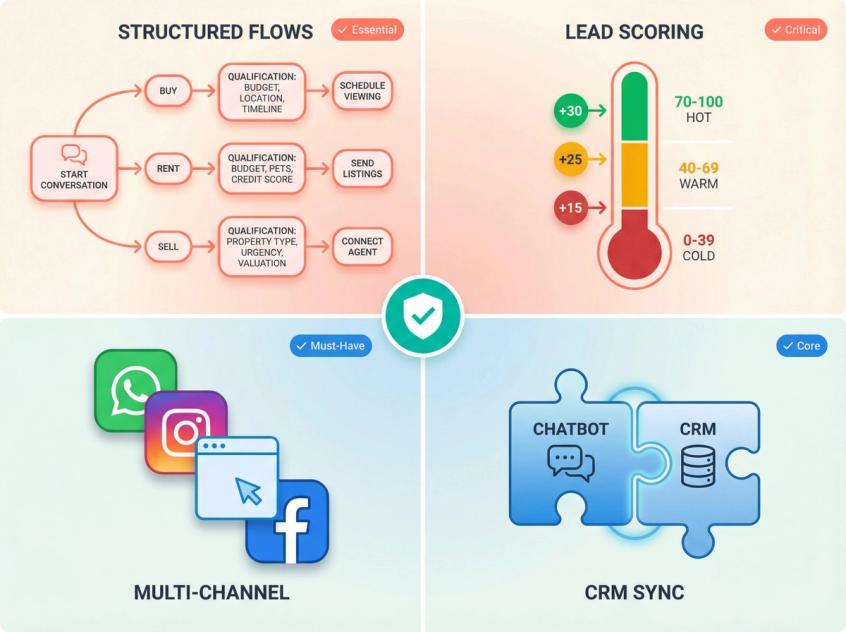
If you're evaluating platforms, what actually matters for real estate lead qualification.
What Features Must Your Real Estate Chatbot Platform Have?
Any platform you choose MUST have:
- Structured flow builder (buttons + validations, not just free-text)
- Custom fields + tagging
- Lead scoring + routing rules
- Human handoff with full transcript
- Calendar booking integration
- CRM integration (native or via webhooks/HTTP)
- Ad attribution + ability to send quality signals back
- Policy tooling for opt-in capture, template management (especially for WhatsApp)
How Does Spur Compare to Other Real Estate Chatbot Platforms?
- Strong in social automation
- Has "AI replies" and knowledge sources
- BUT: Can't train AI deeply on your own knowledge base like Spur can
- Our edge: More sophisticated AI for real estate-specific qualification
- Good for knowledge-based site chat
- BUT: Lacks WhatsApp/IG marketing automation at scale
- Our edge: We have marketing automation on WhatsApp, Instagram, and Facebook that Chatbase doesn't offer
- Powerful and developer-friendly
- BUT: Heavier setup, meant for technical folks
- Our edge: Spur is no-code and user-friendly. Business users can set up in days
- CRM-first approach
- Good if your main system of record is the CRM layer
- Our edge: We're conversation-first with seamless CRM integration
Bolddesk, Botpenguin, LiveChatAI:
- Website-chat focused options
- BUT: Limited multi-channel + ads feedback loops
- Our edge: Spur excels at multi-channel (WhatsApp, IG, FB, website) in one unified inbox
What Makes Spur the Best Choice for Real Estate Lead Qualification?
- Built-in knowledge base training (AI learns from YOUR brochures, FAQs, and listings)
- Marketing automation across WhatsApp, IG, FB (not just website chat)
- No-code visual automation builder (set up flows in hours, not weeks)
- Multi-channel unified inbox (see all leads in one place)
- "Actionable AI" (doesn't just answer questions; books meetings, updates CRM, routes leads)
- Proven in real estate (House Hunt case study shows 35% CPL reduction)
How to pick fast:
- If you're ads + DM heavy → Focus on click-to-message workflows + conversion signals (Spur)
- If you're website lead heavy → Focus on site-context chat + booking + CRM (Spur)
- If you're ops heavy (large teams) → Focus on routing, inbox, permissions, reporting (Spur)
Notice a pattern? Spur handles all three.
What Are the Best Practices for Real Estate Chatbot Implementation?
Getting the most out of an AI chatbot requires thoughtful setup. Proven practices from real estate teams who've done this successfully:
1) Should You Define Chatbot Goals and Scripts Before Setup?
Before touching any software, decide what you want the chatbot to achieve:
- Booking appointments directly?
- Collecting lead info for later follow-up?
- Sending listing links?
Define the key questions it should ask (your "qualification script") and what criteria define a qualified lead for you.
Draft the chatbot's questions and prompts to be friendly and on-brand. Avoid jargon. Phrase questions like a person would.
Test the script with a few colleagues acting as buyers to see if it feels natural.
2) When Should You Integrate Chatbots with Your CRM and Calendar?
Plan the integrations from the start. At minimum, connect the chatbot to your CRM or lead management tool so new leads and chat transcripts are logged automatically.
If you use a scheduling app (Calendly, Google Calendar, etc.), integrate that so the bot can schedule tours or calls.
And if possible, integrate your property database or MLS feed for real-time listing info.
Many chatbot platforms support webhooks or API calls, which can pull in listing data or push leads to other software. The more seamlessly data flows, the less manual work later.
3) Should You Deploy Chatbots Across Multiple Channels for Real Estate?
Identify where your leads spend time, and deploy the chatbot there:
- On your website (as a chat widget)
- On your Facebook business page (Messenger bot)
- On Instagram (via Direct Messages automation, especially if you run IG ads or get story mentions)
- On WhatsApp if you market heavily in WhatsApp-centric regions
A unified platform like Spur lets you manage one bot across these channels.
This multi-channel approach ensures whether a lead comes from a web search or swipes up on an Instagram story, they get the same instant, helpful experience.
It also centralizes the conversation history. You get a full picture if someone first chatted on IG then later comes to your website chat.
4) How Should You Train Real Estate Chatbots on Your Knowledge Base?
Besides the scripted qualification questions, take advantage of AI by training your chatbot on relevant information.
Most AI chatbot platforms allow you to upload or point to a knowledge base (which could be your FAQ page, your about us, your inventory info, etc.).
For real estate, this might include:
- Neighborhood details
- School ratings
- Financing FAQs
- Your current property listings
By doing this, your chatbot can answer complex questions more accurately.
For example, if asked "What's the property tax rate there?" or "Is there a swimming pool in this condo complex?", the bot can pull the answer from the knowledge base if it's been provided.
This moves your bot from just a lead screener to a smart assistant that provides real value in the conversation.
Always keep this content up to date. If a property is sold or a new one comes online, update the info so the bot stays accurate.
5) When Should Real Estate Chatbots Hand Off to Human Agents?
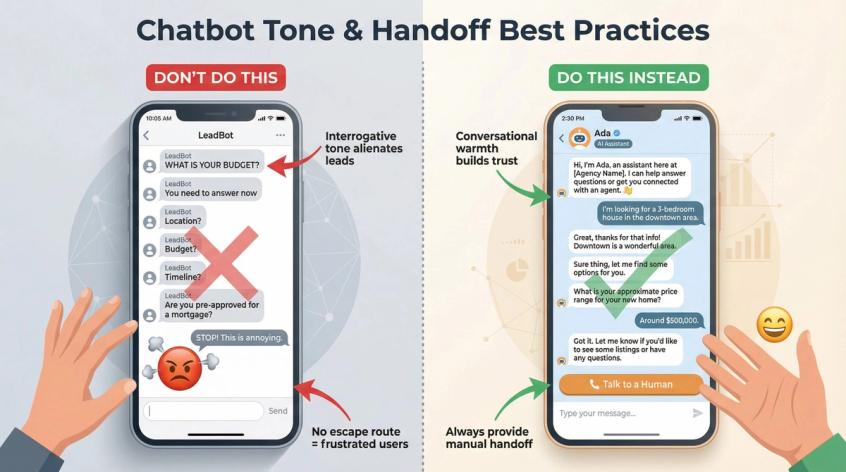
Determine at what point the bot should involve a human.
For example, you might configure:
- If lead has a score above 70 or explicitly asks for an agent → notify human team
- If user types "help" or the bot can't answer after one clarification → transfer to human
Make sure you have a notification system so agents know when to jump in (many platforms will ring a mobile app or dashboard for agents).
During business hours, you might route hot leads to an on-duty agent in real time.
After hours, you might route to an email or simply schedule a follow-up.
Whatever the case, define it clearly. And always let the user manually request a human easily (e.g. if they type "agent" or "human" or click "Talk to a person" button).
This ensures that frustrated users aren't stuck. A well-designed bot will never block a potential client from reaching a person. It should facilitate it at the right moment.
6) What Tone Should Real Estate Chatbots Use?
As you implement, pay attention to the chatbot's tone. It should be polite, concise, and helpful. Not too pushy or too verbose.
Use short messages, maybe one or two sentences at a time. And don't make every chat feel like an interrogation.
Pepper in responses like "Great, thanks for that info!" or "Sure thing, let me find some options for you." to acknowledge the user's input.
The bot should also avoid being overly salesy. It's there to assist and qualify, not hard-sell.
If the user goes quiet or seems hesitant, the bot can gently prompt ("Let me know if you'd like to see some listings or have any questions.") but should not badger.
Striking this balance leads to 69% consumer satisfaction with chatbot interactions. A heavy-handed bot can annoy visitors, so test it out and ensure it feels like how you'd talk to a client in person.
7) Should Real Estate Chatbots Disclose They're AI?
In 2026, people are generally comfortable chatting with AI as long as it's useful. It's best to be transparent that it's an automated assistant, not pretend to be human.
You can give it a friendly name or just call it "virtual assistant." Many companies have the chatbot introduce itself: "Hi, I'm Ada, an assistant here. I can help answer questions or get you connected with an agent."
This sets the right expectation. If the bot can't answer something, it should admit it and offer a workaround (like "I'm sorry, I don't have that info. Let me ask my team to follow up.").
Honesty helps preserve trust and avoids user frustration when they realize they're not talking to a live person.
8) How Should You Test and Refine Real Estate Chatbots?
Once set up, do a soft launch. Test the chatbot with friendly clients or colleagues. Try unusual questions and see how it handles them.
You might discover gaps (e.g. someone asks "Do you have any open houses this weekend?" and the bot wasn't set up to answer that).
You can then add that to the knowledge base or flow. Monitor chats for the first few weeks closely.
Check where people drop off or what questions commonly confuse the bot. Use that data to improve: maybe you need to tweak the wording of a question that people aren't answering, or perhaps add a quick reply button to make it easier for users to respond on mobile.
Continuous tuning is key. The good news: many platforms now provide analytics and even AI training suggestions to improve performance over time.
9) How Should You Handle Privacy and Compliance for Real Estate Chatbots?
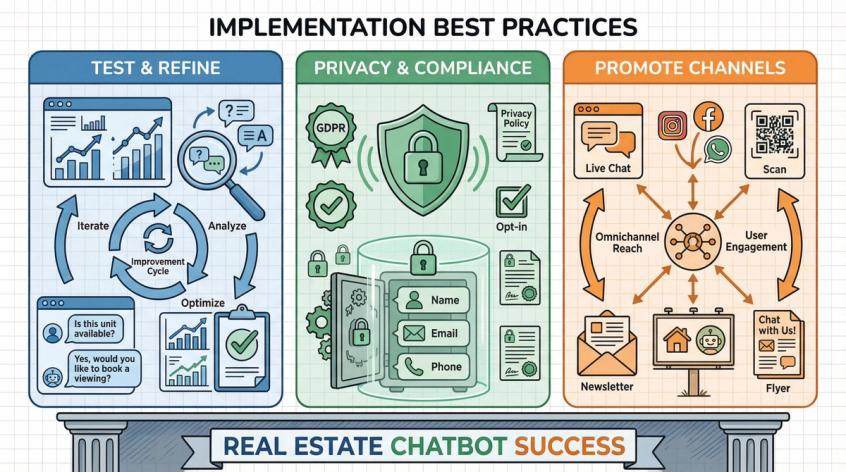
Since chatbots will gather personal info (name, email, phone), make sure you handle that data according to privacy laws (GDPR if in EU, for example).
Have a privacy notice accessible in the chat or on your site.
If you're using WhatsApp or SMS, be mindful of messaging rules and opt-ins. For instance, WhatsApp has a 24-hour window rule for business-initiated messages unless the user opts in to specific notifications.
If your chatbot is on WhatsApp, ensure that after the initial session, any follow-up messages comply (using approved template messages if outside 24h).
Platforms like Spur take care of a lot of these compliance pieces for you in the background, but it's good to be aware.
Also, train the bot with ethically sourced data and make sure it doesn't inadvertently violate fair housing laws or other regulations (e.g. it should provide info equally and not steer clients in a way that could be seen as discriminatory. Basically, it should follow the same guidelines as a human agent must).
10) How Should You Promote Your Real Estate Chatbot Channels?
Finally, let people know they can reach you via chat!
Add the chat widget to your site prominently. On your Facebook and Instagram bios, enable the "Message" buttons.
If you have an email newsletter, mention that "We now have an AI assistant on our site ready to help 24/7."
If you're doing offline marketing (billboards, flyers), consider adding a QR code or short link to your chat. For example, a flyer might say "Chat with us 24/7: m.me/YourRealty or WhatsApp us at [number]".
The easier it is for leads to initiate that chat, the more usage you'll see and the more leads you'll capture.
Some agencies even run specific campaigns like "Text HELLO to [number] for instant home listings" (which is basically inviting people into a chatbot conversation via SMS or WhatsApp).
Be creative and make sure this tool is integrated into all your customer touchpoints.
Ready to Transform Your Real Estate Lead Qualification?
If reading this has you thinking about all the missed deals and slow follow-ups in your current process, you're not alone.
The good news is, adopting an AI chatbot has never been easier.
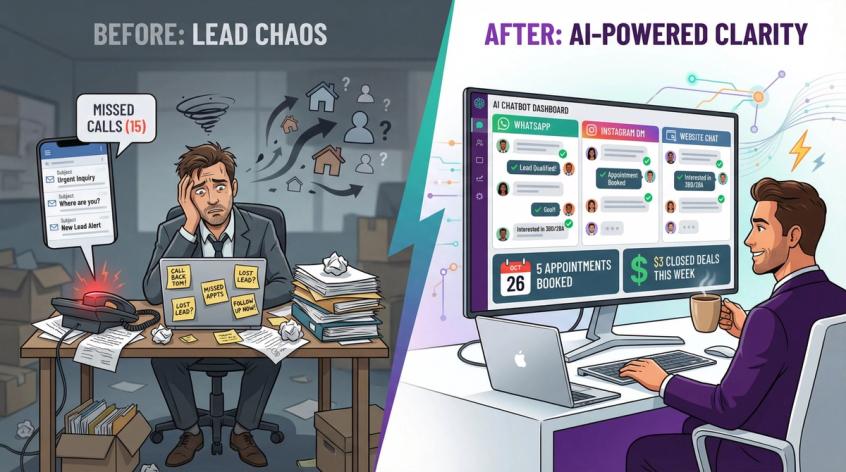
Why Spur Makes This Simple
Spur is built specifically for businesses like yours that need to:
- Engage leads instantly across WhatsApp, Instagram, Facebook, and website chat
- Qualify them with smart questions and AI trained on YOUR knowledge base
- Book appointments and site visits automatically
- Route hot leads to the right agent in seconds
- Sync everything to your CRM
- Optimize your ad spend with conversion quality signals
Unlike basic FAQ bots, Spur's AI agents don't just ask questions. They take action. They can book appointments, send property links, update your CRM records, and instantly route qualified buyers to your phone.
And they're trained on your specific knowledge base (properties, FAQs, policies) so they can handle complex conversations while staying on script for qualification.
The Results Are Real
We showed you the House Hunt case study earlier: 35% reduction in cost per qualified lead and 43% increase in qualified lead volume.
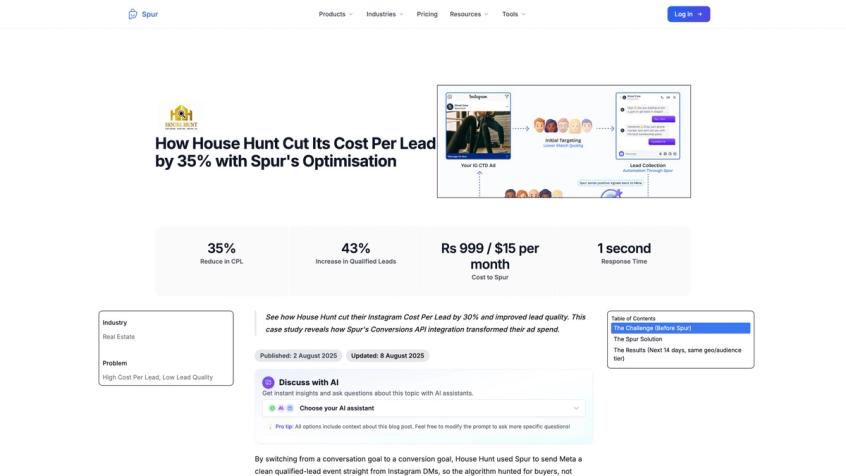
That's not a one-off. Real estate teams using AI chatbots consistently see 3× higher conversion rates and never let a hot lead slip away again.
If your average commission is $5K-$15K, just one extra deal closed thanks to faster follow-up pays for the system many times over. And it's rarely just one extra deal. Teams see dozens more conversions over a year.
Get Started Today
Spur offers a 7-day free trial. You can be live in less than a week, with no coding required.
The opportunity cost of not acting is real. Every day you wait, you're losing leads to competitors who respond in seconds instead of hours.
Don't let your next million-dollar buyer go cold waiting for a callback.
Engage them instantly with AI. Qualify them intelligently. Convert them consistently.
The future of real estate sales is conversational, intelligent, and immediate.
Start your free trial with Spur today →
Or browse our case studies to see how other real estate businesses are transforming their lead qualification.
Because in real estate, location matters. But so does speed. Make sure you're always first to respond.
Frequently Asked Questions
Yes, if it's structured (buttons + short questions), captures opt-in correctly, and routes hot leads to humans.
WhatsApp's service window and free entry points make it especially cost-effective when users start the conversation. Instagram DMs work beautifully with click-to-message ads for instant qualification.
WhatsApp's January 15, 2026 terms target general-purpose "AI providers" using WhatsApp as a distribution channel for an assistant product.
Task-focused business bots (support, booking, sales qualification) are the safe path. As long as your bot is helping prospects find properties and book visits (not acting as a generic "ask me anything" assistant), you're fine.
Use a hybrid: scripted flow for qualification + AI for Q&A + guardrails for anything that could be wrong (pricing/availability).
It's safer and converts better. Pure AI can hallucinate or make commitments you can't keep. Hybrid gives you the best of both worlds.
Costs vary by platform and usage:
- Platform fees: Spur starts around $31/month on annual plans
- WhatsApp conversation fees: Vary by country and category
- AI credits: If you use AI features heavily, you may need top-ups
For a typical real estate business running moderate messaging volume, expect $50-$200/month total. The ROI from even one extra deal makes this trivial.
With Spur, you can be live in days. The no-code builder means you don't need developers.
The setup process:
- Day 1-2: Define flows and custom fields
- Day 3-4: Build and test chatbot
- Day 5: Train AI on knowledge base
- Day 6: Wire integrations (CRM, calendar)
- Day 7: Soft launch and monitor
No. AI chatbots augment agents, they don't replace them.
The bot handles the volume (instant responses, qualification, scheduling) so your agents can focus on the value (building relationships, negotiating, closing deals).
Your agents will actually love it. They get warm, qualified leads instead of spending hours calling people who won't answer.
Modern AI chatbots are designed to recognize when they're out of their depth.
A well-configured bot will either:
- Attempt to find the answer in its knowledge base
- Offer to connect the user with a human agent
- Capture the question for follow-up: "Great question! I'll have an agent get back to you on that within an hour."
Not with Spur. It's a no-code platform designed for business users, not developers.
The visual automation builder is drag-and-drop. If you can use Excel or create a Facebook post, you can build a chatbot in Spur.
Absolutely. Spur gives you full control over:
- What questions to ask
- The order and branching logic
- Button options and responses
- Scoring criteria
- Handoff triggers
- Nurture sequences
You can customize everything to match your business model and market.
Spur integrates with:
- E-commerce: Shopify, WooCommerce
- Payments: Stripe, Razorpay
- Logistics: Shiprocket, Return Prime
- Custom: Via webhooks and HTTP requests, you can connect to any CRM, calendar, or database
Was this article useful?