How to Measure Instagram DM ROI (2026 Guide)

Discuss with AI
Get instant insights and ask questions about this topic with AI assistants.
💡 Pro tip: All options include context about this blog post. Feel free to modify the prompt to ask more specific questions!
TL;DR: Instagram DMs aren't just conversations. They're a trackable sales channel. Using Spur's Instagram automation with built-in analytics, Meta Conversions API integration, and proper attribution (UTM links, qualification tracking, and CRM sync), you can prove exactly how much revenue your DMs generate. Most brands see 5-10× higher conversion from DM interactions versus standard traffic ads.
Instagram hit 3 billion monthly active users in September 2025, with private messaging cited as a key growth driver. The platform keeps shipping DM features because that's where real business happens now.
But there's a disconnect: research shows 150 million people message businesses monthly and 89% of consumers want to message brands, yet most companies measure DMs like they're engagement fluff instead of what they actually are: a mini sales and support channel with trackable ROI.
Your CFO doesn't care that people replied a lot.
They care about whether Instagram DMs made more money than they cost.
This guide shows you how to prove it. You'll learn to track every dollar in and out, connect DM conversations to actual purchases (even when the sale happens days later on Shopify), and build a dashboard that tells you what's working. By the end, you'll know your exact Instagram DM ROI down to the percentage.
What Is Instagram DM ROI and Why Does It Matter?
ROI exists because resources are finite. You invest time and money into something, and you need to know if it created more value than it consumed.
The formula is simple:
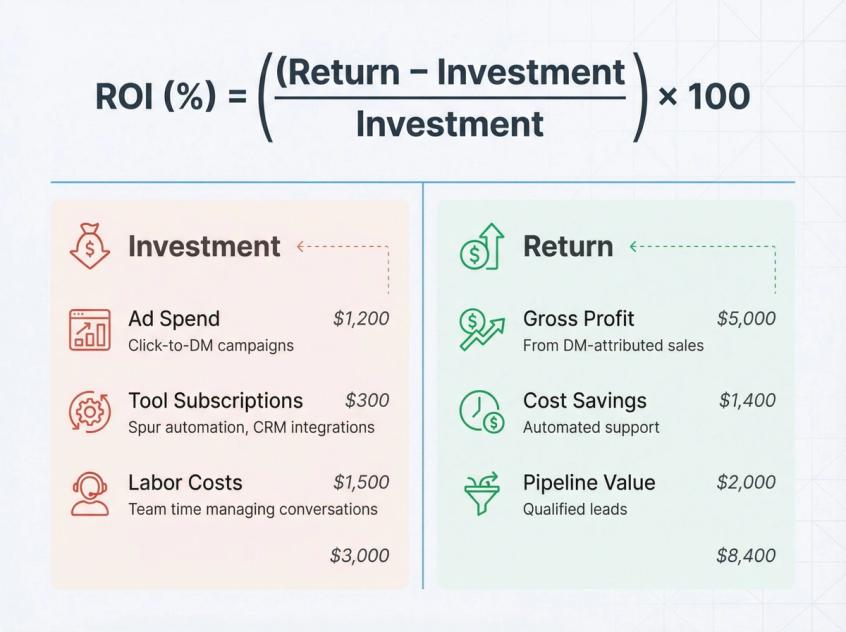
ROI (%) = ((Return − Investment) / Investment) × 100
For Instagram DMs:
→ Investment = Ad spend on Click-to-DM campaigns + tool subscriptions (Spur automation, CRM integrations) + labor costs (team time managing conversations)
→ Return = Gross profit from DM-attributed sales + cost savings from automated support + pipeline value from qualified leads
But most teams mess up here. They think "Instagram showed some purchases" or count reply rates as success. The CFO doesn't care about fluffy engagement stats. They care about ROI.
A DM conversation isn't valuable until it produces a business outcome.
100 DMs that generate zero leads have zero ROI. 10 DMs that close $50,000 in deals? That's gold.
How to Define Return Based on Your DM Strategy
| DM Use Case | What to Measure as Return | Specific Metrics |
|---|---|---|
| Sales Channel (ecommerce, high-ticket services) | Revenue & customer value from DM conversations | • Gross profit from DM-originated orders • Customer lifetime value of DM-acquired customers |
| Lead Generation (real estate, education, B2B) | Expected value of qualified leads | • Qualified leads × Close rate × Average profit per deal • Don't count leads as revenue – count statistical worth |
| Support (deflection, faster resolution) | Cost savings & risk reduction | • Tickets deflected by AI without human intervention • Minutes saved per ticket × fully loaded support cost • Reduced refund/chargeback risk from better CX |
Blind spot to fix: If you only measure revenue ROI, you'll under-credit support automation (which saves costs) and over-credit discount-driven sales campaigns (which might have low margins).
What Is the Instagram DM Funnel You Need to Track?
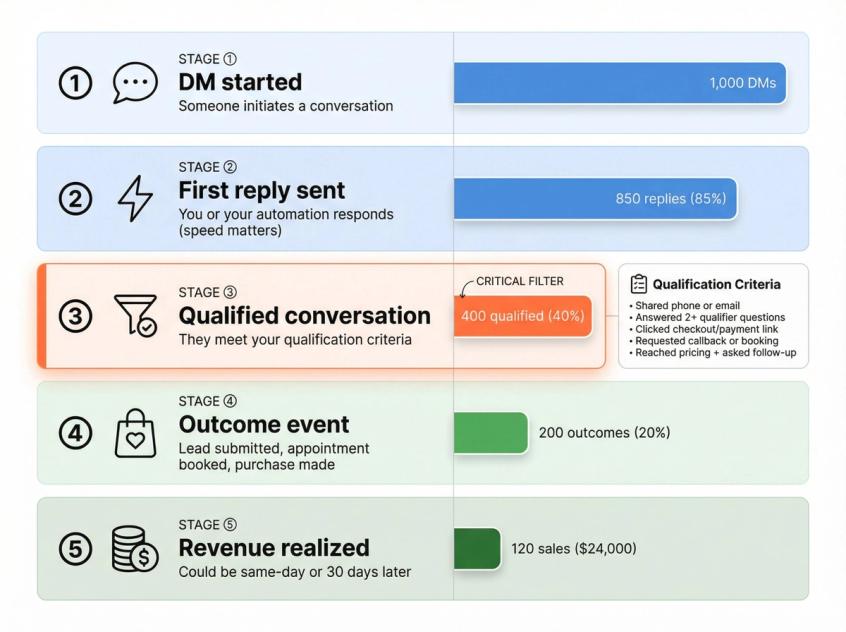
Stop mixing stages. Here's the only funnel that matters:
① DM started → Someone initiates a conversation
② First reply sent → You or your automation responds (speed matters here)
③ Qualified conversation → They meet your qualification criteria
④ Outcome event → Lead submitted, appointment booked, purchase made, payment link clicked
⑤ Revenue realized → Could be same-day or 30 days later
The critical layer? Qualification.
A "DM started" is not a lead. Most DMs are "hey" or emoji reactions or support questions that don't convert to revenue. You need a measurable qualification rule:
• They shared phone number or email
• They answered 2+ qualifier questions (budget, location, product fit)
• They clicked a checkout or payment link
• They requested a callback or booking
• They reached "pricing shown" and asked a follow-up question
Spur's Instagram Direct analytics tracks depth metrics like "3+ message conversations" and negative signals (blocks, drops) specifically because conversation volume means nothing without qualification.
If you can't define "qualified DM" in one sentence that your team can measure consistently, your ROI tracking will stay squishy forever.
Spur's Instagram automation handles this qualification layer automatically. The platform can track which conversations meet your criteria, route qualified leads to your team, and measure conversion at each stage.
What Instagram DM Metrics Actually Predict ROI?
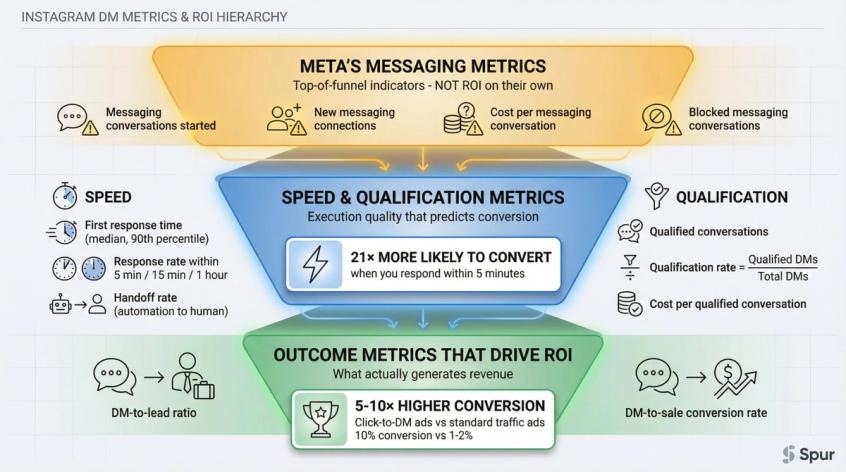
Meta's messaging reports use specific terminology that's easy to misread. Here are the metrics that connect to ROI:
| Metric | What It Actually Measures | Why It Matters for ROI |
|---|---|---|
| Messaging conversations started | Conversations attributed to your ads (new or restarted after inactivity) | Top-of-funnel volume; not ROI on its own |
| New messaging connections | People added as messaging connections from your ads | Growth of reachable audience |
| Cost per messaging conversation | Average cost per started conversation | Efficiency metric; can mislead if conversations don't qualify |
| Blocked messaging conversations | People who blocked you after engaging | Quality red flag – you can optimize into annoying people |
Two critical warnings:
- These are not ROI metrics. They're top-of-funnel indicators. ROI only happens after you connect conversations to qualified outcomes and profit.
- Some messaging features and metrics can be unavailable for ads delivered to/from Europe or Japan due to privacy regulations. Your measurement stack needs to work even when Meta's reporting goes dark.
Which Instagram DM Metrics Actually Drive Revenue?
Speed & Quality:
→ First response time (median, 90th percentile)
→ Response rate within 5 min / 15 min / 1 hour
Research shows that contacting a lead within 5 minutes makes conversion 21× more likely than after a delay. Minutes literally equal money here.
→ Handoff rate (automation to human)
Qualification:
→ Qualified conversations (your definition from earlier)
→ Qualification rate = Qualified DMs / Total DMs started
→ Cost per qualified conversation (for ads) = Ad spend / Qualified conversations
Outcomes:
→ DM-to-lead ratio
→ DM-to-sale conversion rate
Industry data shows that Click-to-Instagram DM ads often convert around 10% of users to customers versus ~1-2% for standard traffic ads. That's 5-10× higher conversion simply by engaging people at peak interest in a DM instead of sending them to a website.
How to Track Where Every Instagram DM Came From
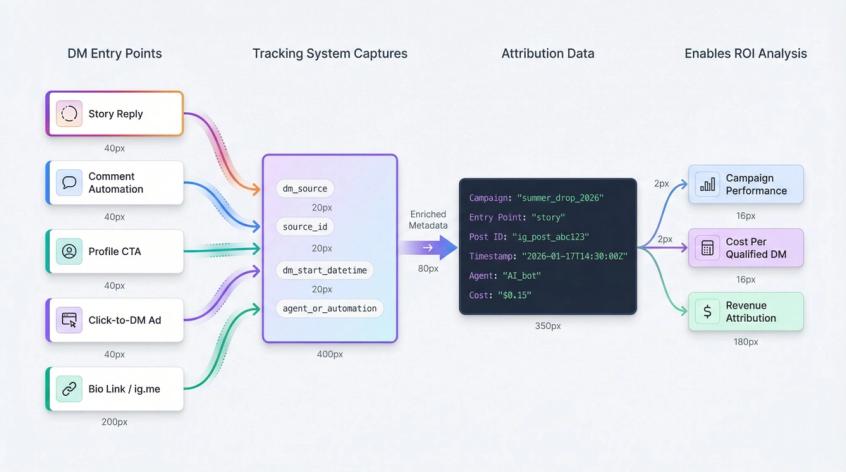
If you can't answer "which post/ad/campaign created this DM," your ROI analysis will always be guesswork.
You need one persistent field per conversation:
dm_source(story, comment automation, profile CTA, Click-to-DM ad, broadcast channel, influencer code)source_id(post ID, ad ID, campaign ID)dm_start_datetimeagent_or_automation(human, bot, hybrid)
How to Use ig.me Links for Campaign Attribution
Meta operates ig.me, a URL shortener that opens Instagram DMs directly. You can create links like:
https://ig.me/m/yourusername
Spur's Instagram chat link generator makes these for you. Use different links for different campaigns (email blasts, bio link, influencer partnerships, QR codes).
Why this matters: You get deterministic attribution for organic campaigns where Meta Ads reporting doesn't apply.
How to Pass Reference Data for DM Attribution
Some platforms support appending a ref= parameter to DM entry points so you can track which specific campaign triggered the conversation. This data can be saved into custom fields for later analysis.
Practical limitation: Desktop support has constraints, and you need "conversation starters" set up for users without an existing thread.
How to Tag Every DM Conversation in Your CRM
When a DM comes in, your automation or team should immediately log:
- Lead source: Instagram DM
- Campaign: [specific campaign name]
- Entry point: [story/post/ad/bio link]
- Timestamp
This is why platforms like Spur exist. They automatically capture this metadata and sync it to your CRM so you're not manually tagging 200 DMs a day.
How to Connect Instagram DMs to Actual Revenue
Most teams can see DMs. They can see Shopify orders. They just can't join them.
Here's how to fix that:
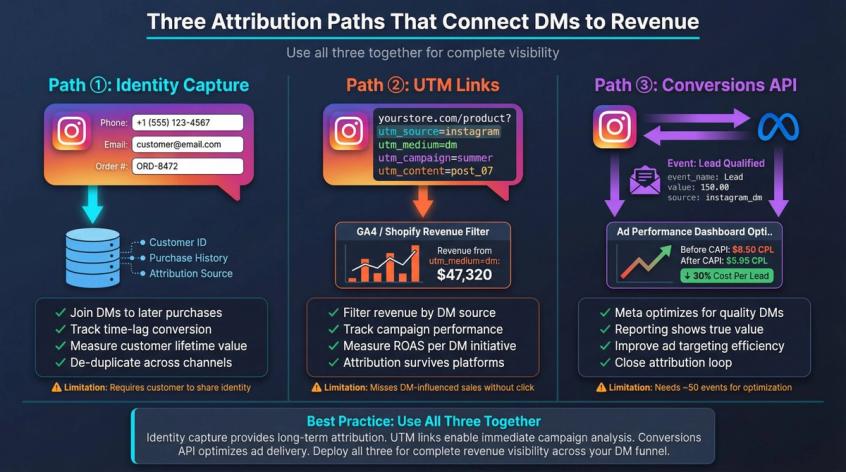
| Attribution Path | How It Works | What It Enables | Blind Spots |
|---|---|---|---|
| ① Capture Identity Inside the DM | Ask for phone, email, or order number early in conversation | • Join DM conversations to later purchases • Measure time-lag to conversion • Track customer lifetime value • De-duplicate across channels | Requires customer willingness to share identity |
| ② Use Trackable Links and UTMs | Tag every product link with utm_source=instagram&utm_medium=dm&utm_campaign=[name] | • Filter Shopify/GA4 revenue by utm_medium=dm• Track campaign performance | Misses "DM-influenced but didn't click" cases |
| ③ Send Conversion Signals to Meta | Push qualified outcomes back via Meta Conversions API | • Meta optimizes ad delivery • Reporting reflects real downstream value | Requires ~50 events before optimization works well |
How to Capture Customer Identity Inside Instagram DMs
Ask for one piece of durable identity early in the conversation:
- Phone number
- Email address
- Order number (for support)
- Any CRM identifier
Once you have identity, you can:
• Join DM conversations to purchases that happen later
• Measure time-lag to conversion (someone DMs Monday, buys Friday)
• Track customer lifetime value for DM-acquired customers
• De-duplicate across Instagram, WhatsApp, website chat
This is the most powerful long-term ROI tracking method because it survives attribution windows and platform limitations.
How to Use UTM Links to Track Instagram DM Sales
Every product link you send in a DM should be tagged:
utm_source=instagram
utm_medium=dm
utm_campaign=summer_drop
utm_content=post_reel_07
Then filter Shopify/GA4 revenue by utm_medium=dm.
Blind spot to fix: UTMs alone miss "DM-influenced but didn't click the link" cases (someone asks questions in DM, then later Googles your brand and buys). That's why you also need identity capture or Conversions API.
How to Send Instagram DM Conversions Back to Meta
If you run Click-to-DM ads, you should push qualified outcomes back to Meta using Meta Conversions API so:
✓ Meta optimizes ad delivery toward higher-quality conversations (not just cheap clicks)
✓ Your reporting reflects real downstream value (not just "conversation started")
Spur supports sending CAPI events directly from automation flows when someone qualifies or purchases.
Important note: Meta needs roughly 50 CAPI events before it can optimize well for a new objective. Don't judge campaign performance too early.
Regional constraint: Pages registered in EU or Japan may face CAPI restrictions due to ePrivacy Directive. You might see errors like "Messaging Event Within Messaging Restrictive Region."
How to Calculate Instagram DM ROI Step-by-Step
Now that you're capturing data, here's how to compute actual ROI:
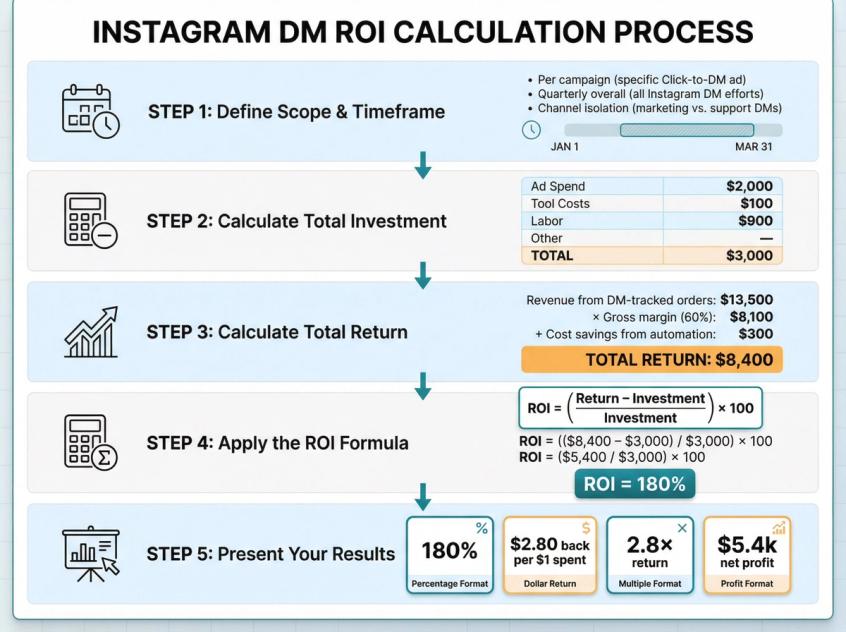
Step 1: Define Your ROI Measurement Scope and Timeframe
Decide what you're measuring:
- Per campaign (ROI of a specific Click-to-DM ad campaign)
- Quarterly overall (all Instagram DM efforts combined)
- Channel isolation (just marketing DMs vs. just support DMs)
Pick one period and stick with it for consistent comparisons.
Step 2: Calculate Total Instagram DM Investment
| Investment Category | What to Include | Example |
|---|---|---|
| Ad spend | Click-to-DM campaigns, promoted posts driving DM engagement | $2,000 |
| Tool costs | Spur automation platform, CRM integrations, analytics tools (pro-rated) | $100 |
| Labor costs | Hours spent managing DMs × average hourly wage | 30 hours × $30/hour = $900 |
| Other expenses | Creative costs specific to DM initiative | — |
| TOTAL INVESTMENT | $3,000 |
Labor includes:
- Agents responding to DMs
- Time setting up automation flows
- Team reviewing and optimizing campaigns
Step 3: Calculate Total Return from Instagram DMs
Attributable sales revenue: Using UTMs, coupon codes, and CRM tracking, sum revenue from customers who engaged via DM
- 30 orders totaling $8,500 from DM-tracked links
- 1 B2B deal worth $5,000 from DM-originated lead
- Revenue: $13,500
Gross profit calculation: Revenue × gross margin = profit
- If margin is 60%, gross profit = $13,500 × 0.60 = $8,100
Cost savings: If automation handled support queries
- Bot resolved 100 FAQs that would've taken 10 agent hours
- At $30/hour = $300 saved
- Add to return: $300
Total Return: $8,400 (profit + savings)
Step 4: Apply the Instagram DM ROI Formula
ROI = ((Total Return − Total Investment) / Total Investment) × 100
Example calculation:
- Return: $8,400
- Investment: $3,000
- Profit: $8,400 − $3,000 = $5,400 net gain
- ROI: ($5,400 / $3,000) × 100 = 180% ROI
For every $1 spent on Instagram DMs, you got $2.80 back.
Step 5: How to Present Instagram DM ROI Results
CFOs like both the efficiency metric and absolute impact:
| Presentation Format | Value | What It Communicates |
|---|---|---|
| Percentage | 180% ROI | Return on investment efficiency |
| Dollar return | We spent $3k and generated $8.4k back | Total value created |
| Multiple | 2.8× return on investment | How many times money was multiplied |
| Profit | $5.4k net profit from this channel | Bottom-line impact |
All four tell the same story from different angles.
Real Instagram DM ROI Examples That Prove It Works
Why Click-to-DM Ads Convert 5-10× Higher
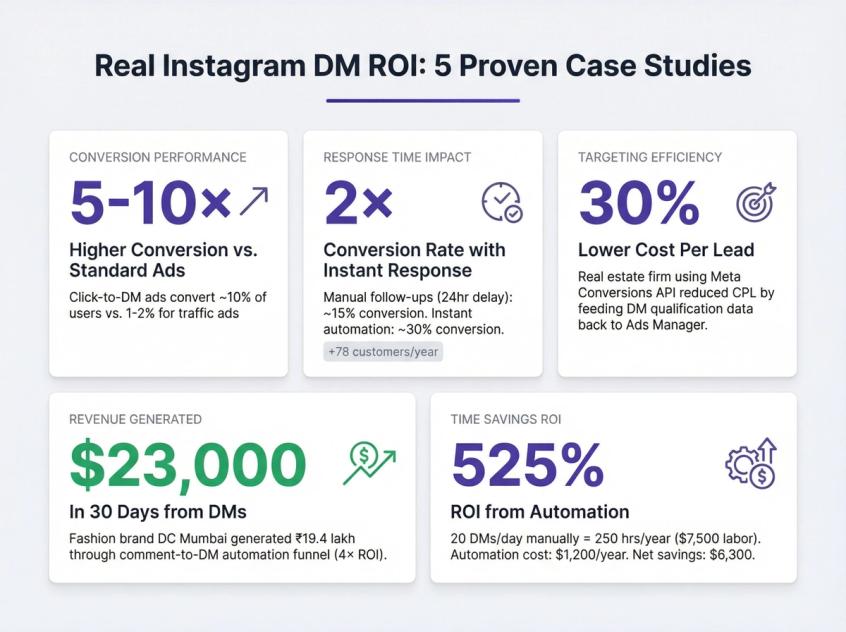
Click-to-Instagram DM ads convert about 10% of clickers into customers versus ~1-2% for standard traffic ads. That's 5-10× higher conversion simply by engaging users at peak intent in a conversation.
Fashion retailer Libas used comment-to-DM automation during an Instagram Live and converted 64 orders from a single session. Those are direct revenue numbers attributable to Instagram engagement with an extremely strong ROI.
How Better Attribution Reduces Cost Per Lead by 30%
A real estate firm using Spur's automation with Meta Conversions API tracked which DM conversations became quality leads and fed that data back to Ads Manager. The result: 30% lower cost per lead on their Instagram campaigns.
Better measurement didn't just prove ROI. It improved ROI by helping Meta target more efficiently.
How One Brand Generated $23,000 ROI from Instagram DMs
Fashion brand DC Mumbai generated ₹19.4 lakh (~$23,000) in 30 days purely through Instagram comments and DMs by automating a funnel from comment → DM → purchase.
By tracking which posts and ads drove those conversations, they could calculate that if campaign costs were ₹5L, the ROI was roughly 4× (400%).
How Instagram DM Automation Delivers 525% ROI
One analysis tracked 20 DMs per day handled manually requiring ~250 hours yearly of team time (roughly $7,500 in labor cost). An integrated automation solution costing $1,200/year handled that work, yielding a 525% ROI in time savings alone.
Even a 5% increase in customer retention can boost profits 25-95%. Customers who get fast, helpful DM responses stick around longer.
How to Maximize Instagram DM ROI Beyond Measurement
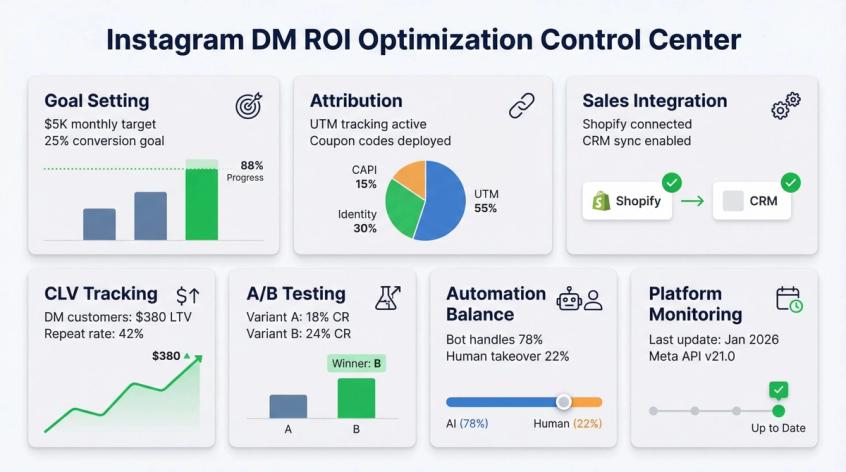
Measuring ROI is half the battle. The other half is systematically improving it:
How to Set Instagram DM Goals That Drive Results
Define what success looks like:
- "Generate $5,000 in sales from DMs this month"
- "Cut average response time to under 10 minutes"
- "Achieve 25% DM-to-lead conversion rate"
Goals give you a target to measure against and align your team around DMs as a revenue channel, not just "social engagement."
How to Attribute Every Instagram DM Outcome
Make it standard procedure that every link, promo, and CTA in DMs is trackable:
→ Use utm_source=instagram_dm on all links
→ Create DM-only coupon codes for each campaign
→ Tag CRM contacts by which campaign sourced them
Best practice: UTM every link and use unique codes. Boring tactics, but they let you prove the channel drives revenue.
How to Integrate Instagram with Your Sales Stack
Siloed DMs are impossible to measure properly.
For ecommerce: Use Spur's Shopify integration to tie DM conversations to customer profiles. Any purchase that customer makes gets attributed back to the conversation.
For CRM: Log Instagram interactions in HubSpot, Salesforce, or your CRM. Even manual notes help ("Contacted via Instagram Jan 10"). Better: use automation to auto-create contacts from DMs.
For support: Connect Instagram to your helpdesk or shared inbox. Missed DMs = missed ROI.
How to Track Customer Lifetime Value from Instagram DMs
A common mistake is counting only the immediate sale and ignoring repeat business.
Track CLV of Instagram-acquired customers. Do DM-sourced customers buy again at higher rates? If yes, the real ROI is even better than first-purchase analysis shows.
Even anecdotal evidence matters: "5 of the 10 customers we chatted with in June have made 3+ purchases now."
How to A/B Test Instagram DMs for Better ROI
Use data to refine your approach continuously:
Low conversion rate?
- A/B test different DM greetings or offers
- "Hey, can I help you find a product?" vs. "Hi! Here's 10% off to shop now"
- Measure downstream sales from each variant
High cost per lead?
- Adjust Instagram ad targeting
- Try lookalikes of your best customers
- Make your chatbot more interactive or human-like
Engagement but no action?
- People DM but don't take the next step
- Train your team or bot to always follow up ("Did that answer your question? Let me know if you'd like the link to purchase.")
Keep a log of experiments and results. Small changes in wording or timing can yield significant gains in conversion rates.
How to Balance Instagram DM Automation and Human Touch
The goal isn't eliminating humans entirely. It's using each resource where it's most effective.
The hybrid model that works:
- AI bot handles 80% of common questions (cheaply)
- Humans handle 20% of high-value or complex conversations (where they shine)
Monitor bot resolution rate and human takeover rate. If the bot deflects enough queries, cost savings go up. If sales staff skillfully close the deals bots route to them, revenue goes up. Both improve ROI.
How to Stay Current with Instagram DM Platform Changes
Instagram ships new DM features constantly. The platform rolled out numerous DM updates in 2025. Meta's API updates enable more analytics on messaging.
Also watch for privacy changes:
Starting January 2026, Meta lets EU users opt for reduced personalized advertising, which can affect targeting and measurement.
Your measurement plan should include:
- First-party "qualified DM" events defined in your system
- UTMs and identity capture (immune to platform changes)
- Cohort tracking (DM start week vs. purchases in next 30 days)
If you rely only on Ads Manager reporting, your ROI visibility will degrade over time.
What Your Instagram DM ROI Dashboard Should Track
Here's a weekly dashboard that enables decisions (not just data):
| Dashboard Section | Metrics to Track | Why It Matters |
|---|---|---|
| Volume and Cost (Top of Funnel) | • DM conversations started (by source) • Cost per messaging conversation • New messaging connections | Understand acquisition costs and funnel entry |
| Speed and Handling (Execution Quality) | • First response time (median, 90th percentile) • Response rate within 5 min / 15 min / 1 hour • Handoff rate (automation to human) • Messages per conversation • Blocked conversations | Execution quality predicts conversion |
| Qualification (ROI Predictor) | • Qualified conversations • Qualification rate = Qualified / DM started • Cost per qualified conversation | This layer predicts actual ROI |
| Outcomes (Real Business Events) | • Leads submitted • Appointments booked • Purchases completed • Revenue from DM-tagged orders • Gross profit from DM-tagged orders | What actually drives revenue |
| ROI (The Decision Layer) | • ROAS = DM revenue / Ad spend • Profit ROI = (DM profit − total cost) / Total cost • CAC from DM • LTV of DM-acquired customers (90-day trailing) | The numbers that drive budget decisions |
Review weekly. Keep the dashboard stable so you can spot trends.
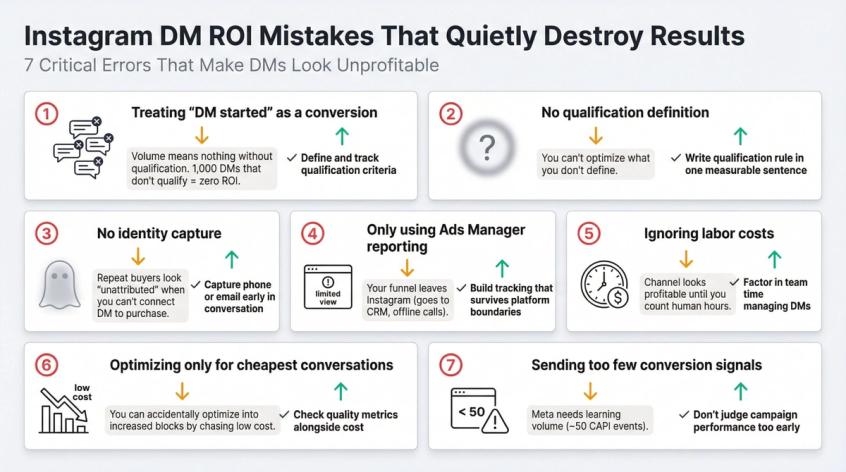
Instagram DM ROI Mistakes That Quietly Destroy Results
| Mistake | Why It Destroys ROI | How to Fix |
|---|---|---|
| ① Treating "DM started" as a conversion | Volume means nothing without qualification. 1,000 DMs that don't qualify have zero ROI. | Define and track qualification criteria |
| ② No qualification definition | You can't optimize what you don't define. | Write qualification rule in one measurable sentence |
| ③ No identity capture | Repeat buyers look "unattributed" when you can't connect DM to purchase. | Capture phone or email early in conversation |
| ④ Only using Ads Manager reporting | Your funnel leaves Instagram (goes to Shopify, CRM, offline calls). | Build tracking that survives platform boundaries |
| ⑤ Ignoring labor costs | Channel looks profitable until you count human hours. | Factor in team time managing DMs |
| ⑥ Optimizing only for cheapest conversations | You can accidentally optimize into increased blocks by chasing low cost. | Check quality metrics alongside cost |
| ⑧ Sending too few conversion signals | Meta needs learning volume (~50 CAPI events). | Don't judge campaign performance too early |
How Spur Helps You Measure Instagram DM ROI
We built Spur specifically to solve the Instagram DM ROI measurement problem.
Here's how we help you prove (and improve) Instagram DM performance:
Actionable AI Agents That Drive Conversions
Most Instagram automation tools give you basic Q&A bots. Spur's AI agents can actually do things:
- Track orders in your system
- Book appointments
- Update CRM records
- Process returns
- Send payment links
Why this matters for ROI: Automation that completes business outcomes (not just answers questions) directly contributes to both sides of the ROI equation: increased conversion and reduced labor cost.
How to Train AI Agents on Your Own Knowledge Base
Unlike some tools where you can't train AI on your own data, Spur lets you train the AI agent on your website content, FAQs, and product catalog. The agent gives accurate, brand-aligned answers.
ROI impact: Better answers = higher conversion rates. Fewer "I need to check with someone" responses that kill momentum.
Instagram Analytics That Connect to Revenue
Spur's Instagram Direct Analytics dashboard pulls together:
- Ad campaign data (cost per conversation, cost per lead)
- Messaging data (conversation depth, blocks, engagement)
- Qualification tracking (which conversations hit your definition)
- Outcome attribution (revenue from DM-tagged customers)
All in one place. No spreadsheet gymnastics required.
Built-In Meta Conversions API Integration
Spur sends CAPI events back to Meta when someone qualifies or purchases through a DM flow. This:
- Improves ad targeting (Meta finds more converting users)
- Gives you accurate attribution in Ads Manager
- Closes the loop between "conversation started" and "revenue realized"
Unified Inbox Across Instagram and All Channels
Spur combines Instagram DMs, WhatsApp, Facebook Messenger, and live chat into one shared inbox with full context.
ROI benefit: No missed DMs (missed DM = missed revenue). Consistent tracking across channels. Team efficiency through consolidated workflows.
How to Set Up Click-to-Instagram DM Ads
Spur's Click-to-DM ad setup includes qualification flows, lead capture automation, and automatic CAPI event sending – all designed to maximize and measure ROI from Instagram ad spend.
Shopify Integration for Perfect DM Attribution
For ecommerce brands, Spur's Shopify integration automatically ties Instagram DM conversations to customer profiles. When that person buys (today or 30 days later), the revenue gets attributed back to the DM source.
No manual UTM tracking needed. It just works.
Start Measuring Instagram DM ROI Today
Try Spur free for 7 days. Set up Instagram automation with built-in analytics, connect your Shopify store or CRM, and start tracking exactly how much revenue your DMs generate.
The alternative is continuing to guess whether Instagram DMs are worth your time. Spoiler: they are, but only when you measure and optimize them properly.
5 Things to Start Tracking Instagram DM ROI This Week
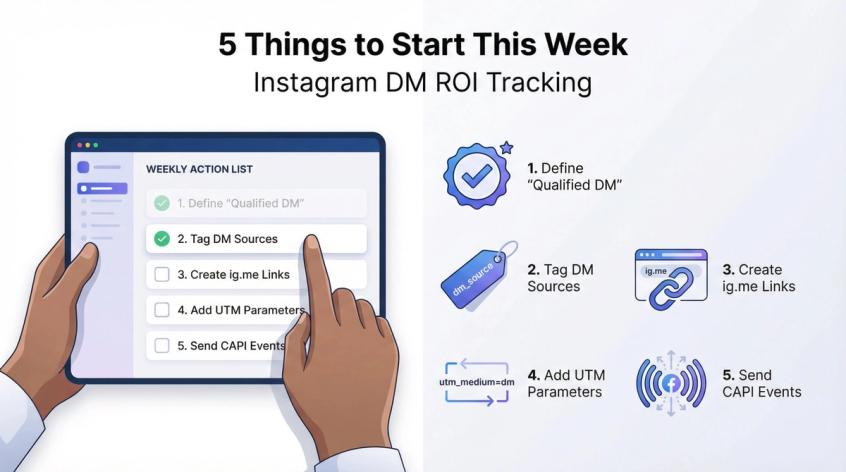
If you only do five things:
① Define "Qualified DM" in One Sentence
Write the specific criteria that make a DM conversation worth counting. Share it with your team.
② Add a dm_source Field and Start Tagging
Every new DM should be tagged by source (organic, specific ad campaign, story, bio link). Use your CRM, a spreadsheet, or Spur's automation to capture this.
③ Create Campaign-Specific ig.me Links
Use Spur's Instagram chat link generator to make unique links for:
- Your bio
- Email campaigns
- Story link stickers
This gives you deterministic attribution for organic DM campaigns.
④ Put UTMs on Every Product Link in DMs
Every single link you send should include utm_source=instagram&utm_medium=dm&utm_campaign=[specific].
⑤ Send a CAPI Event When Leads Qualify
Not just when the chat starts. Send the conversion event when they give contact info, click a payment link, or hit your qualification criteria.
Do these five things and you'll have foundational ROI tracking in place within a week.
Turn Instagram DMs Into Measurable Profit
Instagram DMs are where modern business meets customers in real time. The channel delivers higher conversion rates and more personalized experiences than traditional marketing funnels. But without proper ROI measurement, you're flying blind.
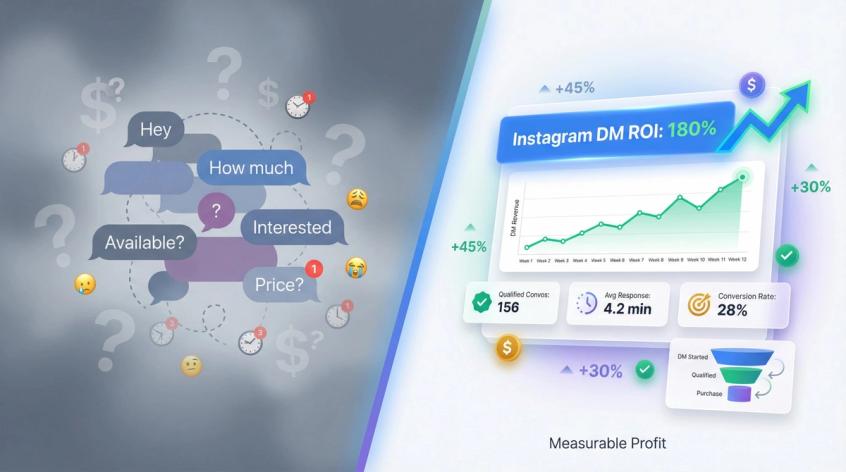
Here's what we've covered:
✓ ROI is a business math problem, not a platform metric. Track gross profit and cost savings, not just reply rates.
✓ The five-stage funnel (started → replied → qualified → outcome → revenue) prevents you from mixing stages and getting confused about what's working.
✓ Three attribution paths (identity capture, UTM tracking, Conversions API) working together give you complete visibility into how DMs drive revenue.
✓ Real examples show 5-10× higher conversion from DM-based interactions versus standard traffic, with some brands seeing 73× or even 128× ROI from well-executed messaging campaigns.
✓ Speed matters immensely. 21× higher conversion when you respond within 5 minutes. Automation isn't optional anymore.
✓ The dashboard that matters tracks volume, speed, qualification, outcomes, and profit ROI – not vanity metrics.
✓ Common mistakes (treating DM volume as success, ignoring labor costs, optimizing for cheap conversations without quality checks) quietly destroy ROI.
Start measuring your Instagram DM ROI now. Track it rigorously for the next campaign or quarter. Treat DMs as trackable touchpoints on the customer journey, not casual social chats.
With proper tracking and continuous optimization, you'll turn Instagram DMs from a "maybe-profitable channel" into a proven profit center that scales predictably.
Customers want direct, fast, authentic communication. Meeting them in DMs is smart. Proving the ROI is what separates guessing from growing.
Get started with Spur's 7-day free trial and see exactly what your Instagram DMs are worth.
FAQ: Instagram DM ROI Measurement
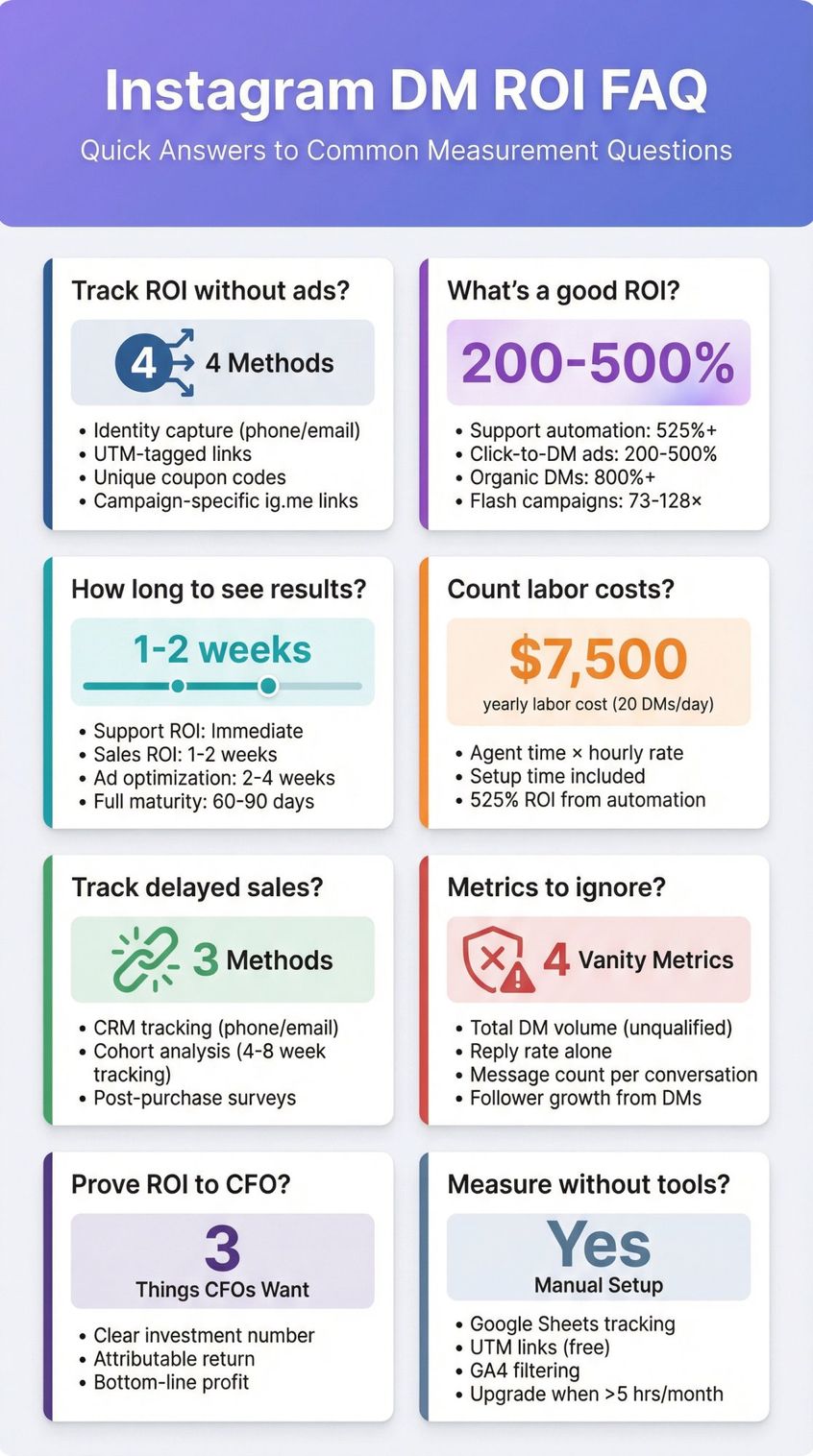
How do I track Instagram DM ROI if I don't run ads?
Even without Click-to-DM ads, you can track organic DM ROI through:
- Identity capture: Ask for phone/email in DMs, then track purchases from those contacts in your CRM
- UTM-tagged links: Every product link sent in DMs should include
utm_source=instagram&utm_medium=dm - Unique coupon codes: "DM-only" codes let you see exactly which sales came from conversations
- Campaign-specific ig.me links: Use different chat links for bio, stories, and email campaigns
Calculate ROI by comparing DM-attributed revenue against tool costs and labor time spent managing conversations.
What's a good Instagram DM ROI?
Context matters, but here are realistic benchmarks:
| Scenario | Expected ROI Range | Notes |
|---|---|---|
| Support automation | 525%+ | Time savings when replacing manual FAQ responses |
| Click-to-DM ads | 200-500% | Solid performance for paid campaigns |
| Organic DM engagement | 800%+ | Main cost is just labor, so ROI can be very high |
| Flash campaigns | 73× to 128× | Some brands achieve extreme ROI on short promotional bursts |
If your ROI is below 100% (losing money), you need to either increase conversion rates or reduce costs. If it's 300%+, you're in healthy territory and should consider scaling.
How long does it take to see ROI from Instagram DM automation?
Timeline varies by setup:
- Support deflection ROI: Immediate – as soon as automation starts handling FAQs, you save time
- Sales ROI from existing DMs: 1-2 weeks – once you implement UTM tracking and start capturing data
- Click-to-DM ad optimization: 2-4 weeks – Meta needs ~50 conversion events to optimize well
- Full measurement maturity: 60-90 days – when you have enough data for reliable cohort analysis and LTV tracking
Start with quick wins (UTM links, time tracking) while building toward comprehensive attribution.
Should I count labor costs in my Instagram DM ROI calculation?
Absolutely yes. Ignoring labor costs is the #1 way teams fool themselves about ROI.
Calculate fully loaded cost:
- Agent hourly rate × hours spent on DMs
- Include setup time for automation flows
- Factor in management overhead
One analysis showed 20 DMs daily handled manually = 250 hours yearly = $7,500 labor cost. If your automation costs $1,200/year and saves those hours, that's 525% ROI on time savings alone.
Without counting labor, you might think "DMs are free" when they're actually consuming $20,000+ in team time annually.
How do I attribute sales that happen days after a DM conversation?
Use identity-based attribution:
Method 1: CRM Tracking
- Capture phone/email during the DM conversation
- When that contact purchases later (even 30 days later), your CRM shows the original source was Instagram DM
- Spur's Shopify integration does this automatically
Method 2: Cohort Analysis
- Tag all DM conversations from Week 1
- Track purchases from those contacts over the next 4-8 weeks
- Calculate: Total revenue from cohort / DM investment = Cohort ROI
Method 3: Ask Directly
- Post-purchase survey: "How did you first hear about us?"
- If significant portion say "Instagram DM," that validates the channel's influence
The key is connecting identity (not just sessions or clicks) across the customer journey.
What Instagram DM metrics should I ignore?
Metrics that don't connect to business outcomes:
| Vanity Metric | Why It's Misleading | Track Instead |
|---|---|---|
| Total DM volume (without qualification) | 1,000 unqualified DMs have zero ROI | Qualified conversations |
| Reply rate alone | Responding to everything doesn't matter if nothing converts | DM-to-lead conversion rate |
| Message count per conversation | Longer isn't always better; sometimes signals confusion | DM-to-sale conversion rate |
| Follower growth from DMs | Followers don't pay bills; customers do | Cost per qualified conversation |
Focus on metrics that ladder up to revenue. If a metric doesn't help you make a decision, stop tracking it.
How do I prove Instagram DM ROI to my boss/CFO?
CFOs want three things:
① Clear Investment Number
- Total cost = Ad spend + Tools + Labor (fully loaded)
- Show it monthly or quarterly with receipts
② Attributable Return
- Revenue from DM-tagged orders (UTMs, codes, CRM source)
- Cost savings from automation (hours saved × hourly rate)
- Use conservative estimates, not best-case scenarios
③ The Bottom Line
- ROI percentage: "For every $1 we spend on Instagram DMs, we generate $X back"
- Net profit: "After all costs, Instagram DMs produced $Y in profit last quarter"
- Comparison: "Instagram DMs deliver 3× higher ROI than email marketing"
Include a simple visual (chart showing investment vs. return over time). Bring receipts: Shopify reports filtered by utm_medium=dm, CRM exports showing Instagram source, time logs.
If you can say "We spent $10k on Instagram DMs and generated $45k in gross profit with receipts to prove it," you'll get budget to scale.
Can I measure Instagram DM ROI without expensive tools?
Yes, but it requires manual discipline:
Free tracking setup:
- Google Sheets: Track every DM manually (date, source, qualified Y/N, outcome, revenue)
- UTM links: Use Google's Campaign URL Builder for every link sent in DMs
- Google Analytics: Filter sessions by
utm_medium=dmto see DM-driven traffic and conversions - Unique codes: Create DM-specific discount codes in your ecommerce platform
- Time tracking: Log hours spent on DMs weekly (honest accounting)
The cost: Your time doing manual data entry and reporting.
When to upgrade: When manual tracking takes more than 5 hours/month, the opportunity cost exceeds the tool cost. Platforms like Spur (starting $31/month annual) automate this for less than the value of your time.