New WhatsApp Charges From October 1: Costs and Fixes

Discuss with AI
Get instant insights and ask questions about this topic with AI assistants.
💡 Pro tip: All options include context about this blog post. Feel free to modify the prompt to ask more specific questions!
WhatsApp service message pricing changes on 1 October 2026, when free-form replies sent inside the 24-hour customer service window stop being free. Each business phone number keeps 1,000 free service messages a month, and every delivered service message after that is billed per message. Utility templates sent inside that same window lose their free status on the same date, with no allowance. Meta confirmed both changes in its official WhatsApp Business Platform pricing documentation.
Every brand on the WhatsApp Business API is affected, including the 600+ D2C brands running WhatsApp, Instagram, Facebook and website chat through Spur. If you have never had to think about the cost of a support reply, you do now.
The change is narrower than the headlines suggest. Inbound messages from customers stay free, message delivery inside the 72-hour free entry point window for Click to WhatsApp ads stays free, and templates outside the window keep the same per-message model, although October is also a quarterly rate update with increases and decreases in a handful of markets.
What changes is the cost of your replies. A brand answering 40,000 customer messages a month moves that volume from a zero line item to a real one, and the fix is not sending fewer messages. It is making each message do more work, which is what a trained AI agent and an inbox connected to your order data are actually for.
This guide covers what becomes billable, what stays free, how to calculate your own number before the invoice arrives, and which parts of your setup are worth fixing first.
Rates and dates here were checked against Meta's pricing documentation on 8 September 2026 and cover India, Germany, Italy, Spain, the UK and Brazil, shown in the currency of each market's rate card. Meta has now published the October rate cards, and the service rate in every market matches the utility and authentication rate on that card, so the figures below are confirmed rather than estimates. They are Meta's list rates only. Your provider's platform fee and any message markup, and local tax, sit on top.
What WhatsApp service message pricing looks like from 1 October 2026
A service message is a free-form, non-template reply your business sends inside an open 24-hour customer service window. It can come from a human agent in your inbox or from a third-party AI agent. Both count.
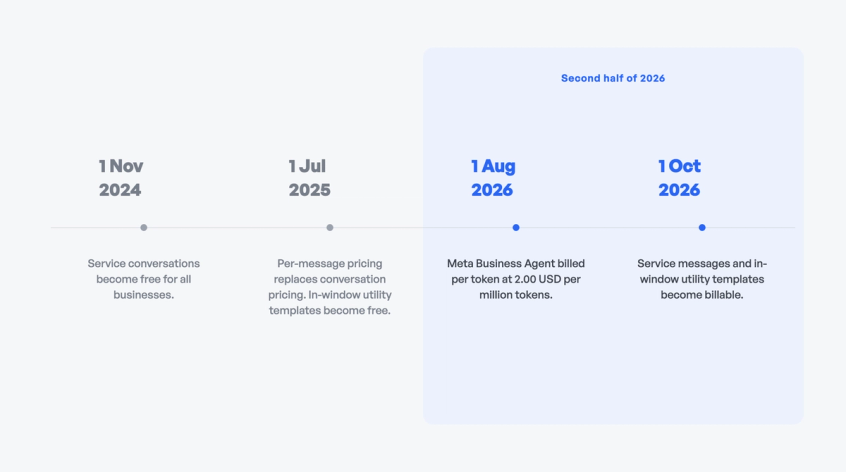
These replies have been free since 1 November 2024, when Meta made service conversations free for all businesses. In-window utility templates became free on 1 July 2025, when Meta moved from conversation-based pricing to per-message pricing.
Both of those exemptions end on 1 October 2026, with one softener. Every business phone number keeps 1,000 free service messages a month, and billing starts with the 1,001st delivered service message. Utility templates inside the window get no such allowance.
| Message type | Until 30 Sept 2026 | From 1 Oct 2026 |
|---|---|---|
| Inbound customer message | Free | Free |
| Free-form reply inside the 24-hour window | Free | Charged per message after 1,000 free a month per business phone number |
| Utility template inside the 24-hour window | Free | Charged per message, no free allowance |
| Utility template outside the window | Charged | Charged |
| Authentication template | Charged | Charged |
| Marketing template | Charged | Charged |
| Message delivery inside a 72-hour free entry point window | Free | Free |
| Meta Business Agent reply | Charged per token since 1 Aug 2026 | Charged per token, including inside the 72-hour window |
Three details matter more than the headline.
First, service messages are priced at the same per-message rate Meta already charges for utility and authentication templates in the recipient's country. If you know your utility rate today, you already know roughly what a service reply will cost.
Second, service messages get no volume discount. Utility and authentication templates unlock lower tier rates as monthly volume grows, but the service rate stays flat whether you send 500 or 500,000. That single detail changes the math for high-volume support teams more than the rate itself does.
Third, the free allowance is per business phone number, not per WhatsApp Business Account and not per customer. It refreshes every month and unused messages do not roll over. A brand running three numbers has 3,000 free service messages a month across them, and billing starts with the 1,001st delivered service message on each number.
The 24-hour window itself is unchanged. It still opens when a customer messages you, still resets on each new inbound message, and still governs when you are allowed to send free-form replies instead of an approved template. It just stops being free.
One operational point sits ahead of all of this. Meta has told Solution Providers and directly integrated businesses to have a payment method configured by 30 September 2026. Accounts without one will have service message delivery stopped from 1 October. If you buy WhatsApp through a provider, that billing setup sits on their side, so confirm it with them rather than assuming.
Still budgeting from last year's rate card? Here is the current breakdown of WhatsApp Business API pricing across every message category.
The second date most teams miss: 1 August 2026
There is an earlier change that already took effect, and it confuses people because it lands in the same conversation as the October change.
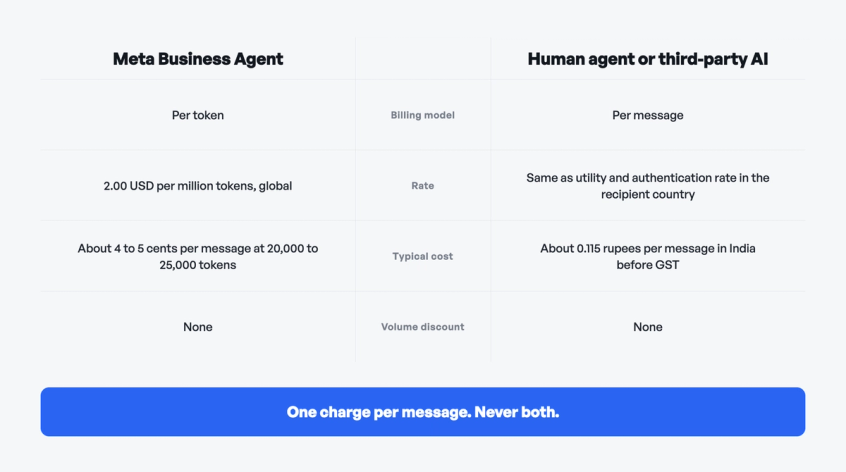
Meta Business Agent is Meta's own AI agent, announced globally on 3 June 2026 at the Conversations conference in London. The Meta Business Agent Platform opened to partners on 1 July 2026, and from 1 August 2026 Meta bills it by token at $2.00 per million tokens, a single global rate.
Meta puts a typical exchange at roughly 20,000 to 25,000 tokens, which works out to about 4 to 5 cents per message. That rate bundles the AI processing and the message delivery into one charge.
The distinction that decides your bill is authorship. A reply written by a human agent or generated by a third-party AI is a service message, billed per message from October. A reply generated by Meta Business Agent is billed per token instead. Meta applies one message charge to any given message, never both. Your provider's platform fee is a separate bill on top of either.
For most Indian D2C brands, that gap is significant. A service reply at the India utility rate costs a fraction of a rupee. A Meta Business Agent reply at 4 to 5 cents lands at several rupees, and that figure moves with the exchange rate since Meta prices the agent in dollars globally.
The comparison is not close on unit cost, and on Meta's charges alone it stays that way. Two Meta Business Agent replies cost more than six India service replies. It only tips once you count the rest of the bill: the third-party AI or platform fee behind those six replies, or the human time if an agent wrote them. That is the comparison worth making.
That is the real question to ask about any AI on WhatsApp: what does one resolved conversation cost, end to end, including the messages it took to get there. A cheap reply that fails to resolve anything just generates another billable reply.
What stays free after October
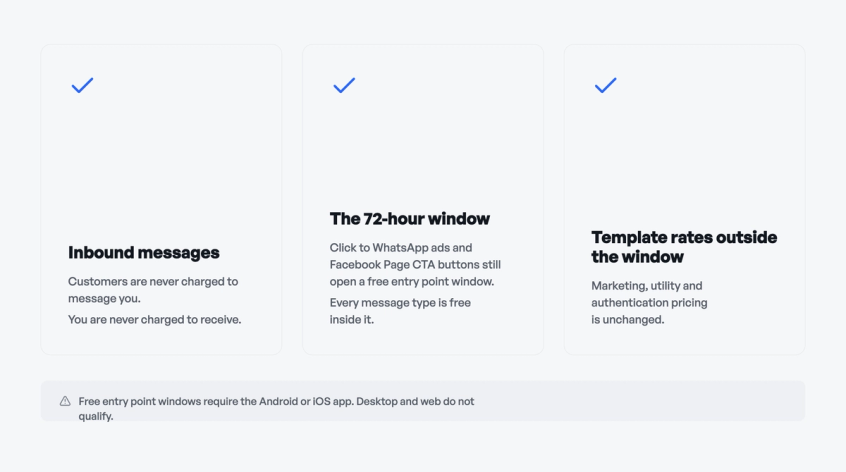
Three things do not change, and two of them are worth building around.
Inbound messages are still free. Customers are not charged to message your business, and you are not charged to receive. Every reply you avoid sending is money saved, which makes response quality a cost lever now, not just a service metric.
The 72-hour free entry point window survives. When a customer reaches you through a Click to WhatsApp ad or a Facebook Page call-to-action button from the Android or iOS app, a 24-hour customer service window opens as normal. If you respond within those 24 hours with any message type, that reply is free and a free entry point window opens from the moment you responded. It stays open for 72 hours, and delivery of every message type is free inside it, including templates. Two caveats. The 24-hour customer service window still governs free-form replies, so once it lapses you send approved templates until the customer writes again. And Meta Business Agent replies still incur token charges inside the window, because the exemption covers message delivery, not AI usage.
Note the constraint in Meta's documentation: desktop and web are not supported for free entry point windows. Only the mobile apps qualify.
The per-message model for templates outside the window is untouched. Marketing, utility and authentication templates keep being billed per delivered message. October is still a quarterly rate update, though, so check your own markets on the published cards. Meta lists higher marketing rates for Kuwait, Morocco, Mexico, Saudi Arabia, the UAE and its Other Middle East and Other Asia Pacific groups, higher utility and authentication rates in eight markets, lower ones in four, and nine markets moving onto standalone rate cards.
The practical read is that high-intent entry points just got more valuable. A conversation that starts from an ad gives you three days of free messaging on both sides. A conversation that starts cold from your bio link does not.
The 72-hour window is now the cheapest real estate on WhatsApp. Here is how to actually use it with Click to WhatsApp ads.
How to calculate your WhatsApp service message pricing before October
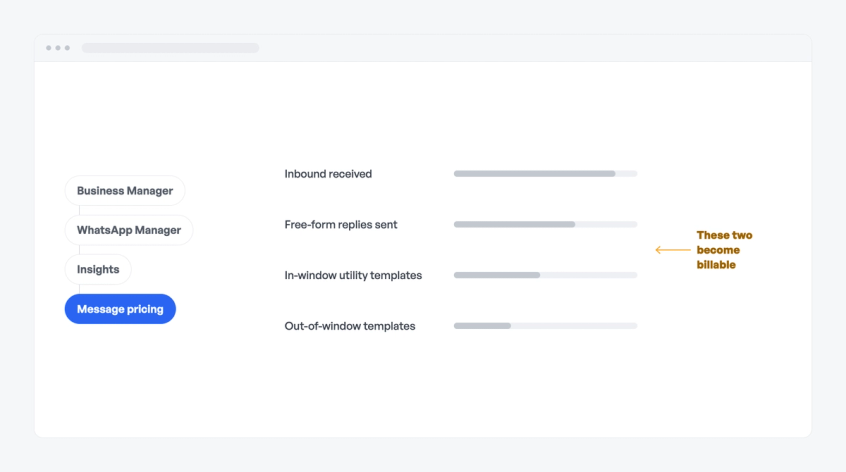
Do not estimate this from a rate card alone. The number that matters is your own message mix, and it is sitting in your account right now.
Step 1: Pull a complete month of data. Open Business Manager, go to WhatsApp Manager, then Insights, and select the last full calendar month. If you are on the API through a provider, your platform analytics will usually give you the same breakdown faster.
Step 2: Separate your message types. You need four counts, not one total: inbound messages received, free-form replies sent inside the window, utility templates sent inside the window, and templates sent outside the window. Count delivered messages, since that is what Meta bills, and split them by business phone number and by recipient market. Modelling everything as one average message is the most common way teams get this wrong by a wide margin.
Step 3: Find your country rate. Service messages are priced at your market's utility and authentication rate on Meta's published October card. Rates follow the recipient's country code, not where your business sits, so a brand in Bengaluru messaging a German customer pays the German rate. The table below covers the major markets.
Step 4: Apply the rate to the newly billable volume. Take your in-window free-form replies, subtract 1,000 per business phone number for the free allowance, and multiply the rest by the utility rate. Multiply all of your in-window utility templates by the same rate, since the allowance does not cover them and they follow the normal utility volume tiers. Those two lines are your new Meta cost. Keep your provider's platform fee and markup as a separate line.
Step 5: Subtract what falls inside a free entry point window. Replies inside an active 72-hour window from a Click to WhatsApp ad stay free. If you run ads into WhatsApp at any scale, this materially reduces the number.
Step 6: Divide by outcomes, not by messages. Take the added cost and divide it by qualified leads, orders, or resolved tickets from WhatsApp in the same month. That per-outcome figure is the one to take into a budget conversation.
What the service rate looks like by market
One quirk of Meta's rate card makes this easy to read. In every major market, the utility rate and the authentication rate are the same number. That is why Meta can describe the service rate as matching "utility and authentication" without picking between them, and it means the utility column below is the service rate you will pay from October.
All figures are Meta list rates on the current rate card, shown in the currency of the card each market is priced on, before tax and before any provider markup. The recipient's country decides which market you pay for, and your WhatsApp Business Account's billing currency decides which currency card applies, so a German recipient does not mean you are invoiced in euros. Meta's October cards confirm the service rate equals the utility and authentication column.
| Market | Rate-card currency shown | Marketing | Utility and authentication | Service rate from 1 Oct 2026 |
|---|---|---|---|---|
| India | INR | ₹0.8631 | ₹0.115 | ₹0.115 |
| Germany | EUR | €0.1131 | €0.0456 | €0.0456 |
| Italy | EUR | €0.0658 | €0.0248 | €0.0248 |
| Spain | EUR | €0.0585 | €0.0166 | €0.0166 |
| United Kingdom | GBP | £0.0458 | £0.0159 | £0.0159 |
| Brazil | USD | $0.0625 | $0.0068 | $0.0068 |
Three things worth pulling out of that table.
Germany is the outlier at the top. German utility and authentication sit at €0.0456 against Spain's €0.0166, so the same support volume costs nearly three times more into a German list than a Spanish one, and that is before you notice German marketing is among the most expensive in Europe. If your list skews European, the October change lands harder than it does on a domestic Indian one.
Brazil still prices on the USD card unless your WhatsApp Business Account bills in BRL, which Meta opened on 1 July 2026 with a native BRL rate card. If you bill in BRL, read Meta's BRL card rather than converting the USD figures yourself.
Tax sits on top and depends on who is billed and by which Meta entity, not on where the recipient is. India adds 18% GST. In the EU and the UK, Meta's cross-border charges to a business often fall under the reverse charge mechanism, so the headline VAT rate may not appear on the invoice at all. Check the treatment with your accountant rather than assuming.
Two more markets are worth knowing. The Netherlands carries the highest marketing rate on Meta's EUR card at €0.1323, and France sits at €0.0712, well below Germany. Pull their utility and authentication rates from WhatsApp Manager or Meta's rate selector when you build your own model.
A worked example
Take a brand messaging Indian customers from a single business phone number, sending 40,000 free-form replies and 20,000 in-window utility templates in a typical month, with no ad-driven traffic.
At ₹0.115 per message, the first 1,000 replies are free, the remaining 39,000 come to ₹4,485, and the 20,000 utility templates come to ₹2,300, since the allowance does not cover templates. That is ₹6,785 of new Meta cost, or about ₹8,006 with 18% GST applied. Provider fees and markup are extra.
If that same month produced 1,200 orders through WhatsApp, the change adds roughly ₹6.67 per order on the GST-inclusive figure. For many D2C brands that is small against contribution margin. For a support-heavy business with no revenue attached to those conversations, it is a genuine line item.
Run the same calculation with your own numbers from WhatsApp Manager, then re-run it after you clean up your automations.
The same volume in European markets
Those 60,000 messages, 59,000 of them billable once a single number's free allowance is used, cost very different amounts depending on where your customers are, and the European markets are the ones that sting. India and Brazil sit in the table below as reference points. At the list rates above, before tax and provider fees:
| Market | 59,000 billable messages |
|---|---|
| India | ₹6,785 |
| Brazil | $401.20 |
| United Kingdom | £938.10 |
| Spain | €979.40 |
| Italy | €1,463.20 |
| Germany | €2,690.40 |
That spread is the whole argument for modelling by market rather than by blended average. A brand doing most of its volume in India will find October a small line. The same brand expanding into Germany will not.
Model your October bill before it lands. Spur breaks message volume down by type, shows what each conversation is actually producing, and ties WhatsApp spend back to Shopify revenue. Start free with Spur and see your real numbers.
Why WhatsApp service message pricing rewards better conversation design
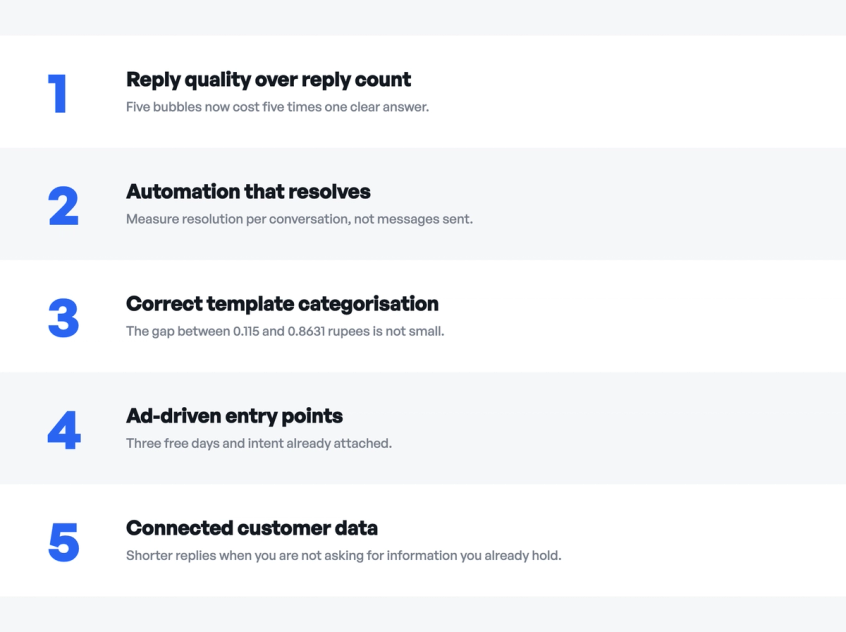
Per-message billing punishes chatter and rewards precision. Five things get more valuable from October.
Reply quality over reply count. Splitting one answer across five short bubbles used to be free and slightly annoying. Now it costs five times as much and is still slightly annoying. Consolidating replies is the single cheapest fix available to most teams.
Automation that resolves rather than responds. An agent that answers accurately, pulls real order data, collects what it needs and hands over cleanly will use fewer messages than one that asks three clarifying questions before doing anything useful. Resolution rate per conversation is now a cost metric.
Correct template categorisation. Utility and marketing do different jobs and carry different rates. Misclassified templates hurt both your cost and your deliverability, and the gap between ₹0.115 and ₹0.8631 in India is not small. Plain order confirmation templates with the order details qualify as utility. Add a promotional line or a recommendation and Meta treats the whole template as marketing, and one-time passcodes belong in authentication, not utility.
Ad-driven entry points. Free entry point conversations arrive with intent attached and three days of free messaging. If you are already spending on Meta ads, routing more of that spend into WhatsApp is now a cost decision as well as an acquisition one.
Connected customer data. When your inbox has order history, catalogue, policies and consent records in the same place, replies get shorter and resolve faster because nobody is asking the customer for information you already have. A WhatsApp shared inbox with Shopify context attached does more per message than a standalone chat window.
There is a sixth item that is less about cost and more about hygiene. Audit your automations for loops, duplicate confirmations and follow-ups nobody asked for. Those were invisible before October. They will show up on the invoice after.
Most teams have no idea which conversations actually convert. Learn how to track WhatsApp messages for business so you can price a conversation properly.
What changed since August, and what is still open
Meta has now published the confirmed October rate cards, and the service rate in every market is the utility and authentication rate on that card, so the figures in this guide are no longer estimates. Two things landed with the cards that early coverage missed: the 1,000 free service messages per business phone number each month, and the requirement to have a payment method on file by 30 September 2026, without which Meta stops delivering service messages from 1 October.
Meta is also moving more markets off shared regional pricing and onto standalone rate cards on 1 October. Bangladesh, Iraq, Nepal and Sri Lanka are set to get lower utility and authentication rates alongside a new higher authentication-international rate. Kazakhstan, Kuwait, Morocco, Oman and Ukraine are going the other way with higher utility and authentication rates.
A few things worth confirming against your own account before you commit a budget:
- Whether your market moves to a standalone rate card in October
- Whether you have any authentication-international traffic, which is priced separately and runs far higher than the domestic rate in India
- The currency your WABA bills in, which now matters more than it used to
Indian brands have a second deadline
If you bill in India, October is not the only date on your calendar. Meta is requiring eligible customers, defined by the Sold-To country in Billing Hub, to migrate every WABA in their business portfolio to INR billing by 31 December 2026. From 1 January 2027, Meta stops delivering messages from non-INR WABAs belonging to those customers.
This used to be painful, because changing a WABA's billing currency meant creating a new account from scratch. Meta shipped WABA Currency Migration APIs on 1 June 2026. The migration still creates a new WABA and moves your phone numbers, templates and Flows across, but it is now two API calls plus status checks, billing setup and verification rather than a rebuild. Coexistence and Authorized Agents WABAs are excluded. Ask your provider where your WABAs stand.
Meta's list rate is identical no matter who you buy through, so the rate card is the same starting point for everyone. Our breakdown of the best WhatsApp API provider in India covers what else to weigh up when you pick one.
Your pre-October checklist
Eight things to work through, roughly in this order.
Confirm a payment method is on file by 30 September. Meta stops delivering service messages from 1 October for accounts without one. If you buy through a provider, ask them to confirm their billing setup covers your account.
Save a baseline. Export a full month of WhatsApp usage and split it into inbound, in-window free-form, in-window utility and out-of-window templates, by business phone number. Calculate the October delta at the published rates, after the 1,000 free service messages per number.
Audit every automation. Remove duplicate confirmations, redundant follow-ups and anything that sends a message without moving the conversation forward.
Consolidate multi-bubble replies. Any flow that answers in five short messages where one would do is now five times the cost for no benefit.
Review template categorisation. Purely transactional updates should be utility, one-time passcodes authentication, and anything promotional marketing. Templates that mix transactional and promotional content are billed as marketing, so split them in two.
Attach outcomes to conversations. Revenue, qualified leads, resolved tickets, support hours saved. Without a denominator you have a cost number and nothing to weigh it against.
Check your ad entry points. Free entry point windows require the mobile app, so confirm your Click to WhatsApp destinations are not sending people to web or desktop.
Refresh the model with the published cards. Meta's October rate cards are live, so swap the confirmed rates into your baseline and take the final number to whoever owns the budget.
If you run Instagram alongside WhatsApp, this is also a good moment to look at how the two channels feed each other. Instagram comment automation that routes high-intent commenters into a WhatsApp conversation gives you a warm entry point rather than a cold broadcast, and our guide to measuring Instagram DM ROI covers how to attribute the revenue properly.
What this changes for your WhatsApp bill
WhatsApp service message pricing is changing on 1 October 2026, and the practical effect is that replies beyond 1,000 a month per business phone number stop being free, while inbound messages and message delivery inside the 72-hour ad window stay free. The channel is not becoming unusable. It is becoming harder to run carelessly.
Brands that blast messages, misclassify templates and measure nothing will feel this first. Brands that attract inbound intent, answer efficiently and know what a conversation is worth will feel it far less.
Open your own account, pull your own numbers, and calculate the cost before the headlines calculate your opinion for you. If you want a platform that shows message cost, conversation outcomes and Shopify revenue in the same view, try Spur free and get your model built before October.
Service messages are only half of this autumn's pricing story. On the marketing side, Meta is replacing the fixed marketing rate with a ceiling you bid, called max price. It opens to every provider's clients in October 2026 and becomes mandatory in eligible markets from Q2 2027. Our guide to WhatsApp max price covers how the bid works and what number to set first.
Frequently asked questions
What is a WhatsApp service message?
A service message is a free-form, non-template reply your business sends inside an open 24-hour customer service window. It can be written by a human agent or generated by a third-party AI agent. Replies generated by Meta Business Agent are billed separately by token and do not count as service messages.
When does WhatsApp start charging for service messages?
1 October 2026. Service messages and utility templates sent inside the 24-hour customer service window both become billable per message on that date. Service messages come with 1,000 free per business phone number each month. Utility templates do not.
Are any service messages still free after October?
Yes. Each business phone number gets 1,000 free service messages a month, and Meta starts charging from the 1,001st delivered service message. The allowance refreshes monthly, does not roll over, and does not cover utility templates sent inside the window.
How much will a WhatsApp service message cost?
Service messages are priced at the same per-message rate Meta charges for utility and authentication templates in the recipient's country, and those two rates are identical in every major market. On Meta's published cards that means ₹0.115 in India, €0.0456 in Germany, €0.0248 in Italy, €0.0166 in Spain, £0.0159 in the UK and $0.0068 in Brazil, all before tax and before any provider markup. The first 1,000 service messages per business phone number each month are free.
Does the October 2026 change affect the free WhatsApp Business app?
No. The change applies only to the WhatsApp Business Platform, also called the WhatsApp Business API. The consumer WhatsApp app and the free WhatsApp Business app are not affected.
Are inbound customer messages still free?
Yes. Customers are not charged to message your business and you are not charged to receive their messages. Only messages you send are billable.
Is the 72-hour Click to WhatsApp window still free?
Yes, for message delivery. When a customer reaches you through a Click to WhatsApp ad or Facebook Page call-to-action button from the Android or iOS app and you reply within 24 hours, a free entry point window opens for 72 hours. Delivery of every message type is free inside it, including templates, though free-form replies still need an open 24-hour customer service window, and Meta Business Agent replies still incur token charges.
Do service messages get volume discounts?
No. Utility and authentication templates unlock lower rates as monthly volume grows, but service messages are charged at a flat per-message rate regardless of how many you send.
Can I be charged twice for the same reply?
No, not by Meta. Each message falls into exactly one billing category. A reply from a human agent or third-party AI is billed as a service message. A reply generated by Meta Business Agent is billed by token at $2.00 per million tokens. Meta never applies both. Your provider's platform fee is a separate charge.