Instagram Lead Ads vs DM Ads (2026 Guide)

Discuss with AI
Get instant insights and ask questions about this topic with AI assistants.
💡 Pro tip: All options include context about this blog post. Feel free to modify the prompt to ask more specific questions!
If you're drowning in cheap lead form submissions that never respond, or stuck with DM conversations that go nowhere, you're optimizing for the wrong thing. The real winner isn't Lead Ads or DM Ads. It's whichever format lets you build a feedback loop that teaches Meta what a qualified lead actually looks like. This guide shows you how to choose the right format for your business, set up campaigns that find buyers (not just clickers), and use Spur to qualify leads instantly so your ad costs drop while quality soars.
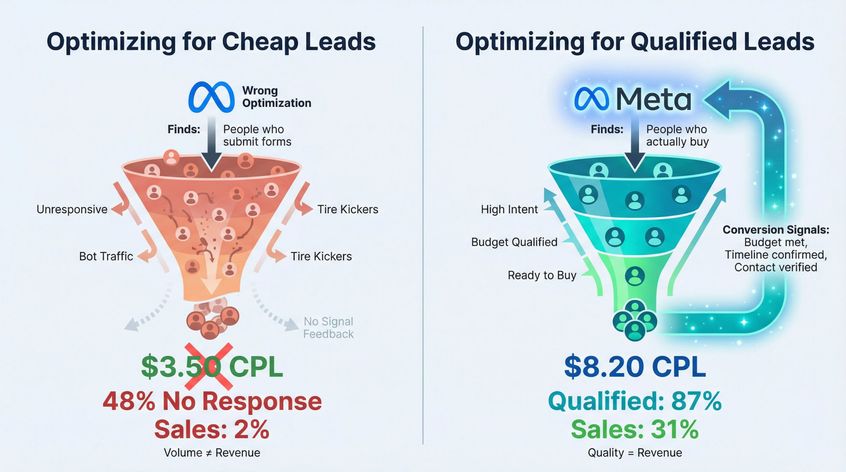
Instagram advertisers face a frustrating choice. You can run Lead Ads with instant forms and get a flood of submissions at low cost per lead. But half of them won't respond when you follow up. Or you can run DM Ads that open conversations, hoping for higher intent. But you end up with dozens of "Hi" messages that waste your team's time and never turn into sales.
The problem isn't the ad format. It's that most campaigns optimize for the wrong outcome.
Meta's ad system is a prediction machine. If you optimize for form submissions, it finds people who submit forms. If you optimize for message starts, it finds people who like chatting. Neither of those is the same as "people who actually buy."
The businesses winning with Instagram ads in 2026 have figured out something crucial. They've built systems where Meta learns what a qualified lead looks like, not just what a cheap lead looks like. They use conversion signals, automation, and instant response to teach the algorithm the difference between a tire-kicker and a buyer. And their cost per qualified lead keeps dropping while everyone else's keeps climbing.
This guide breaks down exactly how to do that. We'll show you when to use Lead Ads, when to use DM Ads, and how to set up either format so it finds the leads that actually convert. By the end, you'll know which approach fits your business model and how to avoid the failure modes that waste thousands of dollars.
What Are Instagram Lead Ads?
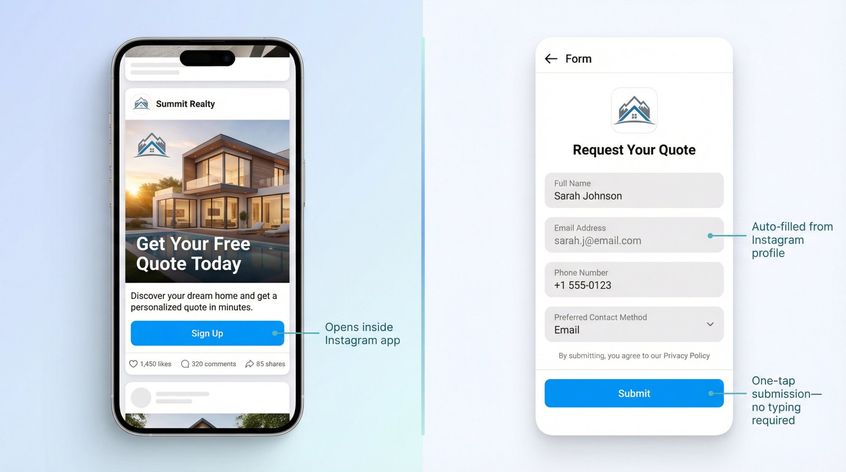
Instagram Lead Ads are ads that let users submit contact information through a form that opens inside the Instagram app. When someone taps your call-to-action (like "Sign Up" or "Get Quote"), they see a pre-populated form showing their name, email, phone number, and any other fields you're requesting. Instagram pulls this data from their profile, so users can review it and tap Submit in seconds.
No external landing page. No typing on a tiny phone keyboard. Just tap, review, submit.
The appeal is obvious. It's frictionless. Because the form auto-fills with profile data, completing it takes one or two taps. This low barrier produces a high volume of leads at a relatively low cost. In fact, native lead form ads on Facebook and Instagram often have about 50% lower cost per lead than campaigns that send people to external landing pages.
Lead Ads work incredibly well for building email lists, newsletter signups, webinar registrations, or any scenario where you want to collect contact info at scale and nurture leads later through email sequences or sales calls.
But that ease comes with a cost. When something takes zero effort, people do it without much consideration. You'll often find that Lead Ad submissions have higher no-response rates when you follow up compared to leads from more interactive channels. Some users tap through your form without real intent. Others might inadvertently submit outdated information if their Facebook profile is linked to an old email they don't check anymore.
There's also an inherent delay in the sales process. After capturing the lead, your team needs to reach out via email or phone to actually start a conversation. By the time you connect (if you connect), that initial spark of interest might have faded. The longer you wait to follow up, the colder the lead gets.
When to Use Instagram Lead Ads
Use them when you want quantity and you have a solid system to nurture leads afterward. They're ideal for offers like downloading an ebook, entering a contest, getting a coupon, or requesting a callback. They're also simpler to manage if you don't have the capacity to engage in live conversations. The lead info is captured for later follow-up, so your team can respond on their own schedule (though responding faster is always better).
Meta's official Lead Ads documentation provides detailed setup instructions and best practices for maximizing form completion rates while maintaining lead quality.
Just be sure to follow up quickly. Studies show that businesses that contact new leads within 5 minutes are able to convert those leads 21 times more than businesses that wait even an hour or more.
What Are Instagram DM Ads?
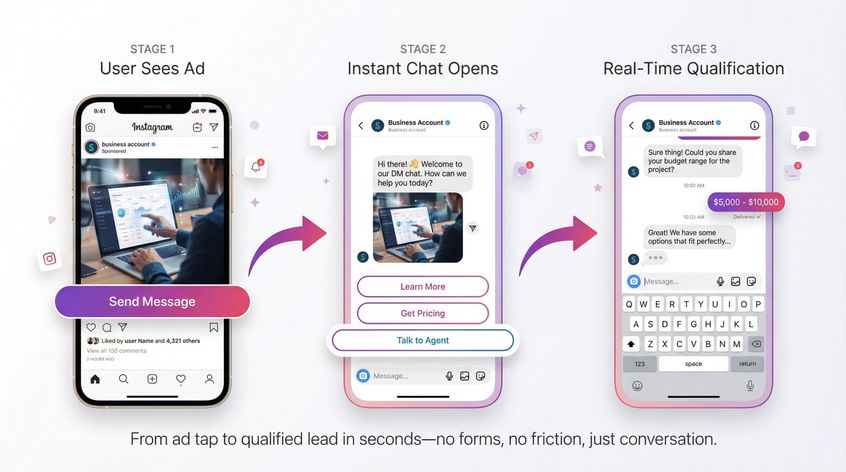
Instagram DM Ads, also called Click-to-Instagram Direct or messaging ads, work completely differently. Instead of showing a form or sending users to a landing page, these ads open a one-on-one conversation in Instagram Direct Messages. When someone taps the "Send Message" call-to-action on your ad, the Instagram app immediately opens a chat thread between them and your business account.
The ad that brought them in is indicated within the chat, and your business can reply instantly to engage or qualify the lead. Click-to-Instagram Direct ads open a conversation in the user's DM instead of a form, letting prospects start a chat while their interest is hottest.
Once the user lands in your DM, they can type and send a message to begin the conversation. Or you can set up an automated welcome message with quick-reply buttons to help prompt them. After the user sends their first message (even just "Hi, I'm interested!"), you can continue the conversation like any other DM. The initial message from the user opens a 24-hour messaging window during which you can freely exchange messages with them.
Why Instagram DM Ads Convert Better
Instead of capturing a lead and contacting them later, you can interact with them immediately in a back-and-forth conversation. This drastically shortens the sales cycle. You're moving the entire "form submission → follow-up → reply" sequence into a single instantaneous chat. Prospects get answers or personal attention on the spot, which can dramatically increase conversion rates.
There's no long form to deter them, so you often get fewer drop-offs. Click-to-DM ads eliminate the need to fill in a contact form, thereby lowering the drop-off rate. Many people who might ignore a form are willing to send a quick message if they're interested, especially since it feels like texting instead of filling out a survey.
Another advantage is accuracy and richness of information. Because you're conversing, you can ask for details like email, budget, preferences, and get accurate answers in context. If a user provides an incomplete or unclear response, you can clarify in real-time. You don't have to worry about wrong contact details the way you do with auto-filled forms that might pull outdated emails.
Leads acquired through a conversation tend to be higher intent. The very act of engaging in a dialogue filters in people who are genuinely interested. Your volume might be lower than easy-fill forms, but those leads are often more qualified. In fact, research shows that business messaging drives 61% higher conversion rates than email, and we've seen campaigns where engaging leads through DM and optimizing that process led to a 34% drop in cost per lead with a 43% increase in qualified lead volume.
Beyond the immediate conversation, DM ads create an open communication channel on Instagram that you can continue to use. Once someone has messaged you, you can send follow-ups (within Instagram's messaging rules) or leverage tools like broadcasts to keep them engaged. With a lead from a form, they're just sitting in your CRM. With DM leads, they're literally a message away from more content or offers.
DM Ads Requirements and Challenges
You must be prepared to respond quickly. If someone taps "Send Message" and gets radio silence, it's a poor experience and a lost lead. To succeed with DM ads, you need either a team ready to manage incoming DMs or a chatbot automation solution that can handle inquiries instantly.
Speed matters enormously in this channel. And 35% of users expect a reply within an hour on social media, with expectations climbing even higher for ads.
Another potential downside is that not everyone will initiate a chat. Some users prefer the simplicity of a quick form, or may not be in a situation to start a conversation. This can sometimes translate to a lower click-through rate on DM ads compared to lead ads. Your cost per click might be higher because the audience willing to start a chat is more selective. But those who do enter the chat are more committed.
Measuring success can also be more nuanced. With lead forms, each submission is clearly counted as a conversion. With messaging, the default is often optimizing for message starts (how many people open a chat). But a message start isn't necessarily a qualified lead. It's crucial to define what a qualified lead means in a DM context, such as the user providing their contact info or answering key qualifying questions. Advanced advertisers use tools to send a "Lead Qualified" event back to Meta for each DM conversation that meets certain criteria, training the algorithm to find users who will turn into real leads, not just casual chatters.
When to Use Instagram DM Ads
Use Instagram DM ads when your goal is higher-intent leads or faster conversions, and when the nature of your product or service benefits from a conversation. If you're in real estate, a DM ad allows a prospect to instantly ask about a property and for you to qualify them on budget and location in real time. If you sell a high-ticket item or B2B service, DM ads let you handle objections and tailor information on the spot. They're also great for ecommerce with a personal touch, like helping a shopper find the right product via chat automation.
Meta's Click-to-Message ads guide walks through campaign objectives, message templates, and optimization strategies to maximize conversation quality and conversion rates.
Use DM ads if you have (or can implement) the infrastructure for immediate responses, whether that's a live team during business hours or a well-designed chatbot that greets users, answers common questions, and collects lead info 24/7.
Instagram Lead Ads vs DM Ads: Side-by-Side
Let's compare the two formats on the factors that actually matter for your bottom line:
| Factor | Lead Ads | DM Ads |
|---|---|---|
| Lead Capture Method | One-way form submission. Static and standardized. | Two-way conversation. Dynamic and personalized on the fly. |
| User Experience | Quick popup form with Submit button. Transactional and contained. | Chat interface with your business. Personal, like texting. |
| Speed of Engagement | Delayed. Must wait hours/days for follow-up. Response rates drop sharply with delay. | Immediate. Conversation can happen right after click. Compresses multiple funnel stages. |
| User Drop-Off & Quality | Form drop-offs if too much work. Easy submissions include low-intent leads. | No form drop-offs. Users who engage tend to be more serious. |
| Cost Per Lead | Lower cost per lead in raw numbers. Wide net for volume. | Higher cost per conversation start. But lower cost per qualified lead after filtering. |
| Follow-Up Method | Form automation, email sequences, sales calls. Human touch comes later. | Immediate on-platform conversation. Team processes integrate with Instagram DMs. |
| Optimization | Simple. Meta optimizes for completed forms. Can use "Higher Intent" review step. | More complex but powerful. Default is message starts. Can send custom qualified events back to Meta. |
| Trust & Experience | Transactional. User gives info and hopes for later contact. | Interactive. Immediate brand engagement builds trust and rapport. |
Which Ad Format Should You Choose?
Most marketers miss this. The question isn't "Lead Ads or DM Ads?" The question is "Which format lets me create the best feedback loop to Meta's algorithm?"
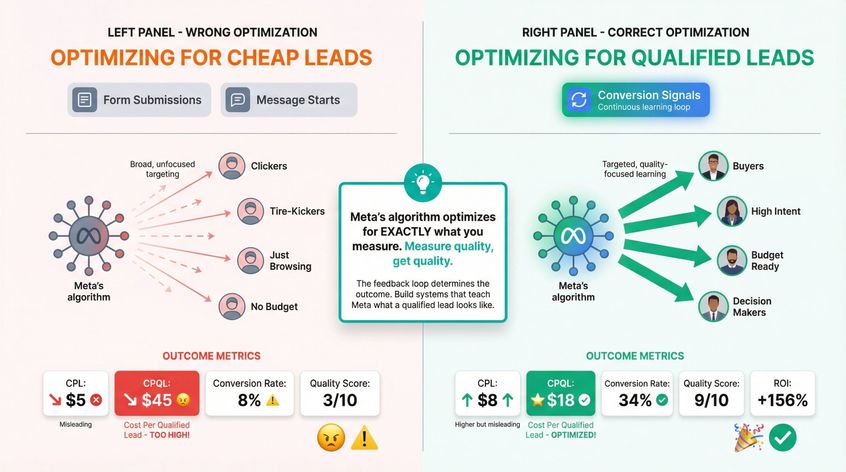
Meta's ad system is basically a prediction machine. It does two jobs:
① Find people likely to do the thing you're optimizing for
② Do it at the lowest cost it can manage
So if you optimize for:
• "Form submissions" → it will find people who submit forms
• "Message starts" → it will find people who start messages
• "Qualified leads" (if you send that signal back) → it will find people like the ones who became qualified
That's the whole game.
This is why Meta has been pushing "conversion leads" and measurement improvements. Advertisers want quality, not just volume. Research shows that advertisers using Meta's instant form conversion leads performance goal saw lower cost per qualified lead in specific comparisons.
The real tradeoff isn't friction versus intent. It's whether you're measuring and feeding back the right outcome.
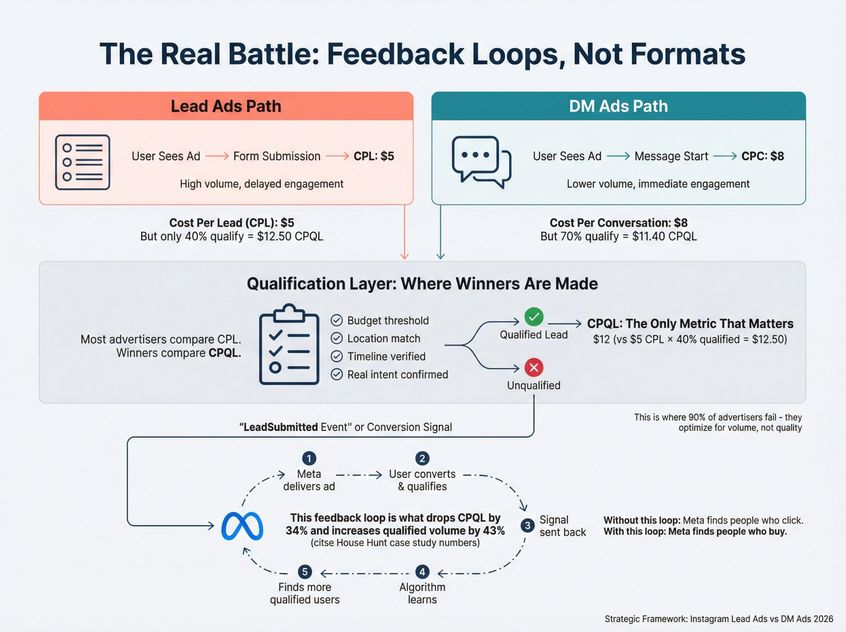
Most teams compare cost per lead (CPL) from forms versus cost per conversation start from DMs. But the correct comparison is almost always cost per qualified lead (CPQL). Where "qualified" is your definition based on:
• Budget above threshold
• Serviceable location
• Timeline within 30 days
• Real intent (not "just browsing")
• Has verified phone/email
How to Optimize for Qualified Leads, Not Just Leads
House Hunt, a real estate business, was running Instagram DM ads and initially optimized for "conversation starts." They were paying for lots of chats, but many leads weren't serious. When they switched to optimizing for a conversion goal and started sending a "LeadSubmitted" event back to Meta after qualifying leads in the chat, their cost per qualified lead dropped from ₹150 to ₹98 with qualified volume rising from 840 to 1,200 leads.
Even if you ignore the specific numbers, the structure of the improvement is what matters:
→ Wrong optimization event = cheap activity, low outcomes
→ Correct optimization signal = better outcomes at lower cost
The businesses that win are the ones that build this feedback loop. They qualify leads (whether in a form or a chat), define what "qualified" means, and send that signal back to Meta so the algorithm learns what good looks like.
When to Use Instagram Lead Ads
Let's make this practical. When to use each format based on your funnel physics.
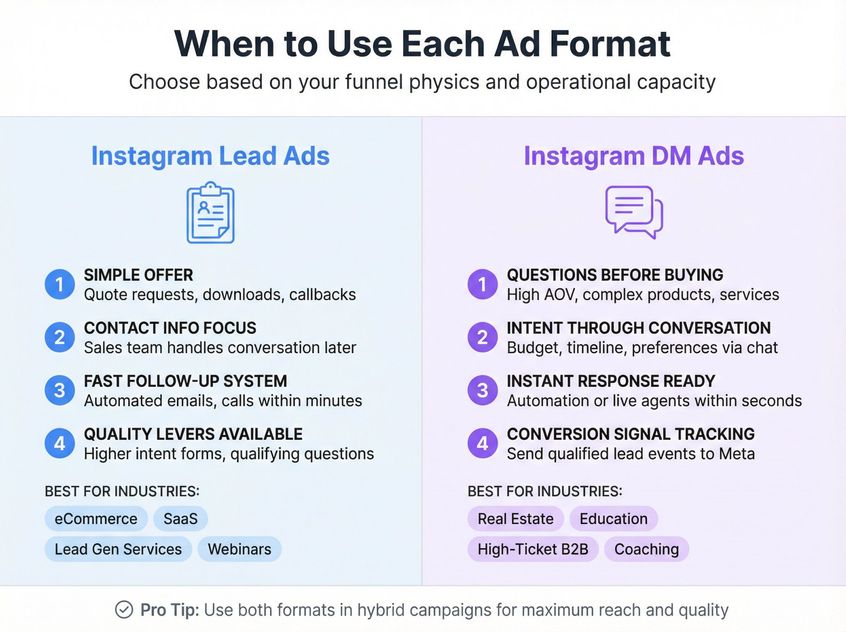
Use Instagram Lead Ads When These Are True
① Your offer is simple enough to decide later
Examples: quote request, catalog download, callback request, "book a free consultation." If the user doesn't need to ask questions before signing up, a form works great.
② You mainly need contact info, not a conversation
If the next step is a call anyway, forms often win. You get their details, then your sales team calls them to have the conversation.
③ You can follow up fast, reliably
If you take 6 hours to call leads, your real problem isn't the ad format. It's your follow-up speed. But if you have systems in place for rapid response (automated emails, WhatsApp messages, immediate calls), Lead Ads can feed that machine efficiently.
④ You can improve quality with one of these levers:
• "Higher intent" form type (adds review step for users to confirm details)
• Conditional logic or qualifying questions in the form
• "Maximize number of conversion leads" performance goal once your measurement loop is ready
Use Instagram DM Ads When These Are True
① Your customers always ask questions before buying
D2C high average order value (AOV) products, services, real estate, education admissions. Any business where the sale depends on answering "What about...?" questions.
② "Intent" is hard to infer from a form, but easy in a chat
Example: budget, location, timeframe, preference. A conversation lets you qualify on the spot instead of guessing from form data.
③ You can respond instantly (or automate the first 30 to 90 seconds)
Speed matters more in DMs because the user is literally waiting. If you can't guarantee fast response through automation or live agents, DM ads will underperform.
④ You can send back a qualified signal to Meta
Otherwise you're optimizing for "people who like messaging," not "people who buy." Spur's LeadSubmitted conversion signal after qualification is explicitly designed for this purpose.
Should You Use Both Lead Ads and DM Ads?
Not everyone wants the same experience. Some users prefer a form, others prefer chat. Meta's own lead gen materials describe testing combinations like instant forms versus instant forms with ads that click to Messenger or Instagram Direct.
In fact, advertisers who used instant forms combined with messaging saw 48% more leads captured with an 8% lower cost per lead compared to using forms alone. This hybrid approach lets the user pick their preferred method. Some will happily submit a form. Others need a conversation. You get both without forcing a single flow.
Which Ad Format Works Best by Industry?
D2C Ecommerce (Mid AOV):
Cold audiences can work with either format depending on whether questions are common. Retargeting tends to work better with DM ads because the user already has context. DM ads win when size, shade, compatibility, delivery time, or return policy questions are typical.
Real Estate and Rentals:
DM ads often win because qualification is everything: location, budget, move-in timeline, buyer versus renter. House Hunt's example shows how a strict qualification flow in DMs and optimization toward qualified-lead signals improved cost per qualified lead significantly.
Education and Admissions:
Lead ads can work well if you ask for course interest, graduation year, and city in the form, then follow up instantly. But DM ads can win if prospects need conversations about "Which program?", "What score?", or "Can I pay in installments?"
High-Ticket Services (Agency, Coaching, Clinics):
Lead ads can win if your funnel is form submit → appointment booked → sale. DM ads can win if the sale depends on answering objections fast or if you want to filter out low-budget leads before booking calls.
How to Set Up Instagram Lead Ads That Convert
If you're going with Lead Ads, make them work.
Choose the Right Form Type (This Is Your Friction Dial)
Most platforms give you at least:
• "More volume": Best for scale, worst for quality if you ask weak questions
• "Higher intent": Adds confirmation step; slightly more friction, typically better data quality
• "Rich creative": More context and content inside the form (use it to pre-sell and pre-qualify)
Rule of thumb: If your sales team says "these leads are junk," your first move usually isn't changing targeting. It's increasing friction slightly and improving qualification.
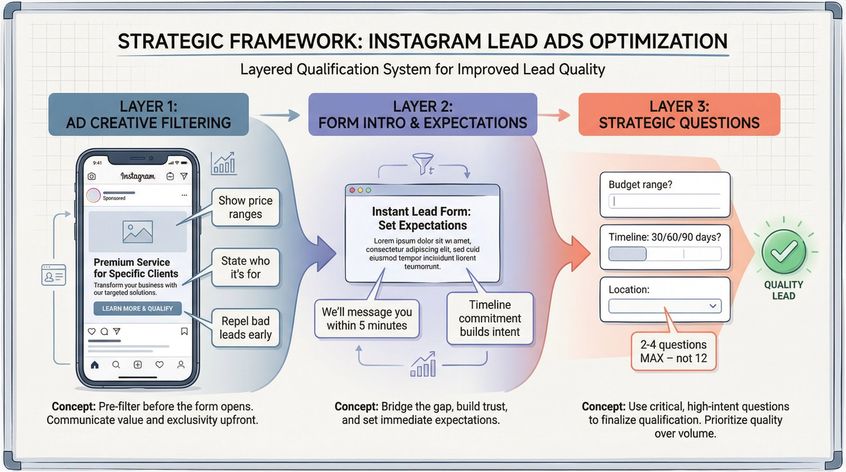
Put Your Qualification Where It Matters
You have three places to qualify:
① In the ad creative (best place):
Show price ranges, who it's for, who it's not for. Good creatives repel bad leads. If you're selling premium products, say so in the ad. If you only serve certain locations, mention it.
② In the form intro:
Set expectations. "We'll message you within 5 minutes" or "We'll call you tomorrow." This filters out people who aren't ready for that interaction.
③ In the questions:
Avoid 12 questions. Ask 2 to 4 that separate buyers from browsers. Examples: "What's your budget range?" or "When are you looking to move?" Make questions auto-populate whenever possible to reduce friction while still qualifying.
Upgrade to "Conversion Leads" When You're Ready
A lot of teams get stuck at "Maximize number of leads" and never graduate. Meta's ecosystem talks about using the performance goal "Maximize number of conversion leads" for lead quality, paired with data integrations (CRM plus Conversions API).
Conversion leads use CRM feedback to teach Meta what high-quality leads look like. This usually requires Conversions API setup, but the payoff is significant.
How to Fix Slow Lead Follow-Up
This is brutal but true. If your follow-up is slow, Lead Ads will look "bad" because the lead goes cold before you contact them.
One pragmatic solution is to pipe form leads into a messaging channel fast. Spur publishes a step-by-step workflow showing Facebook Lead Ads triggering WhatsApp messages via Zapier, turning "form submit" into "instant follow-up."
Even if you're using email, automate an immediate response ("Thanks for your interest, here's more info while we prepare a custom quote...") and have your team reach out personally within a few hours at most.
Integrate with CRM and Marketing Tools
Use Meta's integrations or tools like Zapier to automatically send lead data where you need it (CRM, email platform). This avoids leads falling through the cracks and enables instant nurturing. It also helps track downstream conversion of those leads in your system.
Monitor Lead Quality and Adjust
Keep an eye on how many of your form leads turn into actual customers or at least meaningful conversations. If you find lots of junk leads, you may need to refine your ad targeting, add a qualifying question, or try the messaging approach.
How to Set Up Instagram DM Ads That Qualify Leads
If you're going with DM Ads, do it right.
Set Up an Automated Welcome
Take advantage of Instagram's Message Template feature when creating the ad. Craft a greeting message that aligns with your campaign ("Hi there! Interested in our product? Let us know what caught your eye.") and consider adding a few quick-reply buttons for common questions. For example, provide FAQs like "Pricing", "See Examples", or "Talk to an agent".
This lowers the barrier for the user to respond. They can just tap a button to get started. Having this structured prompt can improve the rate of conversation starts because it gives the user an idea of what to say or ask.
Your First Message Is Not "Hi". It Is the Funnel.
Most DM ads fail because the flow starts like this:
→ User: "Hi"
→ Brand: replies hours later with "How can I help?"
That's dead on arrival.
Instead, treat message #1 like a landing page headline:
• Continue the promise from the ad
• Give 2 to 3 quick-reply buttons
• Ask one easy question first, not the most personal one
Spur's Click-to-DM setup guide emphasizes instant welcome messages, then qualifying questions, then branching based on replies.
Leverage Chatbots or AI for Scale
If you expect more than a handful of DMs, deploy a chatbot or an AI agent to handle the initial interactions. The bot can greet the user, ask qualifying questions ("Can I get your email in case we disconnect?" or "What are you looking for today?"), and even answer simple queries.
This ensures every user gets an instant response 24/7. Over 60% of companies using chatbots use them to qualify leads and categorize them. It's a proven tactic to manage large volumes of inquiries without sacrificing quality.
The bot can tag or route the conversation to a human agent once it's ready (for example, user has serious buying intent or asks something complex). Platforms like Spur are capable of Instagram automation and can integrate with your CRM as well.
Qualify Inside the Chat, Then Fire the "Lead" Event
This is the central advantage of DM ads. You can decide what a lead means before you count it.
Spur's "Send Meta Conversion API Event Action" describes sending a LeadSubmitted event after qualifying answers (example: budget threshold met), to tell Meta what high-quality looks like.
House Hunt's case study explicitly describes qualifying in DMs, sending LeadSubmitted events, then switching optimization toward leads (after accumulating signals).
Be Extremely Responsive if Handling Manually
If you're handling DMs manually, treat incoming ad DMs like a ringing phone. Answer it immediately. Instagram will show an "Ad" label or thumbnail in the conversation, so you know that message came from your ad promotion.
Prioritize those in your inbox. Aim to reply within a couple of minutes at most. The faster and more helpfully you reply, the higher the chance of converting that person. If you can't commit to near-instant responses during campaign hours, use an autoresponder ("Thanks for reaching out! We'll be with you in a few minutes...") at minimum.
Understand Learning and Signal Volume
Spur's help center notes Meta often needs around 50 conversion signals before it can optimize well for a new objective. Let campaigns learn before judging performance.
Treat "50" as a practical heuristic, not a law of physics. The point is: don't panic if early results are mixed. The algorithm needs data.
Watch for Region Restrictions
Spur notes EU or Japan pages may face Conversions API restrictions tied to regional rules, and you may see "Messaging Event Within Restricted Region" errors. If you operate internationally, treat this as a launch checklist item.
Feed the Outcome Back to Meta
This is a pro tip for maximizing DM ad performance. If you have the capability (through a tool or developer), use the Conversions API or Offline Events to send a custom event to Meta for when a DM lead converts or is qualified.
For example, after your chatbot marks someone as qualified (they answered all questions), you fire a "Lead (Qualified)" event. Then you can optimize your campaign for that event instead of generic message clicks. As noted, doing this helped Meta start "hunting for buyers, not chatters" and significantly lowered cost per true lead.
How Spur Solves the Hard Parts of DM Lead Generation
The reality is this. The operational challenge of DM ads isn't running the campaign. It's responding to dozens or hundreds of incoming messages fast enough to convert them, while also qualifying each lead so you're not wasting time on tire-kickers.
Most businesses hit a wall. They can handle 10 DMs a day manually. But when the campaign scales to 100 or 500 incoming chats, they either hire an army of support agents or they watch leads slip away because response times balloon to hours.
This is where we built Spur to solve the exact problem holding back DM ad campaigns.
AI Agents for Automatic Qualification
Spur's AI agents are trained on your knowledge base. Not generic FAQ bots that give canned responses. Actionable AI that can answer product questions, qualify budget and timeline, collect email and phone, and even take actions like tracking orders or booking meetings.
When someone messages you from a DM ad, our AI agent greets them instantly, asks the right qualifying questions, and determines if they're a serious lead or just browsing. You set the qualification criteria (budget above $X, location in serviceable area, timeline within 30 days). The AI handles it automatically.
Knowledge Base Training (Our Competitive Advantage)
Unlike tools that just automate messages, Spur lets you train the AI on your own data. Upload your product catalog, pricing, FAQs, policies. The AI learns your business and can answer specific questions accurately.
This is the difference between a bot that says "Let me connect you with a human" for every question, and an AI that actually helps the prospect make a decision. Many prospects will qualify themselves and convert without ever needing a human agent.
Conversion API Integration for Meta Feedback
This is where we close the loop. After our AI qualifies a lead (they meet your criteria), Spur automatically sends a LeadSubmitted event back to Meta via Conversions API.
This teaches Meta's algorithm what a qualified lead looks like for your business. Over time, the ad delivery shifts to find more people like the ones who qualified, and fewer people who just wanted to chat. Your cost per qualified lead drops while volume of good leads increases.
This is exactly what happened with House Hunt. They were running DM ads but optimizing for conversation starts. Lots of chats, weak pipeline. When they switched to Spur's qualification flow with LeadSubmitted events, their cost per qualified lead dropped 34% (from ₹150 to ₹98) and qualified lead volume jumped 43% (from 840 to 1,200 leads).
Multi-Channel Unified Inbox
Spur doesn't just handle Instagram DMs. We're a multi-channel platform built for WhatsApp Business API, Instagram DM automation, Facebook automation, and website live chat. All in one unified inbox with shared team access.
This matters because your leads don't live in just one channel. A prospect might see your Instagram ad, message you there, then later reach out on WhatsApp. With Spur, you have the full conversation history and context across channels. Your team doesn't waste time asking "Have we talked before?"
Why This Matters for Lead Ads Too
Even if you're running Lead Ads, not DM ads, Spur can help. Remember that fast follow-up is critical for lead form submissions. Our WhatsApp automation can catch form submissions via Zapier and instantly message the lead on WhatsApp with next steps, qualifying questions, or a link to book a call.
Spur integrates seamlessly with Shopify and other e-commerce platforms, bringing the same instant qualification and automation to your existing tech stack.
This turns your delayed Lead Ads funnel into an instant-engagement funnel. Form submit at 3pm, WhatsApp message at 3:01pm. Lead is still hot, and you've moved them into a conversational channel where you can qualify and close.
The businesses winning with Instagram ads in 2026 aren't just running better campaigns. They're building better operational infrastructure. Spur is that infrastructure.
3 Common Mistakes (And How to Fix Them)
Let's talk about the three failure modes we see all the time, and the specific fixes that work.
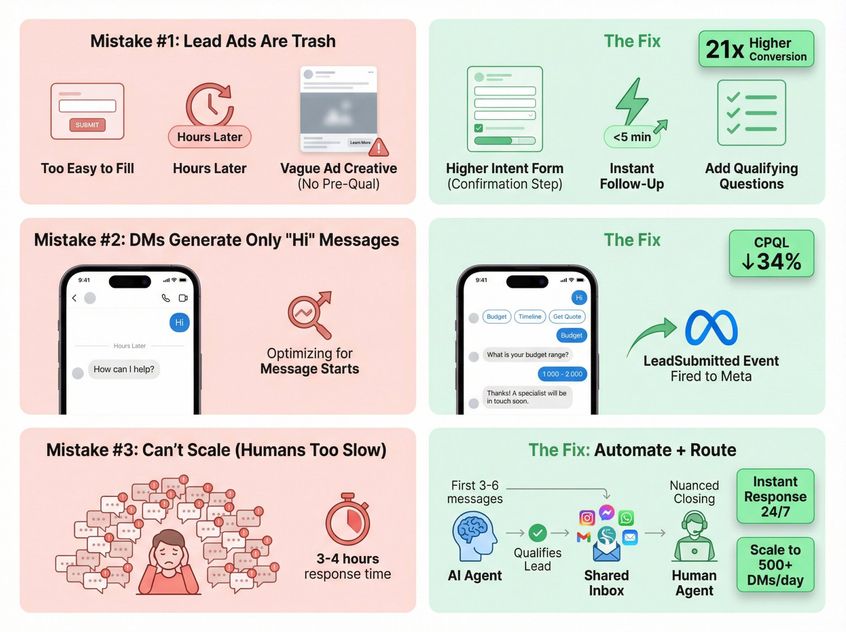
Mistake 1: "Lead Ads Are Trash"
Usually means:
• Form too easy (no qualifying questions)
• Not enough pre-qualification in ad creative
• Slow follow-up (waiting hours or days)
Fix:
• Switch to "Higher intent" form type (adds confirmation step)
• Add 1 to 2 disqualifying questions ("What's your budget range?")
• Automate follow-up within minutes (WhatsApp, email, call)
If your sales team complains that leads are unresponsive, the problem usually isn't targeting. It's that you're making it too easy to submit, and then taking too long to follow up.
Mistake 2: "DM Ads Generate Only 'Hi' Messages"
Usually means:
• The ad promise is vague
• Your first reply is slow or generic ("How can I help you?")
• You're optimizing for conversation starts, not qualified events
Fix:
• Make message #1 a flow, not a greeting (give quick-reply buttons, ask a qualifying question)
• Qualify fast, then fire a qualified signal back to Meta
• Set up automation so first response is instant
Don't optimize for "people who like chatting." Optimize for "people who answer qualifying questions and meet your criteria."
Mistake 3: "We Can't Scale Because Humans Can't Reply Fast"
Fix:
• Automate the first 3 to 6 messages (greeting, qualifying questions, basic FAQs)
• Hand off to humans only when qualified or confused
• Centralize in a shared inbox like Spur
That's literally the core "conversational acquisition" stack. AI handles the repetitive qualification. Humans handle the nuanced closing.
How to Set Up Your First Campaign (Step-by-Step)
A production-ready launch plan you can copy for your team.
All Instagram ad campaigns, whether Lead Ads or DM Ads, are created and managed through Meta Ads Manager. The interface shown above is where you'll configure targeting, budgets, creative, and optimization goals for your campaigns.
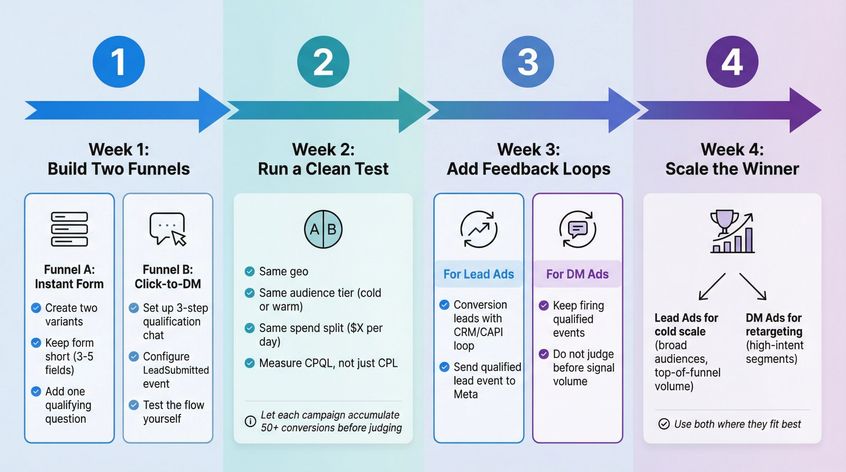
Week 1: Build Two Funnels
Funnel A: Instant Form
• Create two variants: "More volume" versus "Higher intent"
• Keep the form short (3 to 5 fields maximum)
• Add one qualifying question (budget, timeline, or location)
Funnel B: Click-to-DM
• Set up 3-step qualification chat (greeting → qualify → collect contact)
• Configure to send LeadSubmitted on qualification
• Test the flow yourself to ensure it works smoothly
Week 2: Run a Clean Test
• Same geo
• Same audience tier (cold or warm, but keep it consistent)
• Same spend split ($X per day for each funnel)
• Measure cost per qualified lead (CPQL), not just cost per lead (CPL)
Don't judge too quickly. Let each campaign accumulate at least 50+ conversions (form submits or qualified leads) before making decisions.
Week 3: Add Feedback Loops
For Lead Ads:
Conversion leads with CRM/CAPI loop if possible. Send a "qualified lead" event back to Meta when a form submission turns into a sales opportunity.
For DM Ads:
Keep firing qualified events. Do not judge before you have signal volume. Meta needs data to learn.
Week 4: Scale the Winner and Keep the Other for Retargeting
Most accounts end here:
• Lead Ads for cold scale (broad audiences, building top-of-funnel volume)
• DM Ads for retargeting and high-intent segments (people who visited your site, engaged with content, or abandoned cart)
You don't have to choose just one format forever. Use both where they fit best.
Frequently Asked Questions
Can I use both Lead Ads and DM Ads in the same campaign?
Yes, and Meta actually offers a hybrid format called "Lead Ads that Click to Message." This lets the algorithm decide on the fly whether to show a user an instant form or open a chat, based on what might convert them best. Advertisers using this combined approach saw 48% more leads at 8% lower cost per lead.
You can also run them as separate campaigns. Use Lead Ads for broad cold traffic to fill your funnel, then retarget form submitters with DM ads offering personalized help.
How fast do I really need to respond to DMs from ads?
As fast as possible. Businesses that respond within 5 minutes convert leads 21 times more than those that wait an hour or more. And 35% of users expect a reply within an hour on social media.
If you can't guarantee human response that fast, use automation. A chatbot greeting the user instantly is far better than a human replying 3 hours later.
What's the actual difference in cost per lead between the two formats?
It varies wildly by industry and setup. Generally, Lead Ads will show a lower raw cost per lead (say, $5 versus $8 for a DM conversation start). But when you measure cost per qualified lead, DM ads often win because you're filtering for intent in the conversation.
One case study showed cost per qualified lead dropping 34% with DM ads after proper optimization. The key is tracking the right metric.
Do I need special tools to run DM ads effectively?
Not technically. You can handle DMs manually through Instagram's native inbox or Meta Business Suite. But if you're running any meaningful volume (50+ DMs per week), you'll want automation.
Tools like Spur let you set up chatbots for instant response, qualify leads automatically, integrate with your CRM, and send conversion events back to Meta. Without automation, DM ads don't scale.
Can I use Lead Ads or DM Ads for B2B?
Absolutely. B2B typically works well with DM ads because the sale often requires a conversation. You can qualify on company size, role, budget, and timeline right in the chat.
Lead Ads can work for B2B if you're just capturing contact info for a sales call. But expect to do qualification on the phone, not in the form.
What happens if someone messages me from a DM ad but I don't reply?
You have a 24-hour messaging window to respond freely after someone initiates a conversation from an ad. After that, you can only send follow-ups using approved message tags or if they re-engage.
So it's critical to respond within that first day. If a lead goes quiet, send a quick reminder within 24 hours ("Hi, just checking if you had any other questions!"). If you collected their email or phone in the chat, you can also follow up there.
How do I know if my leads are "qualified"?
You define what qualified means for your business. Common criteria:
• Budget above your minimum
• Located in your serviceable area
• Timeline for purchase within a reasonable window (30 to 90 days)
• Specific need that matches your offering
• Provided verified contact info
In a DM conversation, you can ask these questions directly and get answers in real time. In a form, you might add one or two qualifying questions, then do deeper qualification on the follow-up call.
Can I run Instagram DM ads if I don't have a chatbot?
Yes, but it's harder to scale. You'll need a human monitoring the inbox and responding quickly. This works fine if you're testing with small budgets (say, 10 to 20 conversations per day).
But if the campaign succeeds and you're getting 100+ DMs per day, manual response becomes unsustainable. That's when automation becomes necessary.
What's the best way to measure ROI on these campaigns?
Track the full funnel:
For Lead Ads: form submits → contacted → qualified → opportunity → sale
For DM Ads: conversation starts → qualified in chat → opportunity → sale
Calculate cost per stage. Don't just look at cost per lead. Look at cost per sale or cost per customer acquired.
Also track time-to-conversion. DM ads often close faster because the conversation happens immediately. Lead Ads might have lower CPL but longer sales cycles.
Do these strategies work for small budgets?
Yes. You can start with as little as $10 to $20 per day per campaign. The key is tracking the right metrics from day one.
Even with small budgets, focus on cost per qualified lead, not vanity metrics. And be patient. Meta needs time and data to optimize. Don't kill a campaign after 3 days if it hasn't "crushed it" yet.
The Competitive Advantage Is in the Feedback Loop
The question of Lead Ads versus DM Ads isn't really a question of which format is better. Both formats work when executed properly. Both can deliver cheap leads that go nowhere if executed poorly.
The competitive advantage is in building systems that teach Meta's algorithm what a qualified lead actually looks like for your business. It's in responding fast enough that interest doesn't cool. And it's in qualifying leads before you waste sales team time on tire-kickers.
Lead Ads are perfect for frictionless contact collection when you have a solid nurture system and fast follow-up. They fill the top of your funnel efficiently. DM Ads turn lead generation into an immediate conversation, shining when lead quality and rapid conversion matter more than sheer volume.
The smartest approach? Use both. Lead Ads for cold scale. DM Ads for retargeting and high-intent segments. And build the operational infrastructure (automation, qualification, conversion tracking) that makes either format work.
If you're ready to stop paying for leads that don't convert and start building a qualification system that actually teaches Meta what "good" looks like, Spur's Click-to-Instagram Direct solution is built exactly for this. We handle the instant response, the AI qualification, and the conversion signal feedback loop that turns DM ads into your most profitable channel.
The leads are out there. The question is whether you're optimized to find the ones that actually buy.