What Does ChatGPT Stand For? Complete Meaning & Explanation

Discuss with AI
Get instant insights and ask questions about this topic with AI assistants.
💡 Pro tip: All options include context about this blog post. Feel free to modify the prompt to ask more specific questions!
TL;DR: ChatGPT stands for "Chat Generative Pre-trained Transformer." It's OpenAI's conversational AI that combines a chat interface with GPT technology (a large language model trained on massive text data using transformer architecture). This powerful combination lets it understand context and generate human-like responses. At Spur, we help businesses deploy similar AI agents for customer support across WhatsApp, Instagram, Facebook Messenger, and live chat. Unlike basic Q&A bots, our actionable AI agents can track orders, book appointments, and handle real business tasks while maintaining natural conversations.
ChatGPT is actually two parts: Chat + GPT. The "Chat" part is straightforward. It indicates that you interact with the AI through conversation, just like messaging a knowledgeable friend. It's essentially an AI chatbot designed for dialogue.
The "GPT" part is where things get interesting. GPT stands for Generative Pre-trained Transformer, and each word reveals something important about how the technology works:
Generative: It can generate new content rather than just retrieving static answers. ChatGPT doesn't rely on a fixed database of responses. It creates answers on the fly.
Ask it to write a poem or explain quantum physics, and it will generate a unique response for you. This generative ability is why ChatGPT can produce everything from essays and code to creative stories.
Pre-trained: The model has been pre-trained on vast amounts of data before you ever start using it. OpenAI fed GPT models huge datasets of text (books, articles, websites) so it could learn patterns of language, facts, and reasoning.
"Pre-trained" means it has already learned from this massive text corpus in advance. When you ask ChatGPT a question, you're leveraging all that prior learning. This pre-training is what gives ChatGPT its broad knowledge and ability to respond on all sorts of topics.
Transformer: This refers to the Transformer neural network architecture, a groundbreaking AI model design that is the core of GPT. The Transformer was introduced by Google researchers in 2017 in a paper titled "Attention Is All You Need." It uses a mechanism called "self-attention" that allows the model to weigh the importance of different words in a sequence, rather than reading text strictly left to right like older models.
In practice, this means the Transformer can understand context extremely well. If you ask "What's the weather like in Paris? Can I walk around, or will it rain?", the Transformer architecture helps the model grasp that "it" refers to the weather, and ties together the context about Paris and rain.
As Duke University professor Jiaming Xu puts it, "Transformer emulates how humans process language, by focusing on the most relevant information". This architecture is highly efficient at language tasks, enabling GPT models to consider an entire sentence or paragraph at once and figure out relationships between words. The Transformer design is why GPT is so powerful at understanding and generating coherent text.
So, ChatGPT equals a chat-based AI system built on a Generative Pre-Trained Transformer model. In plainer language, it's a chatbot powered by a large language model that was trained on tons of text and uses an advanced neural network (the Transformer) to generate its answers.
ChatGPT was created by OpenAI, an artificial intelligence research company. OpenAI introduced ChatGPT to the public on November 30, 2022 as a prototype conversational AI. They chose the name to highlight that this is a GPT-based AI you can chat with.
Prior to ChatGPT's debut, OpenAI had developed a series of GPT models (GPT-1 in 2018, GPT-2 in 2019, GPT-3 in 2020, etc.) which were impressive but mainly accessible through APIs or research demos. Those were powerful engines, but not user-friendly chatbots.
OpenAI's breakthrough idea was to fine-tune their latest model (GPT-3.5 at the time) to behave in a conversational manner and deploy it in a simple chat interface that anyone could use. Thus, ChatGPT (the conversational GPT) was born.
The name signals exactly what it is: a GPT-based AI tuned for chatting. According to OpenAI, "We've trained a model called ChatGPT which interacts in a conversational way. The dialogue format makes it possible for ChatGPT to answer follow-up questions, admit its mistakes, challenge incorrect premises, and reject inappropriate requests."
In other words, ChatGPT was designed for dialogue. It can remember what you asked earlier in the conversation, clarify ambiguities, and handle instructions or corrections you give. All key elements of a natural chat experience.
It's worth noting that GPT itself (the technology) is used in other ways too. For instance, it powers various apps through the OpenAI API and runs coding assistants like GitHub Copilot. But "ChatGPT" refers specifically to this chat-based implementation that OpenAI made widely available. The name helps distinguish it from just the raw model. Think of GPT as the engine, and ChatGPT as the approachable product built around that engine, with guardrails and a user-friendly interface.
Now that we know ChatGPT equals Chat + GPT (Generative Pre-trained Transformer), let's unpack the GPT side a bit more. Understanding what a Generative Pre-trained Transformer is will clarify why ChatGPT is so capable.
GPT is what's known as a large language model (LLM), essentially a giant neural network trained on text. The GPT family of models are among the most advanced LLMs. GPT models were pioneered by OpenAI, which introduced the first GPT in 2018. Each subsequent version (GPT-2, GPT-3, GPT-4, GPT-5) grew in size and ability.
These models have billions (and now trillions) of parameters. Think of parameters as internal settings or "knowledge connections" the model learned during training.
Unlike a simple chatbot that might be scripted, GPT is generative. It doesn't just choose a canned response from a database. Instead, it creates new sentences word by word by predicting what is the most appropriate or likely next word, given the context of the conversation and its training data.
This is why ChatGPT can invent a reply it's never given before. Ask it to write a short story about a dancing avocado, and it can! The model is essentially a very sophisticated predictor of text, capable of dreaming up original outputs (some serious, some funny, some astonishingly detailed). This generative nature is why ChatGPT can answer open-ended questions or produce code snippets that weren't pre-written anywhere.
GPT models undergo two main stages: first pre-training on a broad dataset, then often a fine-tuning for specific tasks. In the pre-training phase, the model ingests enormous amounts of text from the internet (books, Wikipedia, articles, websites, forums, etc.). OpenAI hasn't released the full list, but it's trillions of words.
The model learns language patterns, facts, and some reasoning abilities from this data by essentially playing the world's largest fill-in-the-blank game. It tries to predict missing words in sentences and in doing so, it gradually gets very good at understanding context and generating logical continuations. By the end of pre-training, GPT has formed a general statistical understanding of how language is used.
Crucially, this training is unsupervised (it learns from raw text without human labeling each example). The outcome is a model that knows a lot about many topics (from history to coding to chemistry) just from reading, though it doesn't truly understand like a human. OpenAI was the first to show that this generative pre-training approach on a Transformer architecture yields powerful results.
The Transformer is the neural network design that made GPT possible. Prior to 2017, AI language models often used recurrent neural networks (RNNs) or LSTMs, which processed words sequentially and struggled with long-range dependencies (like remembering context from far back in a paragraph).
The Transformer introduced a mechanism called self-attention, allowing the model to consider all words in a sentence at once and decide which other words each word is most related to. This was revolutionary.
It means the model can, for example, see that in the sentence "The cat that the dog chased ran up a tree," the word "ran" relates to "cat" (not the nearer noun "dog"), because the grammar and context indicate the cat ran. The Transformer can make these connections by assigning "attention weights" between words. In essence, it builds a rich contextual understanding of the text.
This architecture scales extremely well. When you feed it more data and make it larger, it just keeps getting better. GPT-3, for instance, had 175 billion parameters and could handle very nuanced prompts and generate pages of coherent text. Transformers also enable models like GPT to handle much longer inputs and outputs (imagine keeping track of a full essay's context).
As AWS describes, GPT models "analyze natural language queries and predict the best possible response based on their understanding of language" using the Transformer design. The result is that ChatGPT can produce answers that seem astonishingly human-like and context-aware.
Combining generative capability with transformer architecture and pre-training on huge data yields a very general-purpose language tool. GPT models can be adapted to many tasks: Q&A bots, writing assistance, summarization, translation, coding help, and more.
ChatGPT itself is essentially a fine-tuned GPT model aimed at being a conversational assistant. The "GPT" inside it gives it a vast range of knowledge and the ability to compose answers on virtually any topic (at least any topic covered in its training data up to its knowledge cutoff). This is why ChatGPT can solve a math puzzle in one moment, then help brainstorm social media captions the next, then debug some code after that. Few AI systems before have had such breadth.
In summary: GPT is the powerful brain behind ChatGPT. It's generative (makes new text), pre-trained (taught on internet-scale data), and a Transformer (uses a modern neural net architecture optimized for language). This combination is what enables ChatGPT to "understand" your question and give a detailed, contextually relevant answer that often feels like it's coming from an expert or a knowledgeable friend.
As AWS puts it, "Generative Pre-trained Transformers, commonly known as GPT, are a family of neural network models that use the transformer architecture... powering generative AI applications such as ChatGPT. GPT models give applications the ability to create human-like text... and answer questions in a conversational manner."
Without GPT tech, ChatGPT wouldn't be the fluent AI we know.
When people ask "what does ChatGPT stand for," they often also wonder what exactly is ChatGPT, and how did it get to be so famous? It's worth touching on its history and rapid growth, because it's closely tied to the GPT technology in its name.
ChatGPT was released to the public as a free research preview on November 30, 2022. Within just 5 days, over 1 million users had signed up to chat with it (an unprecedented adoption rate).
Within 2 months, it reached 100 million users, making it the fastest-growing consumer application in history at that time.
Virtually overnight, "ChatGPT" became a household name. It was demoed on news programs, became the subject of countless viral social media posts, and had people from students and writers to doctors and CEOs trying it out. The reason it spread so fast is exactly because of what the name denotes: it's a chat interface (easy to use) backed by GPT (very powerful AI). That combination felt magical to many first-time users.
Suddenly, anyone with an internet connection could talk to an advanced AI about almost anything, for free. By comparison, most earlier AI models were either less capable or not as accessible to the general public.
The initial version of ChatGPT that launched in 2022 was built on GPT-3.5 (specifically, a fine-tuned model from the GPT-3 family, often called "GPT-3.5-turbo"). Even at GPT-3.5, the chatbot was already very capable, but it did have limitations. It could occasionally produce incorrect information (which users dubbed "hallucinations"), and it had a knowledge cutoff (it wasn't aware of events after 2021 in the early versions).
OpenAI didn't stop there. In March 2023, they introduced GPT-4, the next-generation model, into the ChatGPT service (available to paying subscribers of ChatGPT Plus). GPT-4 significantly boosted ChatGPT's abilities: it became far more accurate on factual queries and even passed a number of professional exams with high scores (Bar exam, medical licensing exam, etc., showing near human-level performance on many benchmarks).
GPT-4 also brought new powers: it became multimodal, meaning it could accept images as inputs (you could show it a picture or a chart and it could analyze it) and later it even gained the ability to output spoken responses with a synthetic voice. This means by late 2023, ChatGPT could "see" and "speak," not just text-chat (though those features rolled out gradually and primarily to Plus users).
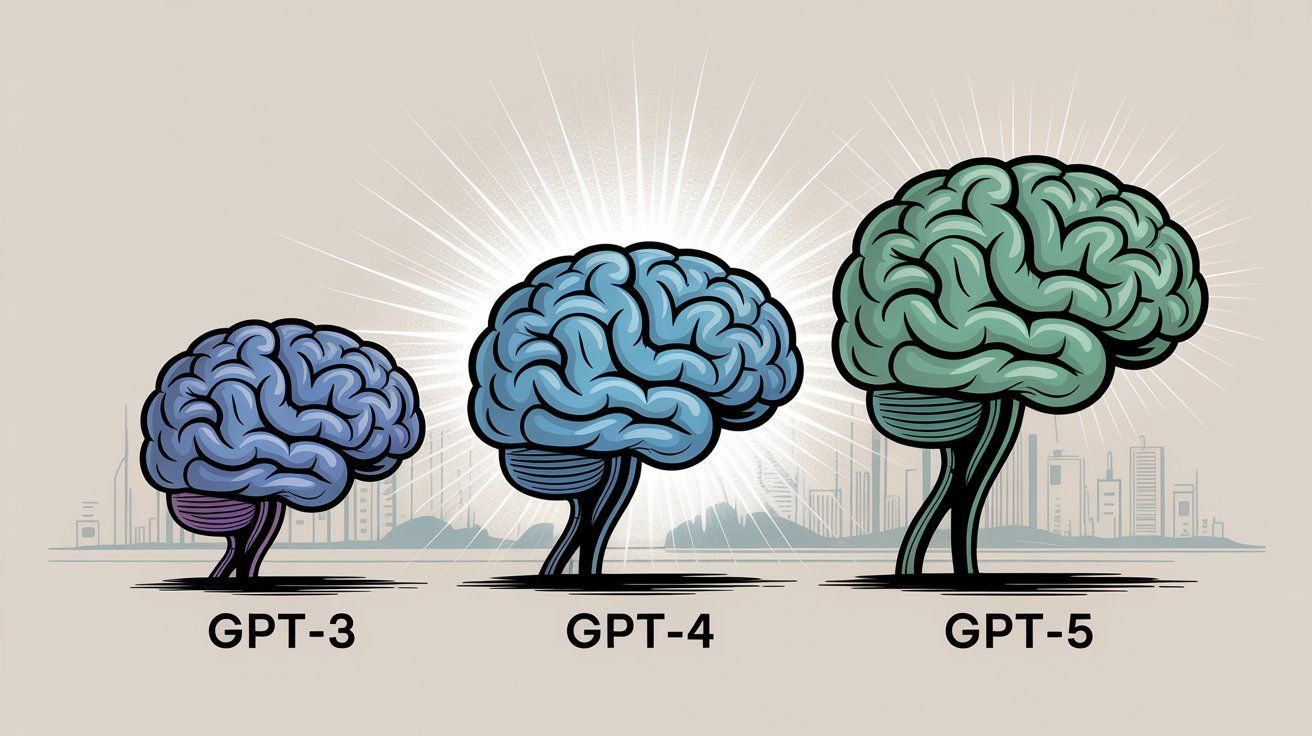
OpenAI continued to refine the GPT line, and in August 2025 they introduced GPT-5, with an upgrade to ChatGPT's capabilities. GPT-5 was described as a "unified system" that could decide when to respond quickly versus when to think longer and harder on tough questions.
Essentially, OpenAI started to build in an automatic reasoning mode: ChatGPT could switch between a fast, lightweight mode for easy queries and a slower, more "deep thinking" mode (called GPT-5 "Thinking") for complex problems. However, the initial GPT-5 release had some hiccups. Users found it sometimes slower or not as dramatically improved as expected.
In response, OpenAI pushed a further update, GPT-5.1, in November 2025, tweaking the system to be "warmer" (more conversational) and more reliable. With GPT-5.1, ChatGPT also gained the ability to adopt different personality styles in responses (OpenAI introduced seven preset "personas" users could choose from, like professional, friendly, humorous tones).
The core technology was still a Generative Pre-trained Transformer, but these refinements showed OpenAI's effort to make ChatGPT more adaptable and aligned with user needs.
As of late 2025, ChatGPT runs on GPT-5.1 for most users (free users get a basic version, while Plus/Pro subscribers can access the full power of GPT-5.1, including those advanced reasoning modes and persona options). The system is markedly more capable than it was at launch. For instance, it can handle much longer conversations or documents as input, it's better at citing sources or performing step-by-step logic, and it's less likely to go off the rails with irrelevant answers.
It's also now part of a broader ecosystem: integrations and plugins allow ChatGPT to perform tasks like browsing the web, controlling third-party apps, or executing code. All this to say, the "GPT" inside ChatGPT has been continuously evolving, and the name stands for not just one static model, but a whole family of increasingly advanced transformers that power the experience.
Fun fact: The popularity of ChatGPT has been so immense that by 2025 its web domain became one of the top 5 most-visited websites in the world, with over 800 million active weekly users interacting with the chatbot. That is a staggering level of usage (a testament to how the generative Transformer technology hit a sweet spot of usefulness for a wide audience). It's not often an acronym becomes a globally recognized brand in under a year, but ChatGPT managed it, precisely because the technology delivered something groundbreaking to everyday users.
Understanding what ChatGPT stands for isn't just a trivia point. It also hints at why ChatGPT has become so important in the tech world and beyond:
ChatGPT demonstrated the power of conversational AI on an unparalleled scale. By building on the GPT (Generative Pre-trained Transformer) foundation, it showed that AI can engage in dialogue, answer complex questions, assist with creative tasks, and even handle follow-up clarifications almost like a human would.
This has massive implications for education, customer service, content creation, programming, and many other fields. People are now using ChatGPT to draft emails, get tutoring help, brainstorm business ideas, write marketing copy, debug code, and much more. Tasks that previously might have required a human expert or a lot of time.
The "Chat" part of the name signified making GPT accessible to anyone. You don't need to be a developer or have AI expertise. Anyone can hop on chat.openai.com and start asking questions. This was a pivotal shift.
Technologies akin to GPT were in research labs for years, but ChatGPT brought it to millions of users directly. In doing so, it also generated valuable feedback that helped improve the model (OpenAI used the research preview to gather data on what ChatGPT got right or wrong, then iterated).
ChatGPT's launch kicked off or at least greatly accelerated an AI boom in 2023-2025. Its sudden success spurred almost every big tech company to pour more resources into AI. Within months, we saw competitors and complementary AI chatbots emerge.
In enterprise software, having a "GPT-powered" feature became the trend. All of this can be traced back to ChatGPT showing the world what a Generative Pre-trained Transformer can do when packaged in a chat format. As The New York Times wrote, ChatGPT (short for generative pre-trained transformer) "landed with a splash" and made AI a water-cooler topic around the globe.
The "GPT" in ChatGPT also implies this technology is not static. Just as GPT-3.5 evolved into GPT-4, GPT-5, and beyond, ChatGPT keeps improving. OpenAI uses techniques like Reinforcement Learning from Human Feedback (RLHF) to fine-tune the model (basically showing the AI which answers are better by human ranking, so it gets even more aligned with user expectations).
So when you use ChatGPT today, you're benefiting from an engine that has been refined not only by data but by human teachers as well. This mixture of pre-training on data and post-training on human feedback is part of the magic behind its often eerily good responses. It's also why sometimes ChatGPT refuses to answer certain questions or avoids harmful content. It's been trained to follow usage guidelines and ethical guardrails as part of that conversation fine-tuning.
Despite the impressive name and tech, ChatGPT is not perfect. It can still err or "hallucinate" facts, because at its core, GPT generates answers based on patterns, not a verified knowledge database. It might confidently tell you something that sounds plausible but is completely made up, especially on topics it's unsure about.
The Transformer architecture doesn't guarantee factual accuracy (it guarantees fluency). OpenAI has been working on reducing these inaccuracies (each new GPT model tends to make fewer mistakes), but they still occur. So, while ChatGPT stands for an advanced technology, users have learned to verify critical information and not treat it as infallible. The name might have "Generative Pre-trained Transformer" in it, but it doesn't include "100% Truthful"! Always use a bit of human judgment with its outputs.
While ChatGPT excels at general conversation, businesses need AI that can actually take actions. That's where actionable AI agents come in.
At Spur, we've built AI agents that go beyond simple Q&A. Our agents are trained on your specific knowledge base (your website content, FAQs, product documentation) and can handle real business tasks across WhatsApp, Instagram, Facebook Messenger, and live chat.
Traditional chatbots (including basic ChatGPT implementations) can answer questions, but they can't do anything with that information. They're reactive, not actionable.
Spur's AI agents are different:
| Traditional Chatbots | Spur's Actionable AI Agents |
|---|---|
| Answer questions from FAQ database | Answer questions + take real actions |
| "Let me connect you to a human" | Actually track orders, book appointments, update records |
| Generic responses for all businesses | Trained on YOUR specific knowledge base |
| Single channel (usually web chat) | Multi-channel (WhatsApp, Instagram, Facebook, Live Chat) |
| Reactive only | Proactive + Reactive |
Specific capabilities:
• Track Orders: Your customers ask "Where's my order?" and our AI agent connects to your e-commerce platform (Shopify, WooCommerce, or custom systems) to pull real-time order status and shipping updates.
• Book Appointments: The AI agent can access your calendar system, check availability, and book appointments without human intervention.
• Update Records: Customer changed their phone number or address? The AI agent can update your CRM directly.
• Qualify Leads: For businesses running Click-to-DM ads on Instagram or WhatsApp, our AI agents can qualify leads by asking relevant questions, collecting information like budget and timeline, and routing high-quality prospects to your sales team.
This is the difference between a chatbot that says "Let me connect you to a human" versus an AI agent that actually solves the problem.
One challenge with modern customer support is that messages come from everywhere. WhatsApp, Instagram DMs, Facebook Messenger, live chat on your website. Managing these separately is chaotic and inefficient.
Spur provides a unified inbox where all these channels flow together. Your team sees one conversation stream per customer, regardless of where they reached out. The AI agent handles routine queries across all channels automatically, while complex issues get routed to human agents seamlessly.
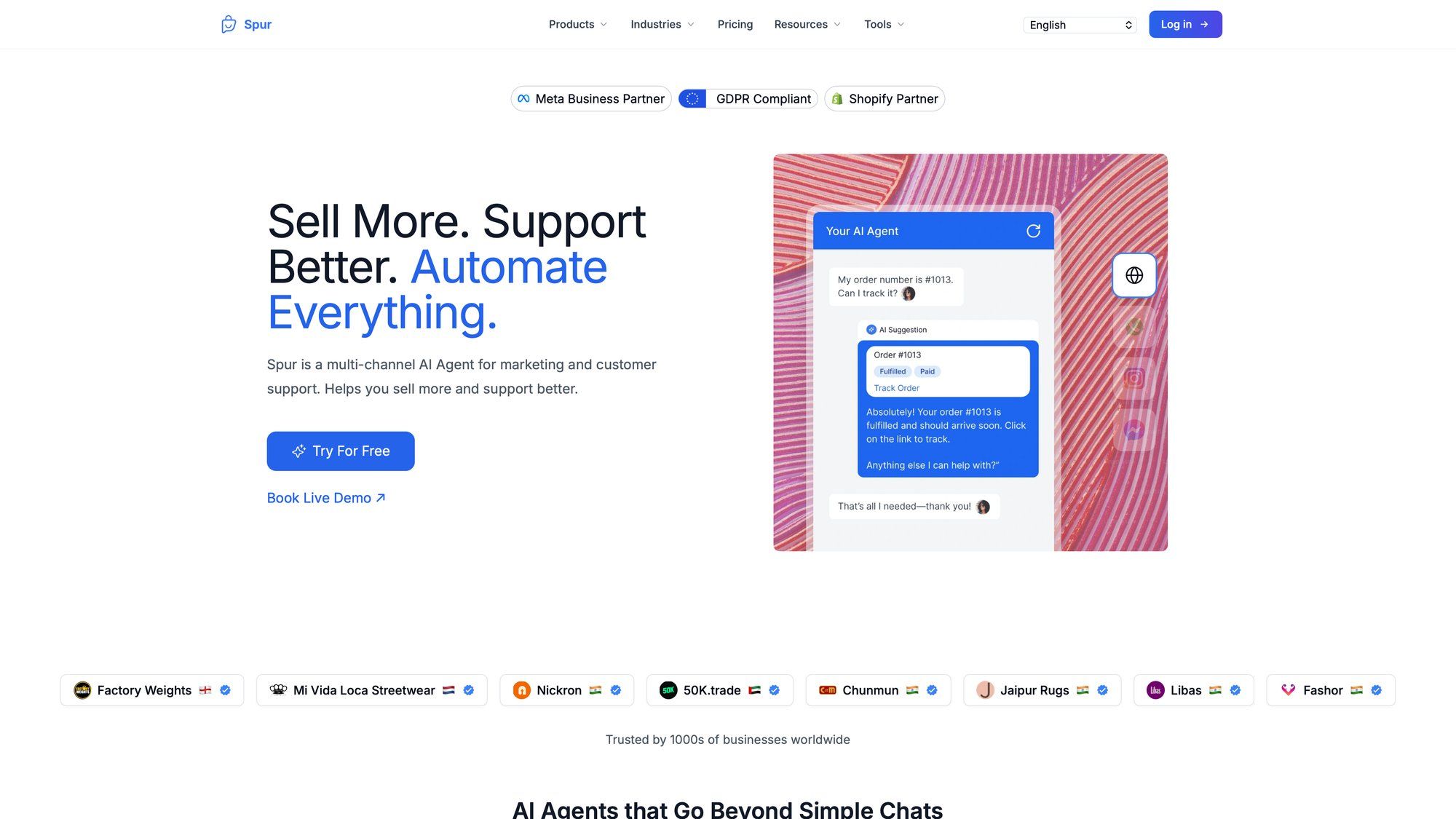
This is especially powerful for D2C brands, e-commerce businesses, real estate companies, and service businesses that need to be responsive across multiple platforms.
Unlike tools that require complex setup, Spur makes it simple to train your AI agent. Point it to your website, upload your FAQs and documentation, and the AI learns your business. You can add custom actions that connect to your backend systems, webhooks, and APIs.
This is one area where Spur stands out from competitors. Our platform combines both: powerful AI agents trained on your data, plus comprehensive customer engagement automation across all your messaging channels.
The proof is in the results. Spur customers have reported:
• 73x ROI on targeted WhatsApp broadcasts
• 88.75x ROI in 24 hours using carousel messages with DeliveryBoost
• 99% message delivery rates
• Significant reduction in support team workload as AI handles 60-80% of routine queries
Want to see how actionable AI agents could work for your business? Start your free trial at Spur and experience the difference between basic chatbots and AI that actually gets things done.
ChatGPT stands for "Chat Generative Pre-trained Transformer," succinctly capturing how it works and what it does. In just that name, we know it's about chatting (conversational Q&A, interactive dialogue) and that it's powered by GPT, a generative AI model trained on huge data using the transformer architecture.
Understanding the components of the name gives insight into why ChatGPT is so powerful: it can generate human-like text (thanks to Generative), it carries a broad base of knowledge (because it was Pre-trained on the internet's text), and it understands context and language nuances (thanks to the Transformer design).
Since its launch, ChatGPT has evolved from an intriguing demo to a ubiquitous productivity and creativity tool. It's now one of the most widely used implementations of AI in the world, and it has introduced millions of people to concepts of AI that were previously behind research lab doors. Every time you see "GPT" in the name (whether in ChatGPT or other applications), remember it's referring to that powerful engine enabling the AI to read and write like an expert.
For businesses looking to deploy similar AI technology for customer support and engagement, the key is finding solutions that go beyond basic conversation. You need AI agents that can take action, integrate with your systems, and work across the channels where your customers actually are.
At Spur, we're helping businesses transform customer support with actionable AI agents that handle WhatsApp, Instagram, Facebook Messenger, and live chat from a single unified platform. Get started with Spur today and see how AI agents trained on your knowledge base can revolutionize your customer experience.
In summary, ChatGPT's name is a nod to both its form ("chat") and its function ("GPT" technology). It's a name that has quickly become synonymous with AI's leap into everyday use. Now that you know what ChatGPT stands for, you also know why it's so remarkable. After all, few inventions live up to a $10 billion hype, but ChatGPT (and the Generative Pre-trained Transformer tech behind it) just might be one that does.
GPT stands for Generative Pre-trained Transformer. "Generative" means it creates new content, "Pre-trained" means it learned from massive datasets before you use it, and "Transformer" refers to the neural network architecture that enables it to understand context and relationships between words.
ChatGPT was developed by OpenAI, an artificial intelligence research company. They launched it publicly on November 30, 2022, as a free research preview. OpenAI continues to improve ChatGPT with newer versions of the GPT model.
GPT is the underlying technology (the large language model), while ChatGPT is the specific chat-based product that OpenAI built using GPT. Think of GPT as the engine and ChatGPT as the car. Other applications also use GPT technology (like GitHub Copilot for coding), but ChatGPT refers specifically to OpenAI's conversational AI assistant.
Yes! While ChatGPT is designed for general conversation, businesses can deploy specialized AI agents for customer support and engagement. At Spur, we offer AI agents that you can train on your own knowledge base and deploy across WhatsApp, Instagram, Facebook Messenger, and live chat. Unlike basic chatbots, our AI agents can take actions like tracking orders, booking appointments, and updating customer records.
As of late 2025, ChatGPT runs on GPT-5.1 for most users. Free users get access to a basic version, while ChatGPT Plus and Pro subscribers can access the full capabilities of GPT-5.1, including advanced reasoning modes and different personality styles.
No, ChatGPT can sometimes produce incorrect information (often called "hallucinations"). While each new version gets more accurate, the technology generates responses based on patterns it learned during training, not from a verified knowledge database. Always verify critical information, especially for professional or medical decisions.
ChatGPT experienced unprecedented growth. It reached 1 million users in just 5 days and hit 100 million users within 2 months, making it the fastest-growing consumer application in history at that time. By 2025, it has over 800 million active weekly users.
ChatGPT itself has limited integration capabilities through plugins and APIs. For businesses needing deeper integration with e-commerce platforms, CRMs, and messaging channels, specialized solutions like Spur offer more comprehensive options. We integrate with Shopify, WooCommerce, Stripe, Razorpay, and can connect to custom systems through APIs and webhooks.