

D2C fashion · WhatsApp bidding · India
Tara C Tara lifted festive WhatsApp delivery from 15% to 68% and earned 15× its messaging cost
Eligible brands can now set a max price for WhatsApp marketing messages, the most they will pay for one delivered message. Tara C Tara's festive offer was delivered to only 15% of its list with a max price below Spur's standard rate. After the max price was raised to 2× the standard rate, delivery reached 68%, and the average price paid stayed below standard.
7-day free trial.
Tara C Tara
Hand block printed ethnic wear from Jaipur, India
68%
Final delivery rate
Up from 15%
- Attributed revenue vs messaging cost
- 15×
- Orders
- 83
- More deliveries
- ~7,900
Overview
Tara C Tara's festive WhatsApp offer was delivered to only 15% of its 14,947 customers while its max price sat below Spur's standard rate. After the max price was raised to 2×, delivery reached 68%, with 83 orders and attributed revenue at 15× messaging cost, and the average price paid stayed about 7% below standard.
Ask an AI about this story
- Challenge
- A festive offer to 14,947 customers, sent with a max price below Spur's standard rate. After the broadcast and three resends, only 15% of the list had received it.
- Solution
- The same message and target audience, with the max price raised to 2× the standard rate before the next resend. Meta charges the max price or less, so the higher ceiling unlocked much more delivery while the average price paid stayed below Spur's standard rate.
- Results
- 68% of the list delivered, up from 15%
- 83 orders and ₹1.62 lakh in attributed revenue, 15× messaging cost
- Average price about 7% below the standard rate
A festive offer most of the list never received
The results show the max price was holding delivery back, though the report never said so: the failures showed up as Meta's per-user marketing limit.
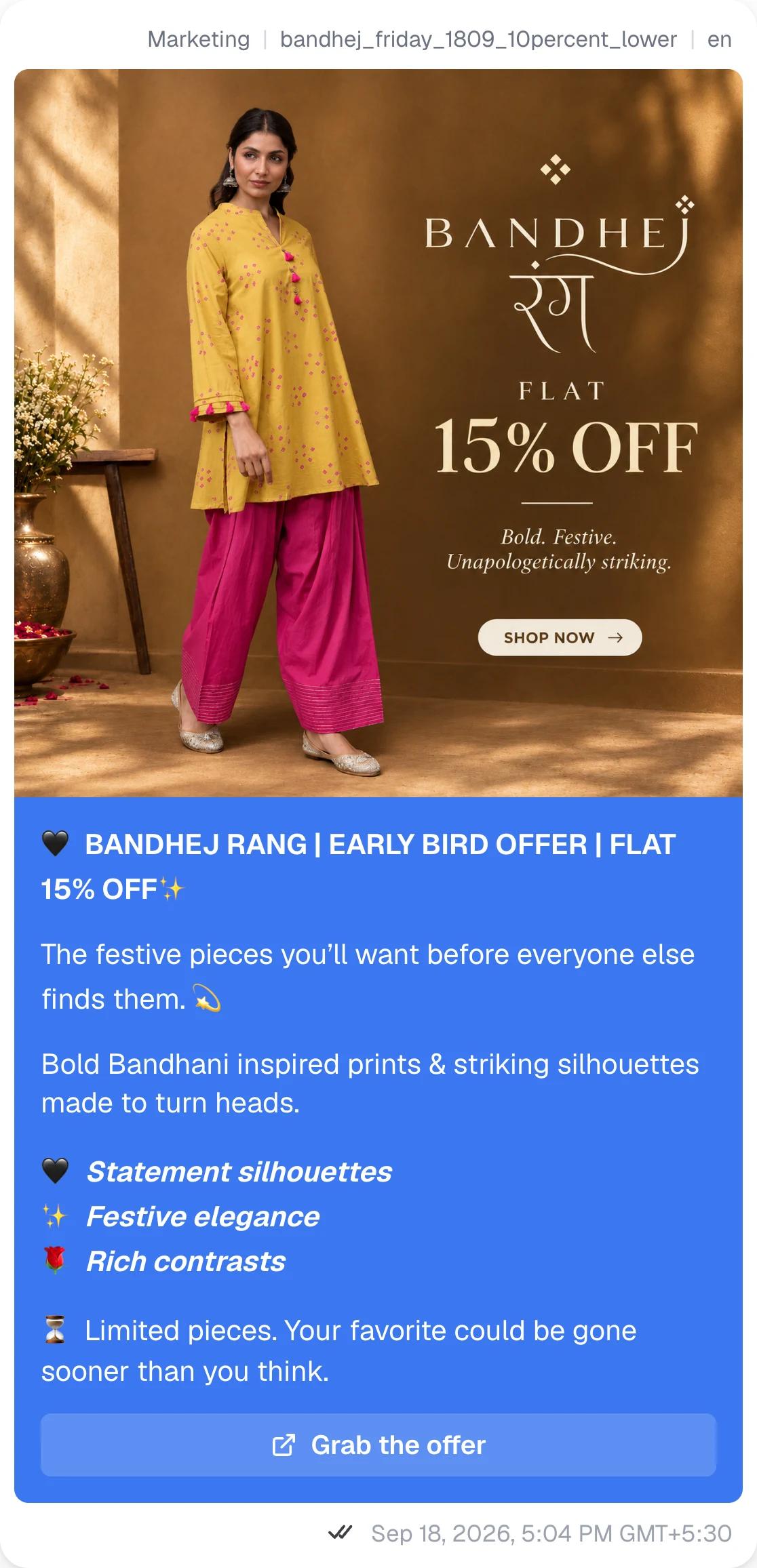
Tara C Tara's Bandhej Rang early-bird offer took a flat 15% off its Bandhani-inspired festive range. It went out as an image-led WhatsApp marketing message with a Grab the offer button.
The list was 14,947 customers in four Shopify segments: VIP buyers with three or more orders, recent first-time buyers, high-value customers who order rarely, and repeat customers who had gone quiet.
Since May 2026, Meta has been rolling out a max price for marketing messages on its Marketing Messages API for WhatsApp: the most a brand will pay for one delivered message. Meta charges that amount or less.
The max price can be at, below or above the published rate, and Meta's delivery system uses it when deciding who receives the message.
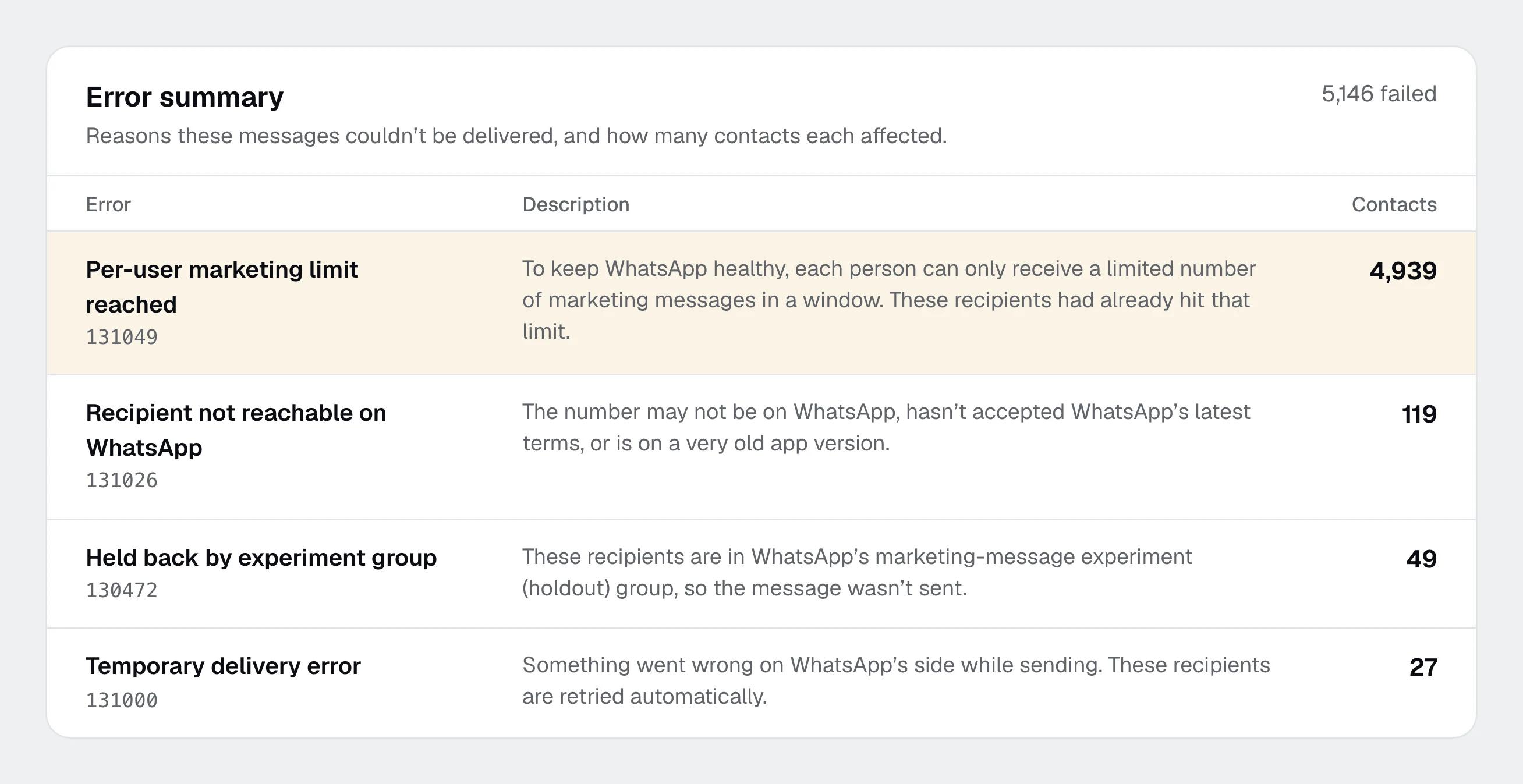
Tara C Tara's first send went out with a max price 10% below Spur's standard rate and was delivered to 1,215 customers. For most of the rest, Meta returned its per-user marketing limit error instead of delivering.
Spur's Delivery Boost resends a broadcast to exactly those people. After three resends, two at 10% below standard and one at 7% below, 2,235 customers had the offer. That is 15% of the list.
Because the failures were labelled as a per-user limit, the problem read like a list or timing issue. Delivery jumped on the first resend after the max price was raised.
Swipe sideways to read the diagram. With a keyboard, focus it and use the arrow keys.
What a max price is
The most you will pay for one delivered marketing message. Meta charges that amount or less, never more, and only for messages it delivers. Setting it higher can get the message to more people. Undelivered messages cost nothing either way.
What they changed
The max price was the only setting changed. The message, the offer and the target audience stayed the same.
-
Send below the standard rate
Broadcast and resends 1 to 3The broadcast went out with a max price 10% below Spur's standard rate and was delivered to only 1,215 people, 8% of the list. Delivery Boost resent it to the people Meta had not delivered to, twice at the same max price and once at 7% below standard. The third resend delivered to only 364 more people.
- Audience
- 14,947 customers
- Max price
- 10% below standard, then 7% below
- Delivered
- 2,235 (15%)
-
Raise the max price to 2× the standard rate
Resend 4Before the fourth resend, the max price was raised to twice the standard rate. The message, the offer and the target audience stayed the same. That one resend delivered to about 3,500 people, nearly ten times the resend before it and more than all the earlier sends together.
- Max price
- 2× standard
- Delivered
- About 3,500 people in one resend
-
Let Delivery Boost finish
Resends 5 to 12Eight more resends at the same max price delivered to fewer people as the remaining list shrank, from about 1,200 in resend 5 to about 300 in the last. By the end, 10,116 of the 14,947 customers had received the offer, 68% of the list.
- Delivered
- 10,116 of 14,947 (68%)
- Typical price after the change
- About 5% below standard
- Average price, whole campaign
- About 7% below standard
The max price is a limit, not the price. No delivery was charged more than 80% of the new max price.
Swipe sideways to read the diagram. With a keyboard, focus it and use the arrow keys.
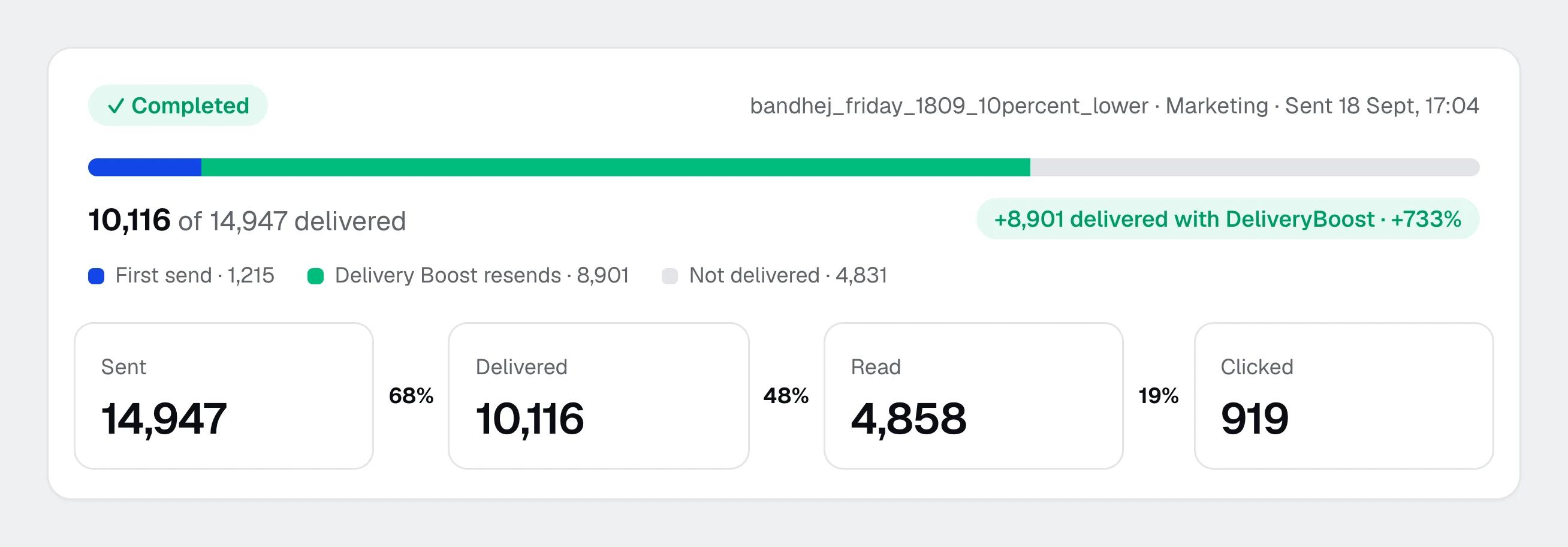
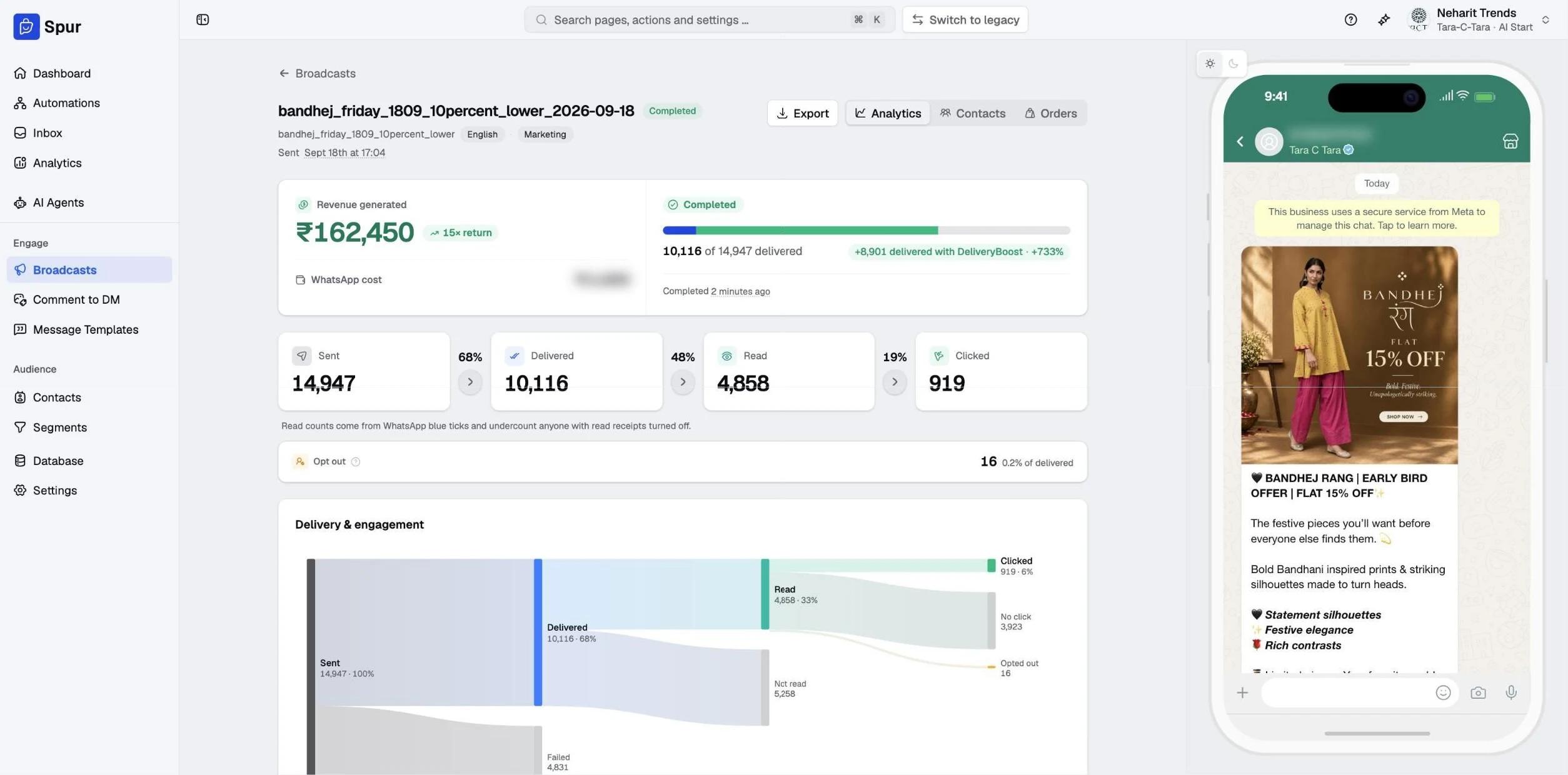
The broadcast report in Spur. 8,901 of the 10,116 deliveries came from Delivery Boost resends.
What it returned
Campaign totals from Spur's broadcast and billing records, rounded.
The campaign delivered to 10,116 of 14,947 customers, 68% of the list and about 4.5 times as many as before the max price change.
It produced 83 orders and ₹1.62 lakh in attributed revenue, 15 times what it cost to send.
The revenue is attributed to the campaign by Spur, not measured against a group that did not get the message, so some of those customers might have bought anyway.
The delivery figures are counted directly: the same message to the same target audience went from 15% to 68% delivered after the max price went up, and the average price stayed below the standard rate.
Bandhej Rang early-bird offer, whole campaign
| Metric | Result |
|---|---|
| Attributed revenue | ₹1.62 lakh |
| Attributed revenue vs messaging cost | 15× |
| Orders | 83 |
| Customers targeted | 14,947 |
| Delivered by the first send | 1,215 (8%) |
| Delivered before the change | 2,235 (15%) |
| Delivered at the end | 10,116 (68%) |
| Read | 4,858 |
| Clicked | 919 |
| Additional deliveries after the change | 7,881 |
| Max price, broadcast to resend 3 | 10% to 7% below standard |
| Max price, resend 4 onward | 2× standard |
| Typical price before the change | About 12% below standard |
| Typical price after the change | About 5% below standard |
| Average price, whole campaign | About 7% below standard |
| Revenue per order ₹1,62,450 ÷ 83 | ~₹1,960 |
| Deliveries compared with before the change 10,116 ÷ 2,235 | ~4.5× |
From Spur's broadcast report and Meta's billing webhooks, rounded; revenue, orders, reads and clicks as of 1 October 2026. Standard means Spur's standard rate for a WhatsApp marketing message in India, and typical means the median delivery. Revenue is attributed by Spur, not an incrementality test. First published by Spur on 26 September 2026 with Tara C Tara's approval.
List to orders
- Customers targeted 14,947
Four Shopify segments
- Delivered 10,116
68% of the list, up from 15%
- Orders 83
₹1.62 lakh attributed revenue
Revenue is attributed by Spur, not measured against a holdout.
Swipe sideways to read the diagram. With a keyboard, focus it and use the arrow keys.
How bidding changed the result
Three things explain the jump, and none of them are specific to fashion.
Resends added little until the max price went up
Delivery Boost resends only to people Meta turned away with its per-user marketing limit error. At a max price below standard, the first three resends delivered to about 1,000 people between them. The next resend, at 2× the standard rate, delivered to about 3,500 on its own.
A higher limit did not mean paying the limit
Doubling the max price sounds expensive, but Meta charges what each delivery costs, up to the limit. The typical delivery went from about 12% below the standard rate before the change to about 5% below after it. Across the whole campaign the average was about 7% below standard.
The fix worked inside the same campaign
Delivery Boost resends up to 12 times over about three days. The broadcast and the first three resends, at a low max price, took more than a day of that window and delivered to 15% of the list. The nine resends at the higher max price took delivery to 68% before the boost ran out.
How to run this on your next broadcast
For any marketing broadcast where reaching the whole list matters, such as a festive or launch offer.
-
Ask Spur to turn on max price for your number
A max price can only be set on WhatsApp numbers connected to Meta's Marketing Messages API, in countries where Meta offers it. Meta limited it to a small number of accounts until 1 October 2026, when it moved to an open beta for all eligible accounts. Book a demo and Spur will check your number and set it up.
-
Turn on Delivery Boost
Delivery Boost resends the broadcast up to 12 times over about three days, only to people Meta held back with its per-user marketing limit. It is what gives a higher max price the chance to reach them.
-
Do not start a big offer below the standard rate
A low max price can reach some customers for less, but on an offer meant for the whole list it can leave most of it unreached, as it did here.
-
Raise the max price if resends stop working
If each resend reaches fewer people and most of the list is still waiting, raise the max price before changing the message or the audience. Meta suggests testing 1.2× the published rate in India. Tara C Tara went to 2× for a festive deadline and still paid below the standard rate on average.
-
Judge by delivery and revenue, not the limit
The max price is the most you might pay, not what you will pay. Compare the share of the list delivered, orders and return on messaging spend between campaigns.
Questions people ask about WhatsApp bidding
Brands on Meta's Marketing Messages API for WhatsApp can set a max price for a marketing message template: the most they will pay for one delivered message. Meta charges that amount or less and uses the max price when deciding who receives the message. Meta calls the feature max price.
For most customers Meta returned its per-user marketing limit error instead of delivering the message. Three resends at the same low max price delivered to only about 1,000 people between them. The first resend after the max price went up delivered to about 3,500.
No. Meta charges the max price or less, and only for delivered messages. Tara C Tara set a max price of 2× the standard rate and paid about 7% below the standard rate on average across the campaign.
No. A higher max price makes delivery more likely, but Meta's other delivery limits still apply. Tara C Tara's campaign ended at 68% of the list delivered, not 100%.
Businesses on Meta's Marketing Messages API for WhatsApp in eligible countries. Meta ran a limited beta from 15 May 2026, moved to an open beta for all eligible accounts on 1 October 2026, and plans to make it required in eligible countries from the second quarter of 2027. Spur can set it for eligible numbers.
No. The revenue is attributed to the campaign by Spur, which counts orders from customers who received it, so some of them might have ordered anyway. The delivery figures are counted directly and are not affected by this.
Was this page useful?
More customer stories
Other brands running the same channels, with the numbers they reported.


A higher max price can unlock much more delivery
Tara C Tara raised one setting, the max price, and its festive offer went from 15% to 68% delivered, with 83 orders and attributed revenue at 15× messaging cost.
7-day free trial
- Meta Business Partner
- Shopify Partner

- 7-day free trial
- Connects to Shopify in minutes
- Billed per conversation delivered
- Meta Business Partner
- Shopify Partner