
Who Invented ChatGPT and When Was It Created?

Discuss with AI
Get instant insights and ask questions about this topic with AI assistants.
💡 Pro tip: All options include context about this blog post. Feel free to modify the prompt to ask more specific questions!
TL;DR: ChatGPT wasn't invented by one person. It's the result of collaborative work by OpenAI's team of researchers and engineers, led by CEO Sam Altman and chief scientist Ilya Sutskever. Launched in November 2022, it went from zero to 100 million users in just two months, sparking an AI revolution that's transforming everything from customer service to content creation. Today, businesses use similar conversational AI technology (like Spur's actionable AI agents) to automate customer support, qualify leads, and scale messaging across WhatsApp, Instagram, and live chat.
When ChatGPT burst onto the scene in late 2022, it felt like the future had arrived overnight. Suddenly, anyone could have intelligent conversations with an AI, get help writing emails, debug code, or even brainstorm business ideas. The chatbot's viral spread raised an obvious question: who actually invented this thing?
The answer isn't as simple as pointing to one genius in a garage. ChatGPT was created by OpenAI, a San Francisco-based AI research lab, through years of collaborative work by scientists, engineers, and visionaries. It's the product of collective innovation rather than a lone inventor's eureka moment.
In this article, we'll explore who's behind ChatGPT, how it was developed, why it represents such a milestone in AI, and how this breakthrough is enabling new applications in business automation and customer engagement.
OpenAI is the company that developed ChatGPT. Founded in 2015, the organization started with an ambitious mission: advance artificial intelligence for the benefit of all humanity. The founding team reads like a who's who of tech and AI:
→ Sam Altman (CEO of OpenAI)
→ Ilya Sutskever (Chief Scientist)
→ Greg Brockman (President and CTO)
→ Wojciech Zaremba
→ Andrej Karpathy
→ Peter Abbeel
Notably, Elon Musk was also a co-founder and early financial backer, serving on OpenAI's board in the early years before departing in 2018 due to potential conflicts with his work at Tesla.
OpenAI began as a nonprofit research lab but transitioned to a "capped for-profit" model in 2019 to secure the massive funding needed for their ambitious AI projects. This structure allowed them to attract billions in investment (including major backing from Microsoft) while maintaining their original mission.
Sam Altman, as CEO, is often recognized as the key figure leading ChatGPT's creation. But Altman didn't single-handedly program the chatbot. The real credit goes to OpenAI's research and engineering teams who built on years of AI breakthroughs.
Ilya Sutskever, OpenAI's chief scientist and one of the world's leading AI researchers, guided the technical direction that made models like GPT-3 possible. Greg Brockman designed the computing infrastructure needed to train these massive models. And the alignment team (including researchers like Jan Leike) developed the crucial training techniques that made ChatGPT safe and helpful.
In truth, no single person invented ChatGPT. It was the product of OpenAI's collective research breakthroughs, with credit due to hundreds of team members (including researchers, engineers, and even the contractors who helped label training data).
Prior to ChatGPT, OpenAI had already proven its capabilities with groundbreaking AI models:
• GPT-3 (2020): A text-generating model that stunned the tech world with its writing abilities
• DALL-E (2021): An AI image generator that could create pictures from text descriptions
• Codex (2021): The AI powering GitHub Copilot, which helps programmers write code
But ChatGPT would become OpenAI's most famous creation, merging their language model advances with an easy-to-use conversational interface that anyone could access.
ChatGPT is an AI chatbot, a software program designed to interact through conversation. It belongs to a category of AI systems called "large language models" (LLMs), which are trained on massive text datasets to generate human-like responses.
The name ChatGPT stands for "Chat Generative Pre-trained Transformer":
→ Chat: Refers to its conversational interface
→ Generative: It generates new text rather than just retrieving information
→ Pre-trained: The model learned from huge amounts of text before being fine-tuned
→ Transformer: The underlying AI architecture (more on this later)
OpenAI released ChatGPT to the public on November 30, 2022 as a free preview. The release was framed as a research experiment to gather feedback, but its impact was immediate and explosive.
Within days, screenshots of ChatGPT's surprisingly coherent answers went viral across social media. By January 2023, ChatGPT had reached 100 million users, making it the fastest-growing consumer app in history at that time. For comparison, it took TikTok about 9 months and Instagram about 2.5 years to hit that milestone.
This rapid adoption showed there's an enormous appetite for AI-powered conversation and content generation. Teachers, students, developers, writers, customer support teams (people from all walks of life) found practical uses for ChatGPT, from serious work to pure entertainment.
Today, ChatGPT is offered in multiple versions:
① Free version Available to anyone, currently running on GPT-3.5 or GPT-4o mini
② ChatGPT Plus ($20/month) Subscription service granting access to more advanced models like GPT-4 and GPT-4o
③ ChatGPT Team and Enterprise Business-focused plans with additional features
As of 2025, OpenAI has continued to upgrade ChatGPT's underlying models. The system now runs on the GPT-4 series of models, making it far more capable than the initial 2022 release.
ChatGPT's abilities include answering questions, writing articles and essays, composing emails or code, tutoring in various subjects, analyzing images, and much more. If you prompt ChatGPT with a question or task, it responds with coherent, contextually relevant answers thanks to the vast knowledge encoded during training.
To understand ChatGPT's creation, you need to know the evolution of the GPT series and the technology behind it. This is a story of incremental breakthroughs building toward a transformative moment.
| GPT Version | Year | Parameters | Key Innovation |
|---|---|---|---|
| Transformer | 2017 | N/A | Foundation architecture from Google ("Attention Is All You Need") |
| GPT-1 | 2018 | 117M | Proved generative pre-training concept |
| GPT-2 | 2019 | 1.5B | Coherent paragraphs, sparked safety debate |
| GPT-3 | 2020 | 175B | Massive leap in capability, offered via API |
| InstructGPT | 2022 | 175B | RLHF training for better instruction following |
| ChatGPT | 2022 | 175B | Conversational interface with RLHF (GPT-3.5) |
| GPT-4 | 2023 | 1T+ | Multimodal, better reasoning, longer context |
The story begins with a breakthrough in AI architecture. In 2017, Google researchers published the paper "Attention Is All You Need," introducing the Transformer architecture. This model could efficiently process language by paying "attention" to different words in context, enabling much larger and more coherent AI language models than previous approaches.
OpenAI quickly saw the potential of Transformers for language generation and began building on this foundation.

OpenAI released GPT-1, the first Generative Pre-trained Transformer model, in June 2018. It showed that pre-training a Transformer on a huge text corpus, then fine-tuning it for specific tasks, yielded excellent results in language understanding.
This concept of generative pre-training was the spark that would eventually lead to ChatGPT. But GPT-1 was still relatively small and limited to research labs.
OpenAI followed up with GPT-2, a much larger model with 1.5 billion parameters that could produce eerily coherent paragraphs of text. GPT-2 garnered attention not only for its capability but also for controversy.
OpenAI initially withheld the full model over concerns it could be misused to generate fake news or spam. This sparked a debate about AI safety and responsible release policies. Eventually, GPT-2 was made fully public as those concerns were managed.
The key lesson: scaling up these models dramatically improved their output quality.
This was the big leap. GPT-3 had 175 billion parameters and was trained on an unprecedented amount of data, ranging from books to websites to code repositories.
Its release in June 2020 stunned observers. GPT-3 could:
→ Generate long-form answers to complex questions
→ Write coherent articles and stories
→ Compose functional code from plain English descriptions
→ Translate between languages
→ Perform arithmetic and reasoning
OpenAI offered GPT-3's capabilities via an API, but it wasn't yet a consumer-facing "chatbot." It was essentially a very powerful brain without a specific interface or conversational persona. Still, GPT-3 set the stage for ChatGPT by proving that a sufficiently large model could engage in surprising levels of conversation and creativity.
Despite GPT-3's prowess, interacting with it could be hit-or-miss. Sometimes it gave irrelevant answers or followed instructions loosely. The raw model was powerful but not particularly helpful or safe.
OpenAI's team tackled this by fine-tuning GPT-3 using human feedback. This technique, called Reinforcement Learning from Human Feedback (RLHF), worked like this:
① Human AI trainers had conversations with the model Providing examples of good responses
② The model generated multiple possible answers To the same questions
③ Human reviewers ranked these answers From best to worst
④ The AI learned to produce responses More like the highly-ranked ones
In early 2022, OpenAI introduced InstructGPT, a version of GPT-3 tuned to follow instructions much better. The success of InstructGPT led directly to ChatGPT, which applied the same technique to create a conversational agent optimized for dialogue.
ChatGPT can be seen as "GPT-3.5," an improved GPT-3 specifically tuned for chat. After months of refinement, OpenAI opened ChatGPT to the public in November 2022 as a free beta to gather even more feedback at scale.
In March 2023, OpenAI released GPT-4, the next-generation model with even greater capabilities. While OpenAI didn't disclose exact specifications, GPT-4 is estimated to have over 1 trillion parameters.
GPT-4 brought several improvements:
• More accurate and nuanced responses
• Better reasoning and problem-solving
• Ability to process images (in multimodal versions)
• Longer context window (can "remember" more of the conversation)
GPT-4 was initially available through ChatGPT Plus subscriptions and the API, making ChatGPT even more powerful for professional and creative uses.
OpenAI has continued to iterate rapidly. By 2025, OpenAI's models have reached new heights with versions like GPT-5:
• Better multi-step reasoning capabilities
• Improved multimodal input/output (handling images, audio, and video)
• Enhanced coding abilities
• Plugin ecosystem for connecting to external tools
ChatGPT today is far more advanced than the initial version launched in 2022. And the development continues.
AI chatbots have existed in some form for decades:
| Chatbot | Year | Capabilities |
|---|---|---|
| ELIZA | 1966 | Simple pattern-matching that mimicked a therapist |
| Siri | 2011 | Apple's voice assistant for predefined tasks |
| Alexa | 2014 | Amazon's smart home assistant |
| Google Assistant | 2016 | Google's virtual helper |
| ChatGPT | 2022 | Open-ended conversational AI with genuine helpfulness |
But those systems were either very limited or not truly conversational. They could handle predefined tasks (set a timer, play music, answer factual questions) but couldn't engage in open-ended dialogue or perform complex reasoning.
ChatGPT's invention represented a turning point because it combined:
① State-of-the-art language understanding Thanks to massive scale and advanced training
② Open-ended conversational interface Not limited to specific tasks or domains
③ User-friendly accessibility No technical skills required to use it
④ Genuine helpfulness Trained to follow instructions and provide useful responses
Unlike virtual assistants that handle a set of predefined tasks, ChatGPT can discuss almost any topic, write in various styles, and perform complex reasoning in its answers. This versatility comes from the massive training corpus and the generality of the GPT architecture.
But what really made ChatGPT special was making this technology accessible to everyone. You didn't need to be a programmer or AI researcher to benefit from it. Anyone with an internet connection could start a conversation and get intelligent help.
The invention of ChatGPT set off an AI revolution in tech and beyond. The impact has been profound and wide-ranging.
As mentioned, ChatGPT gained over 100 million users in just 2 months, an unprecedented rate of adoption. By 2025, ChatGPT's website is among the top 5 most-visited sites in the world, with hundreds of millions of weekly users.
This kind of user growth showed that AI chatbots had finally hit a mainstream nerve. People from all walks of life found uses for ChatGPT:
→ Students Getting homework help and tutoring
→ Writers Brainstorming ideas and drafting content
→ Developers Debugging code and learning new frameworks
→ Business professionals Writing emails, reports, and presentations
→ Customer support teams Handling routine inquiries more efficiently
→ Marketers Creating ad copy and social media content

The use cases seemed endless.
ChatGPT's popularity prompted virtually every major tech company to accelerate their AI efforts. The competitive response was swift and intense:
Microsoft (an OpenAI partner which invested $1 billion in 2019 and a further $10 billion in 2023) integrated OpenAI's models into its products. Most notably, Microsoft launched Bing Chat in early 2023, a search chatbot powered by GPT-4.
Google, which had been cautiously developing its own large language models, fast-tracked the release of its ChatGPT competitor, Bard, in March 2023. By late 2023, Google's DeepMind division unveiled Gemini, a next-generation AI model intended to rival or surpass GPT-4.
Other companies launched their own chatbots:
• Anthropic's Claude: Focused on safety and helpfulness (read our Claude vs ChatGPT comparison)
• Meta's LLaMA: Open-source models for researchers
• Baidu's ERNIE Bot: China's answer to ChatGPT
• Amazon's offerings: Various AI tools integrated into AWS
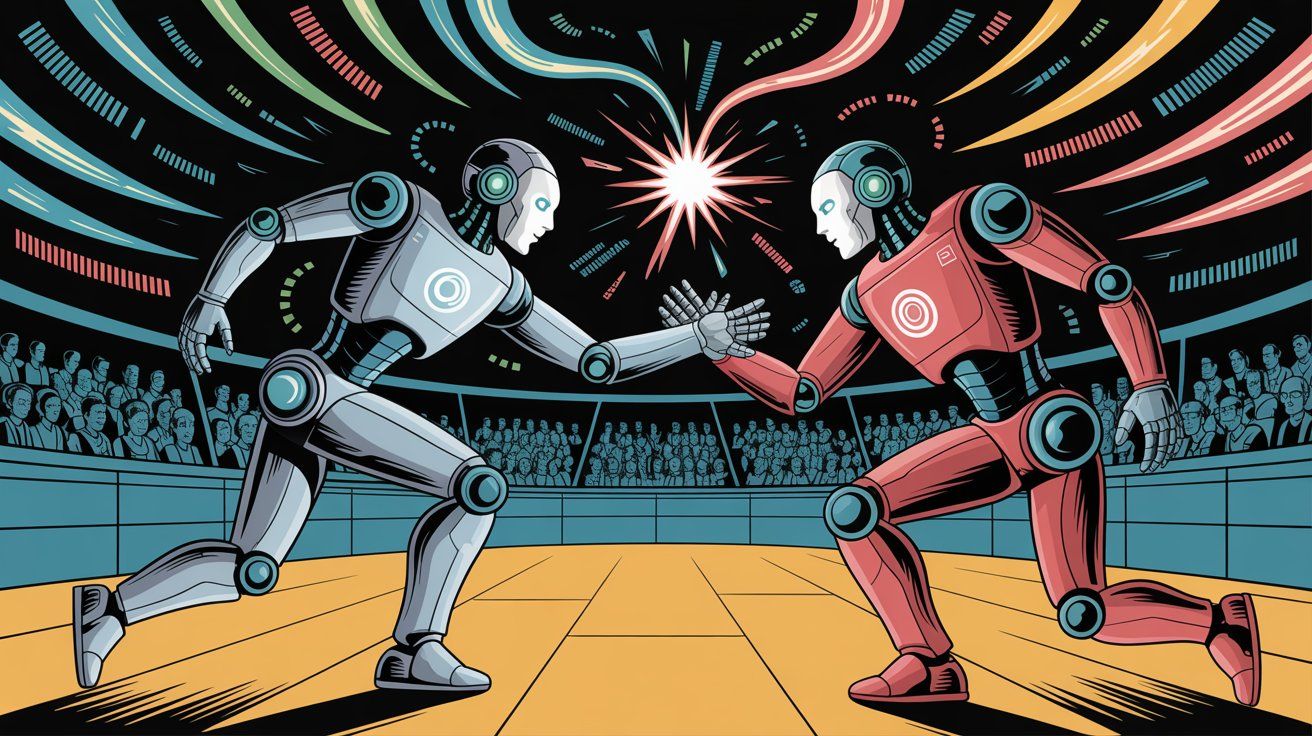
As of 2025, the AI assistant landscape is often described as a "two-horse race" between OpenAI's ChatGPT and Google's Gemini for supremacy in conversational AI, with several other strong contenders in the mix.
This competitive boom has greatly accelerated AI research and deployment worldwide. What might have taken a decade of gradual development happened in just two years.
ChatGPT and similar AI are changing how people work across industries:
Content Writing and Marketing ChatGPT can draft articles, ad copy, social media posts, and email campaigns. Content teams use it to overcome writer's block, generate variations, and scale their output.
Customer Service AI chatbots can handle routine inquiries via chat, often composing answers that human agents can review and refine. This saves time and money for businesses while improving response times. Tools like Spur have built on this technology to create actionable AI agents that can actually take actions (track orders, book appointments, update records), not just answer questions.
Programming ChatGPT helps developers by generating code snippets, explaining bugs, suggesting optimizations, and even reviewing pull requests. GitHub Copilot (powered by OpenAI's Codex) has become an essential tool for millions of developers.
Education ChatGPT serves as a tutoring aid, explaining complex concepts in simple terms. Though not without controversy (students have also used it to cheat on assignments), it's becoming a legitimate educational tool when used properly.
Research and Analysis Professionals use ChatGPT to summarize documents, extract insights from data, and draft reports. It's particularly useful for synthesizing information from multiple sources.

The "AI assistant" is becoming a common tool, much like spreadsheets or search engines once became, due in large part to ChatGPT popularizing the concept.
The rise of ChatGPT also sparked intense discussions about AI's role in society. The conversation has been both excited and anxious:
On the positive side, ChatGPT has been lauded as a tool that can:
• Boost productivity and creativity
• Democratize access to information and expertise
• Automate tedious tasks and free humans for more meaningful work
• Level the playing field for people with different educational backgrounds
On the cautionary side, concerns have been raised about:
→ Misinformation ChatGPT can sometimes produce false but convincing information (AI "hallucinations")
→ Bias The model can reflect biases present in its training data
→ Job displacement If AI can write or code, what work is left for humans?
→ Academic integrity Students using AI to cheat on assignments
→ Privacy Questions about what data is used for training and how conversations are stored (learn more about ChatGPT data privacy)
These debates have prompted calls for AI regulation and guidelines on safe use. Sam Altman himself testified to the U.S. Congress in 2023 about AI oversight and the need for thoughtful governance.
In short, ChatGPT's invention didn't just birth a product. It started a broader conversation about the future of work, education, creativity, and humanity's relationship with increasingly capable AI systems.
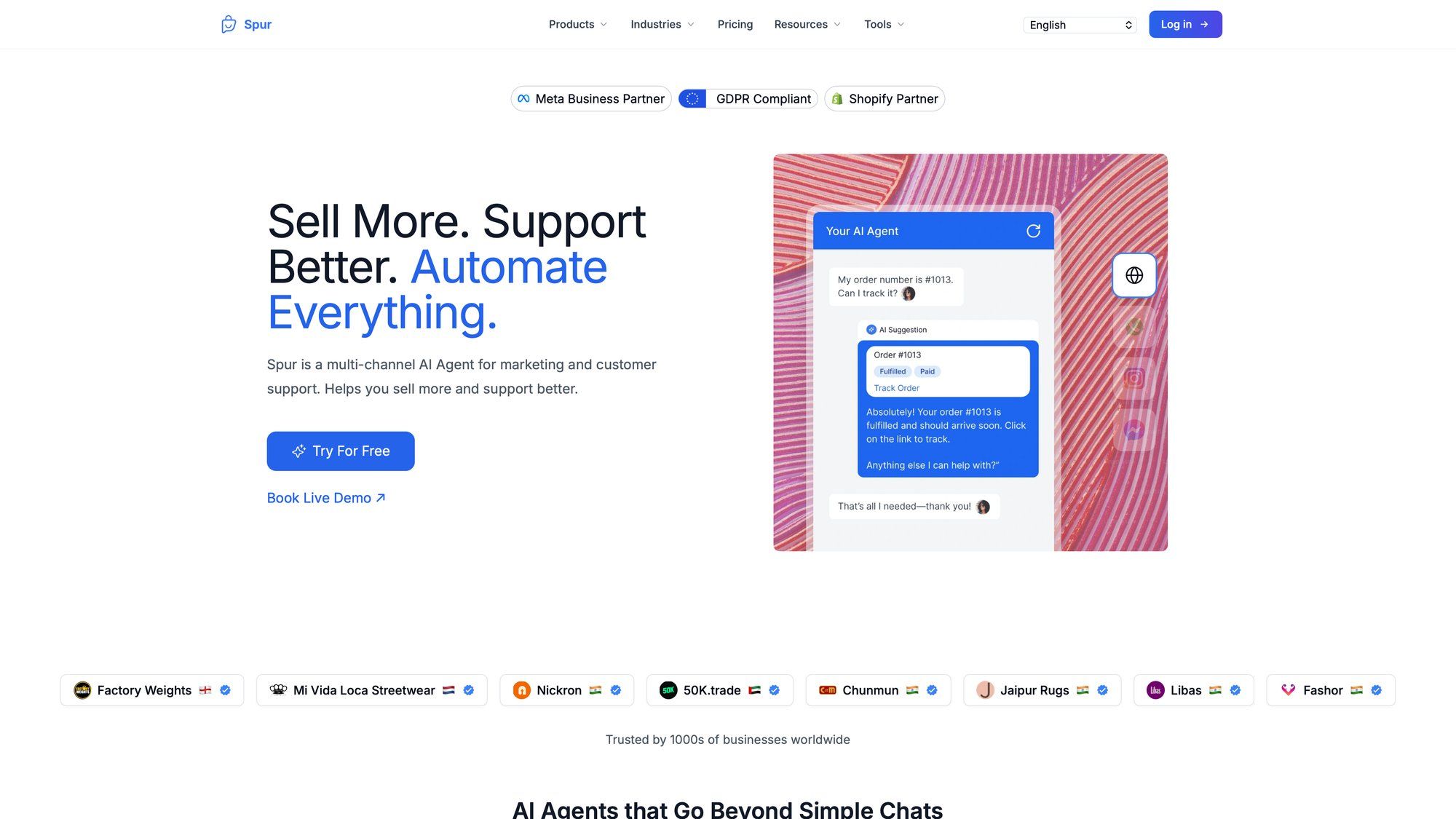
The technology that powers ChatGPT has opened up new possibilities for businesses to automate and improve customer engagement. While ChatGPT itself is a general-purpose assistant, companies are now building specialized AI agents for specific business needs.
At Spur, we've taken the conversational AI breakthrough that ChatGPT represents and applied it specifically to customer engagement and support. But there's a crucial difference: we're not just building Q&A bots.
Actionable AI agents can actually take actions on behalf of customers:
→ Track order status and shipping information
→ Process returns and exchanges
→ Book appointments or schedule callbacks
→ Update account information
→ Qualify leads and collect contact details
→ Trigger workflows in connected systems
This is different from traditional chatbots that can only provide information. Our AI agents are trained on your specific knowledge base (your website content, product catalogs, FAQs, and help documentation) and can connect to your backend systems to get things done.
The ChatGPT breakthrough showed that people are comfortable having natural conversations with AI. We've applied this insight across the channels where your customers actually are:
• WhatsApp Business API: Handle customer inquiries, send order updates, run marketing campaigns
• Instagram DM Automation: Auto-respond to comments and DMs, capture leads from story interactions
• Live Chat Widget: AI-powered chat on your website that can escalate to human agents when needed
• Facebook Messenger: Automated responses with seamless handoff to support teams
All of these channels feed into a unified inbox where your team can see the full customer conversation history, regardless of where the conversation started. The AI handles the repetitive 60-80% of queries, while your human team focuses on the complex, high-value interactions.
The same natural language understanding that makes ChatGPT impressive makes our AI agents helpful for your customers. They can:
• Provide instant responses 24/7
• Handle hundreds of conversations simultaneously
• Maintain context across multiple messages
• Escalate complex issues to human agents smoothly
• Learn from your specific business knowledge
And unlike generic chatbots, they can actually resolve issues instead of just answering questions. That's the "actionable" part.
Want to see how conversational AI can transform your customer engagement? Get started with Spur and experience the ChatGPT breakthrough applied specifically to your business needs.
Summing up, ChatGPT's invention is significant because it reached a new threshold of AI capability and accessibility.
Technologically, it was the culmination of years of research:
① Transformer architecture (2017)
② Massive-scale model training (GPT-3 in 2020)
③ Alignment techniques like RLHF (2022)
④ User-friendly packaging into a conversational interface
Practically, it introduced millions of people to an AI that can assist with everyday tasks, something that previously lived in science fiction. Before ChatGPT, most people had never directly interacted with a large language model. After ChatGPT, it became normal.
Culturally, it shifted the conversation about AI from "what might be possible someday" to "what can we do with this right now?" The technology went from research labs to mainstream awareness almost overnight.
Asking "Who invented ChatGPT?" could also be interpreted as "How did such an AI become possible now?" The answer is that a confluence of factors in the late 2010s and early 2020s made it possible:
① Computing power OpenAI trained models on supercomputers co-designed with Microsoft, with thousands of GPUs working in parallel
② Data availability The internet provided massive text corpora for training
③ Algorithm improvements Transformers, RLHF, and other techniques made models more capable and controllable
④ Investment Billions in funding from Microsoft and others enabled the expensive research
⑤ Boldness OpenAI's willingness to deploy the technology widely, despite risks, accelerated learning and improvement
While no single individual invented ChatGPT, OpenAI as an organization took the bold step to create and release it, under the guidance of visionaries like Sam Altman and Ilya Sutskever.
And the story isn't over. The "invention" of ChatGPT is an ongoing process. The AI is continually being improved and updated. OpenAI's research continues, and rivals are introducing innovations of their own.
As of 2025, OpenAI's ChatGPT and Google's Gemini are at the forefront of AI assistants, each improving rapidly. We're effectively watching the evolution of AI in real time, driven by the breakthrough that ChatGPT represented.
ChatGPT's creation marked the beginning of a new era, not the end of innovation. Here's what's happening now and what's coming next.
The latest versions of ChatGPT and competing models can handle more than just text. They can:
• Analyze images and describe what they see
• Generate images from text descriptions
• Process audio and transcribe speech
• Create videos from prompts
• Understand and generate code in dozens of programming languages
This multimodal capability makes AI assistants far more versatile and useful for real-world tasks.
While ChatGPT is a general-purpose assistant, we're seeing an explosion of specialized AI agents built for specific industries and use cases:
→ Customer support agents Like Spur's AI agents, trained on specific business knowledge
→ Legal research assistants Helping lawyers analyze cases and draft documents
→ Medical diagnosis aids Assisting doctors with differential diagnosis (though not replacing human judgment)
→ Financial analysts Helping interpret market data and write reports
→ Creative collaborators Working with designers, writers, and artists
These specialized agents are often more useful than general-purpose chatbots because they're deeply trained on domain-specific knowledge and can integrate with industry tools.
AI assistants are being integrated into the tools we already use:
| Product | AI Feature | Benefit |
|---|---|---|
| Microsoft Office | Copilot in Word, Excel, PowerPoint | Draft documents, analyze data, create presentations |
| Google Workspace | Duet AI in Gmail, Docs, Sheets | Write emails, summarize documents, generate insights |
| Salesforce | Einstein GPT | CRM automation and customer intelligence |
| Shopify | AI tools for merchants | Product descriptions, e-commerce automation |
| Messaging platforms | AI-powered responses | WhatsApp, Instagram automation |
This integration means AI assistance is becoming ambient and always available, rather than requiring you to visit a separate website.
OpenAI and other leading AI labs are pursuing Artificial General Intelligence (AGI), AI systems that can match or exceed human capability across virtually all cognitive tasks. While we're not there yet, ChatGPT represents significant progress toward that goal.
The improvements from GPT-3 to GPT-4 to the latest models show that scaling up and refining these systems continues to yield surprising new capabilities. What seemed impossible becomes routine with each generation.
Who invented ChatGPT? The simple answer: OpenAI did.
ChatGPT was created by the team at OpenAI, a company co-founded by Sam Altman, Ilya Sutskever, Greg Brockman, and others. It was built upon the research of many brilliant minds in the AI community. Released in November 2022 as the first widely adopted AI chatbot of its kind, it has since transformed the digital landscape.
Rather than crediting one lone inventor, it's more accurate to credit a chain of innovation:
• The Google researchers who pioneered the Transformer architecture
• The OpenAI engineers who scaled it up into GPT-3
• The alignment team that made it user-friendly through RLHF
• The leadership (Sam Altman and others) who dared to put it in everyone's hands
• The hundreds of researchers, engineers, and trainers who contributed to its development
ChatGPT's invention is a landmark in technology. It opened the public's eyes to what AI can do, from drafting business proposals to having friendly conversations. In the process, it kicked off a race among tech giants and startups to build ever-smarter AI assistants.
As we move forward, ChatGPT and its successors will likely become even more integrated into daily life. And while we may not have a single "Thomas Edison" behind this AI, we have a clear origin: ChatGPT was born at OpenAI, through collective effort and ingenuity.
It's worth recognizing that ChatGPT's creation also catalyzed new applications of AI across industries. At Spur, for example, we use the conversational AI breakthrough that ChatGPT pioneered to power actionable AI agents for customer support and engagement. The technology that OpenAI developed is now enabling tools that can handle customer queries, automate marketing conversations, and take real actions to resolve issues, bringing AI's benefits to businesses of all sizes.
In that sense, the inventors of ChatGPT not only built an amazing chatbot but also paved the way for a wave of AI innovation that's touching every facet of work and life. The story is still being written, and we're all part of it now.
Sam Altman is the CEO of OpenAI. He co-founded the company in 2015 and became CEO in 2019. Altman is often recognized as the public face of ChatGPT and has been instrumental in steering OpenAI's strategy to deploy AI tools at scale. Before OpenAI, Altman was president of Y Combinator, the famous startup accelerator.
ChatGPT was released to the public on November 30, 2022 as a free research preview. OpenAI framed it as an experiment to gather feedback, but the response was overwhelming. Within two months, it had reached 100 million users, making it the fastest-growing consumer application in history.
GPT stands for "Generative Pre-trained Transformer."
→ Generative: The model generates new text rather than just retrieving information
→ Pre-trained: It learns from huge amounts of text before being fine-tuned for specific tasks
→ Transformer: The underlying neural network architecture that processes language
The Transformer architecture was introduced by Google researchers in 2017 and has since become the foundation for most modern large language models.
Yes, ChatGPT has a free version that anyone can access. The free version provides access to capable models (currently GPT-3.5 or GPT-4o mini) with some limitations.
For $20/month, ChatGPT Plus subscribers get:
• Access to more advanced models (GPT-4, GPT-4o)
• Faster response times during peak usage
• Priority access to new features
• Higher usage limits
OpenAI also offers ChatGPT Team and ChatGPT Enterprise plans for businesses with additional features and controls.
As of 2025, the AI assistant landscape is primarily a two-way race between ChatGPT and Google's Gemini. Both are highly capable, with different strengths:
| Feature | ChatGPT | Google Gemini |
|---|---|---|
| Best for | Conversational ability, creative writing, code generation | Real-time info, Google service integration, multimodal tasks |
| Strengths | Following complex instructions, maintaining context | Search integration, live data access, image/video handling |
| Context window | Very long | Very long |
| Pricing | Free + $20/mo Plus | Free + paid tiers |
Other competitors include Anthropic's Claude (known for safety and long context windows - read our Claude vs ChatGPT comparison), Microsoft Copilot (integrated into Office apps - see our Copilot vs ChatGPT analysis), and various specialized tools for specific industries.
For business applications like customer support and engagement, specialized platforms like Spur offer AI agents trained on your specific knowledge base and integrated with your business tools, which can be more effective than general-purpose chatbots.
This is a complex question with no simple answer. ChatGPT and similar AI tools are best viewed as augmentation rather than replacement.
What AI can do well:
• Handle repetitive, routine tasks at scale
• Provide first drafts and suggestions for human review
• Answer common questions instantly
• Process and summarize large amounts of information
• Generate code snippets and debug errors
What humans still do better:
• Make nuanced judgments in complex situations
• Understand context and subtext in sensitive interactions
• Build genuine relationships with customers
• Exercise creativity with true originality
• Take responsibility for important decisions
In customer service, for example, platforms like Spur use AI to handle the routine 60-80% of queries (order tracking, basic FAQs, simple requests), while human agents focus on complex issues, upset customers, and high-value opportunities. This combination often delivers better results than either approach alone.
The consensus among experts is that AI will change the nature of work rather than eliminate it. Jobs will evolve to use AI tools, much like how spreadsheets changed accounting without eliminating accountants.
Despite its impressive capabilities, ChatGPT has several important limitations:
① Knowledge cutoff ChatGPT's training data has a cutoff date. The free version's knowledge ends in early 2023, while newer versions are more current but still not real-time. It can't access live information unless connected to tools that can browse the web.
② Hallucinations ChatGPT sometimes generates false information that sounds plausible. It can confidently state "facts" that aren't true, cite non-existent sources, or misremember details. Always verify important information. Learn more about ChatGPT accuracy.
③ No true understanding ChatGPT recognizes patterns in text but doesn't "understand" in the way humans do. It can't truly reason from first principles or apply common sense in novel situations.
④ Bias The model can reflect biases present in its training data, potentially producing outputs that are stereotypical or inappropriate.
⑤ Context limits While the context window has grown significantly, there are still limits to how much text ChatGPT can process at once.
⑥ Can't take actions Standard ChatGPT can't directly interact with other systems, send emails, make purchases, or execute tasks in the real world without plugins or integrations.
For business use cases that require action-taking capabilities (like processing orders or booking appointments), specialized solutions like Spur's actionable AI agents address this limitation by integrating directly with backend systems.
ChatGPT is trained in two main phases:
① Pre-training
The model reads billions of pages of text from the internet, books, articles, and code repositories. It learns patterns in language: grammar, facts, reasoning, and writing styles. This phase creates a general-purpose language model that can predict what text should come next in a sequence.
② Fine-tuning with human feedback (RLHF)
Human AI trainers have conversations with the model, providing examples of good responses. The model generates multiple possible answers to questions. Human reviewers rank these answers from best to worst. The AI learns to produce responses more like the highly-ranked ones. This process makes ChatGPT more helpful, harmless, and honest.
This two-phase approach is what gives ChatGPT its combination of broad knowledge (from pre-training) and conversational helpfulness (from fine-tuning). Learn more about training chatbots on custom data.
OpenAI has privacy policies governing ChatGPT usage, but there are important things to know:
Data collection By default, conversations may be used to improve the model. OpenAI's trainers might review conversations to enhance the system.
Opt-out Users can disable chat history and model training in their settings, which prevents conversations from being used for improvement.
Business plans ChatGPT Team and Enterprise offer enhanced data protections, with conversations not used for training by default.
Best practices:
• Don't share sensitive personal information, passwords, or proprietary business data
• Be especially careful with confidential information like medical records or legal documents
• Review OpenAI's privacy policy to understand how data is handled
• For business use with sensitive customer data, consider enterprise solutions with proper data protection agreements
For businesses handling customer conversations at scale, platforms like Spur offer business-grade security with servers in Frankfurt (for EU data residency), DPAs available, and clear data handling policies.
Absolutely. Many businesses are already using ChatGPT and similar AI tools for:
→ Content creation: Blog posts, social media, marketing copy
→ Customer support: Drafting responses to common inquiries
→ Internal tools: Summarizing documents, analyzing data, writing code
→ Brainstorming: Generating ideas for products, campaigns, or strategies
For general business use, ChatGPT (especially the Team or Enterprise versions) can be very helpful. But it's a general-purpose tool not optimized for any specific business workflow.
For customer-facing applications, you'll likely get better results with specialized AI agents built for your use case. For example, Spur offers AI agents specifically designed for customer engagement across WhatsApp, Instagram, and live chat, with the ability to:
• Train on your specific knowledge base and product information
• Integrate with your e-commerce platform, CRM, or support desk
• Take actions like tracking orders or booking appointments
• Escalate seamlessly to human agents when needed
• Work across multiple messaging channels from a unified inbox
The right choice depends on your specific needs. General-purpose tools like ChatGPT are great for internal productivity, while specialized solutions excel at customer-facing automation.
The AI assistant space is evolving rapidly. Here's what's on the horizon:
Near-term improvements:
• More accurate and reliable responses with fewer hallucinations
• Better reasoning and multi-step problem-solving
• Enhanced multimodal capabilities (text, images, audio, video all seamlessly integrated)
• Longer context windows to handle entire documents or codebases
• Personalization that remembers your preferences and past interactions
Longer-term possibilities:
• AI assistants that proactively help you rather than just responding to prompts
• Deeper integration into operating systems and productivity tools
• Specialized agents for every industry and profession
• True collaboration between humans and AI on complex projects
• Movement toward Artificial General Intelligence (AGI)
For businesses, the trend is toward AI agents that are:
→ Specialized for specific industries or use cases
→ Integrated directly into business workflows and tools
→ Capable of taking real actions, not just providing information
→ Multi-channel and available wherever customers are
Tools like Spur represent this evolution, taking the conversational AI breakthrough that ChatGPT represents and applying it specifically to customer engagement with actionable capabilities.
The AI revolution that ChatGPT started is far from over. We're still in the early days of what these technologies will enable.