

D2C jewellery · Abandoned checkout · India
Daivik won back 225 abandoned orders worth ₹5.3 lakh in 30 days
Most abandoned cart flows go remind, discount, discount harder. Daivik sells jewellery, where hesitation at checkout is about confidence in the piece and the brand. Its WhatsApp journey on Spur sends a reminder, then what other customers said about that piece, and only then a small, time limited offer.
7-day free trial.
Daivik
South Indian and antique style jewellery, India
₹5.3 lakh
Attributed revenue
30 day snapshot
- Orders recovered
- 225
- Messages delivered
- ~4,500
- Recovery rate
- 5%
Overview
Daivik, an Indian jewellery brand on Shopify, recovers abandoned checkouts on WhatsApp with a three message journey built in Spur. About an hour after the checkout is abandoned the customer gets a reminder with the items and a button back to the cart. About a day later they get what other customers said about that piece, with five stars and a quoted review. About two days later, a limited time 5% offer. Customers leave the journey automatically when they buy. In a 30 day snapshot the journey recovered 225 orders and ₹5.3 lakh of revenue from about 4,500 delivered messages, a reported recovery rate of 5%.
Ask an AI about this story
- Challenge
- A gold piece is not an impulse buy. When a Daivik customer stops at checkout, the doubt is usually about the piece and the brand, not the price. A discount at message two answers a question nobody asked, and trains customers to wait for it.
- Solution
- A Spur abandoned checkout flow with proof in the middle. Reminder at about an hour, a real customer review of the piece at about a day, and only then a small, time limited offer at about two days. Anyone who buys drops out of the journey automatically.
- Results
- 225 orders recovered in the 30 day snapshot
- ₹5.3 lakh of attributed revenue from about 4,500 delivered messages
- A reported recovery rate of 5%, with the discount held back to the last message
The standard cart flow answers the wrong objection
Daivik did not have a price problem at checkout. It had a confidence problem, and the usual remind, discount, discount harder sequence does nothing for that.
Daivik sells South Indian, temple and antique style jewellery, the kind bought for weddings and festivals and kept for years. A customer who has put a necklace in the cart and stopped is rarely stopped by ten percent. They are wondering whether the piece looks in person the way it looks in the photo, whether the plating lasts, whether a brand they found on Instagram will deliver what it shows.
The default abandoned cart sequence, on every channel, is a reminder followed by a discount followed by a bigger discount. It works on impulse categories where the only friction is price. On considered purchases it does two things badly: it answers an objection the customer does not have, and it teaches everyone who sees it that the price will drop if they wait.
Daivik was already reaching customers on WhatsApp through Spur, with order updates and a catalogue. It also had what a hesitant buyer actually wants to hear, which is what other people who bought the piece thought of it. The reviews were on the product pages. They were not in the recovery flow.
The design question was ordering. What should the customer hear first, second and third, and where in that sequence does a discount, if any, belong.
Why the discount moved to the end
Held back to the third message, the offer only reaches customers who saw the reminder and the proof and still did not buy. Everyone who converts on the first two messages pays full price, and nobody learns to wait. If you are discounting at message two, you may be paying to solve the wrong problem.
What they built
Three messages over two days, each answering a different reason to hesitate.
-
Start when the checkout is abandoned
Shopify checkout eventThe flow starts from the Shopify checkout event, so it knows the customer, the items and the cart link. Every message in it is an abandoned cart message in Spur, which means a customer who completes the order at any point leaves the journey at once. Nobody who has bought gets a reminder, a review or an offer.
- Trigger
- Shopify · Checkout abandoned
- Exit
- Automatic on purchase, at any step
-
About an hour later, the reminder
~1 hourThe first message is a plain reminder: the items left in the cart, an image, and one button back to complete the order. No offer. Most of the people who were simply interrupted convert here, at full price.
- Delay
- About 1 hour
- Content
- Items in the cart, image, "Complete Order" button
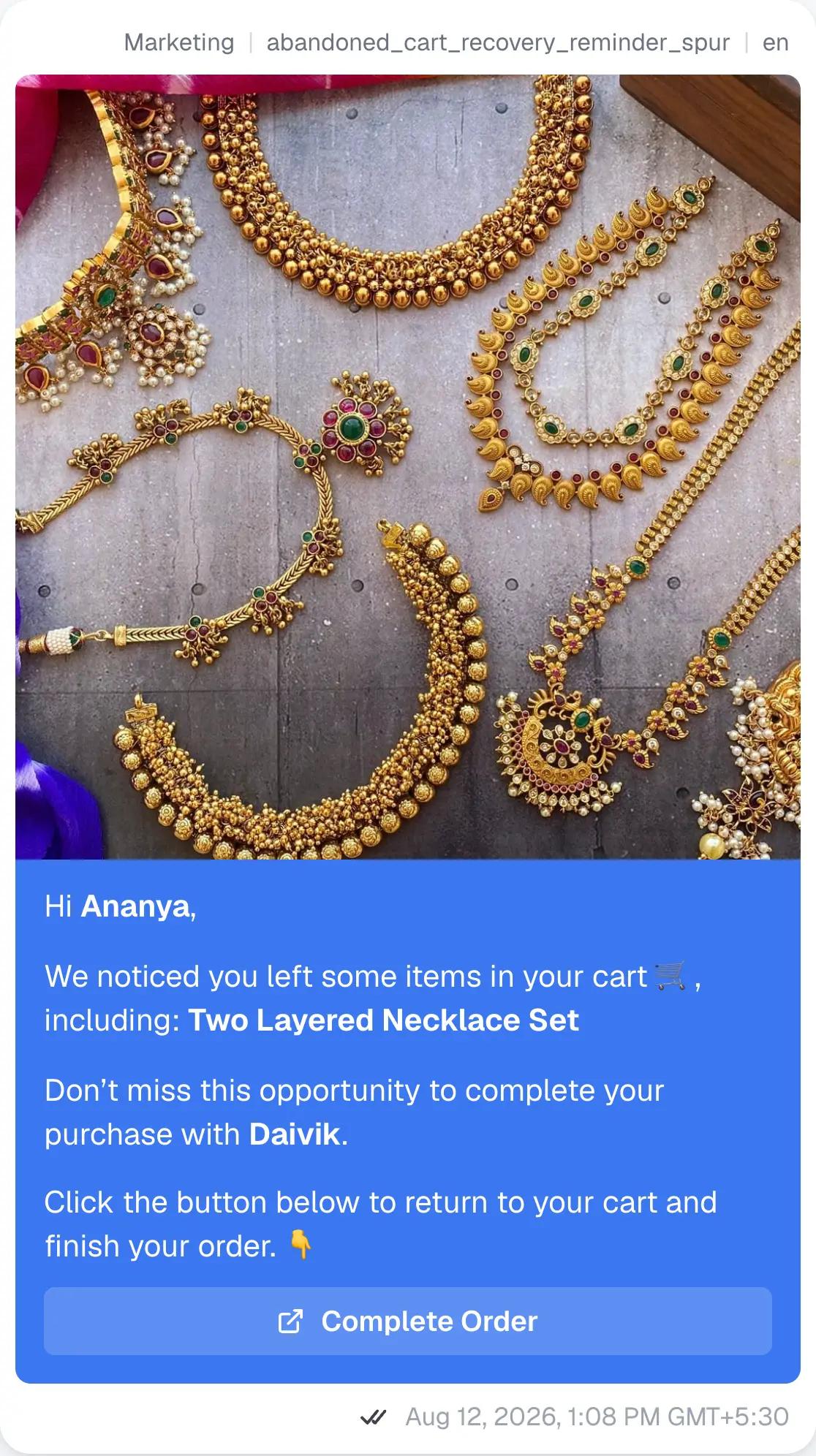
Message one, at full price. The name and the piece are examples. -
About a day later, the proof
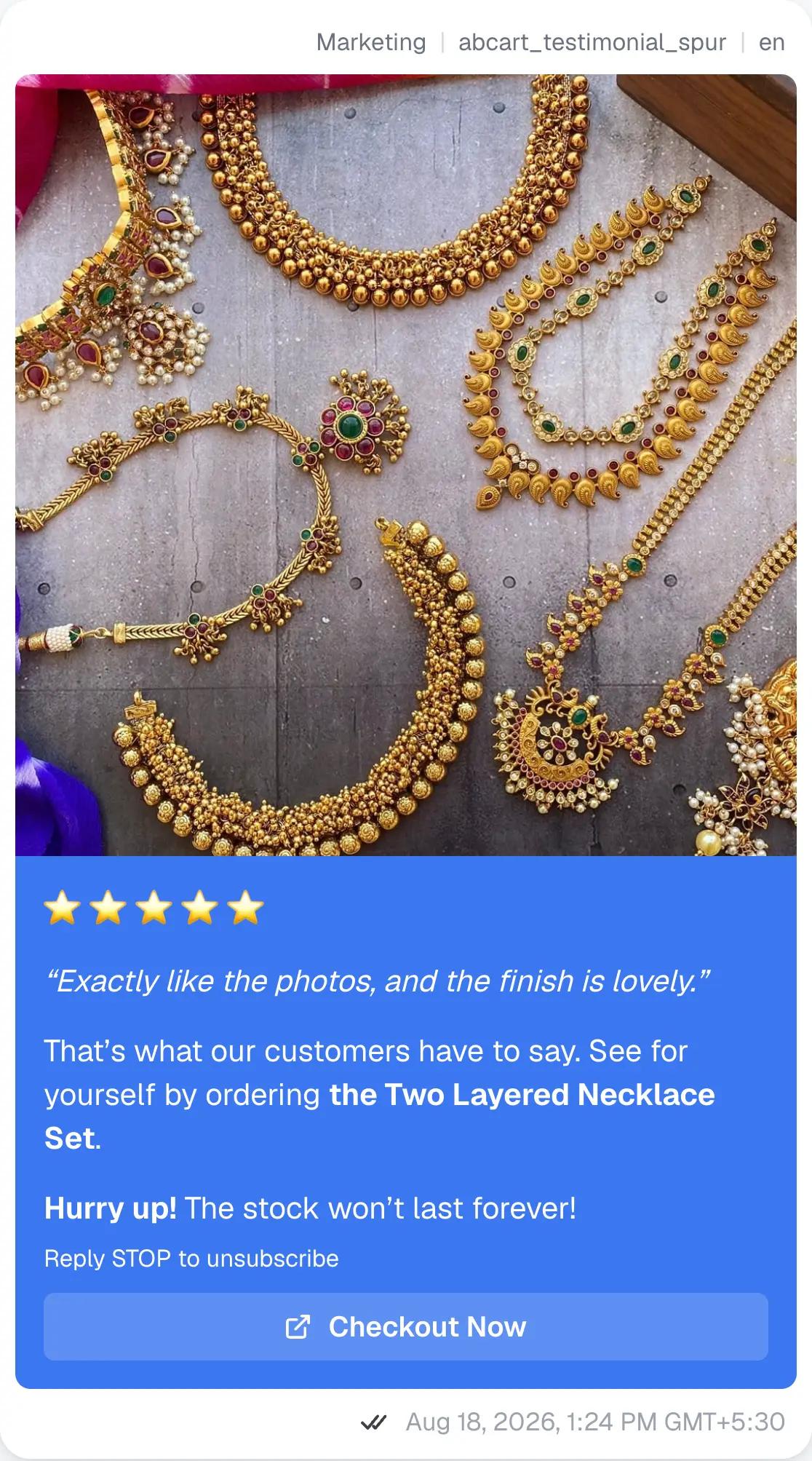
~1 dayThe second message is the one that makes this journey different. Five stars, a quoted review from a customer who bought the piece, and a line inviting the reader to see for themselves. It speaks to the real doubt about the piece and the brand, and it is the message previewed at the top of this page.
- Delay
- About 1 day
- Content
- Five stars, a customer review of the piece, "Checkout Now" button
- Opt out
- "Reply STOP to unsubscribe"
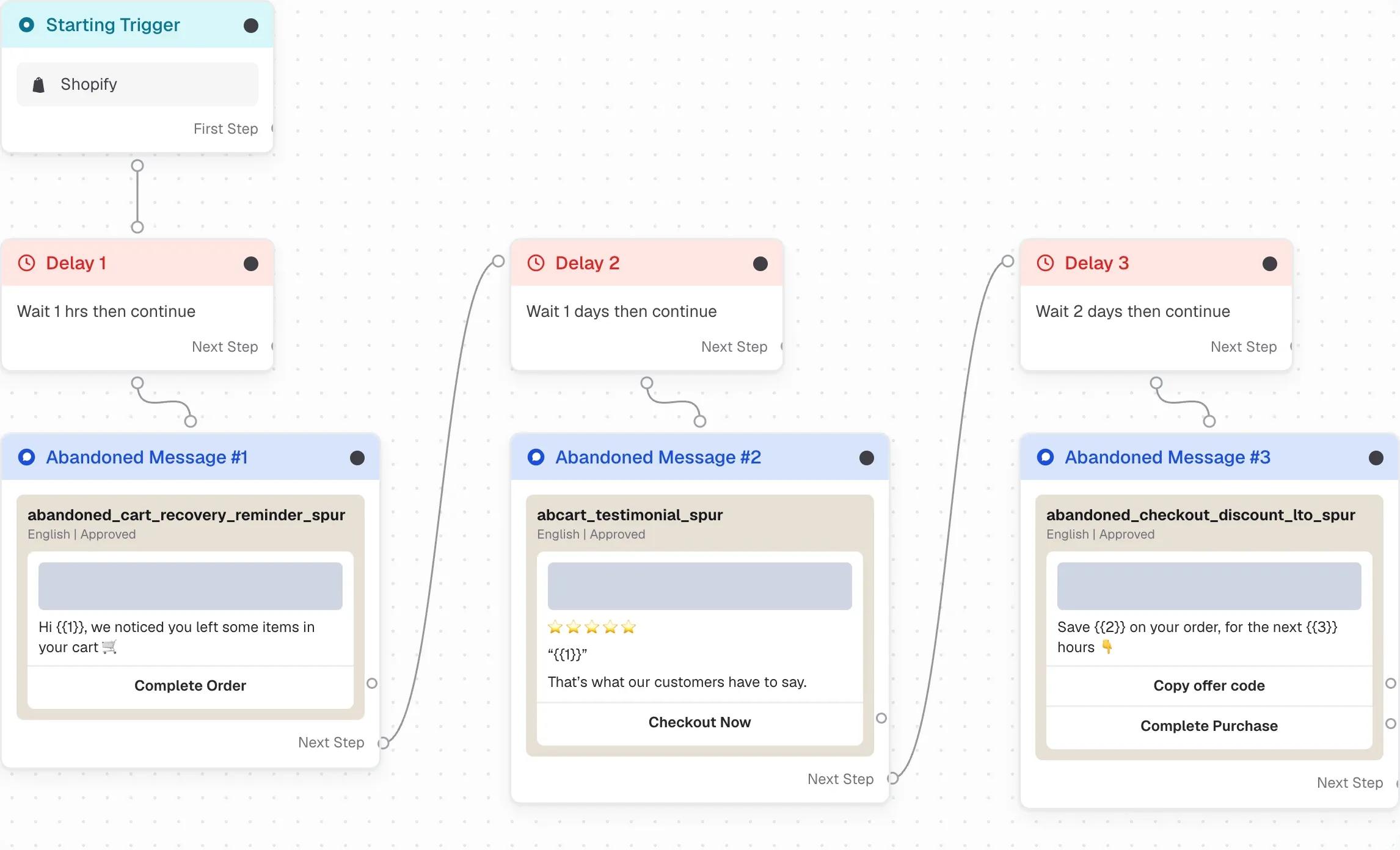
Swipe sideways to read the diagram. With a keyboard, focus it and use the arrow keys.
The whole journey in Spur. Three delays, three messages, and every message drops the customer out as soon as they buy. -
About two days later, a small offer with a clock on it
~2 daysOnly the customers who have seen the reminder and the proof and still not bought reach the third message: a 5% code, valid for a limited number of hours, with a button to copy it and a button to complete the purchase. The discount closes a decision the proof has already opened.
- Delay
- About 2 days
- Offer
- 5% off, limited time
- Buttons
- "Copy offer code" · "Complete Purchase"
A 5% offer is small by category standards. It is enough to be a reason to act today, and not so large that it becomes the reason to buy.
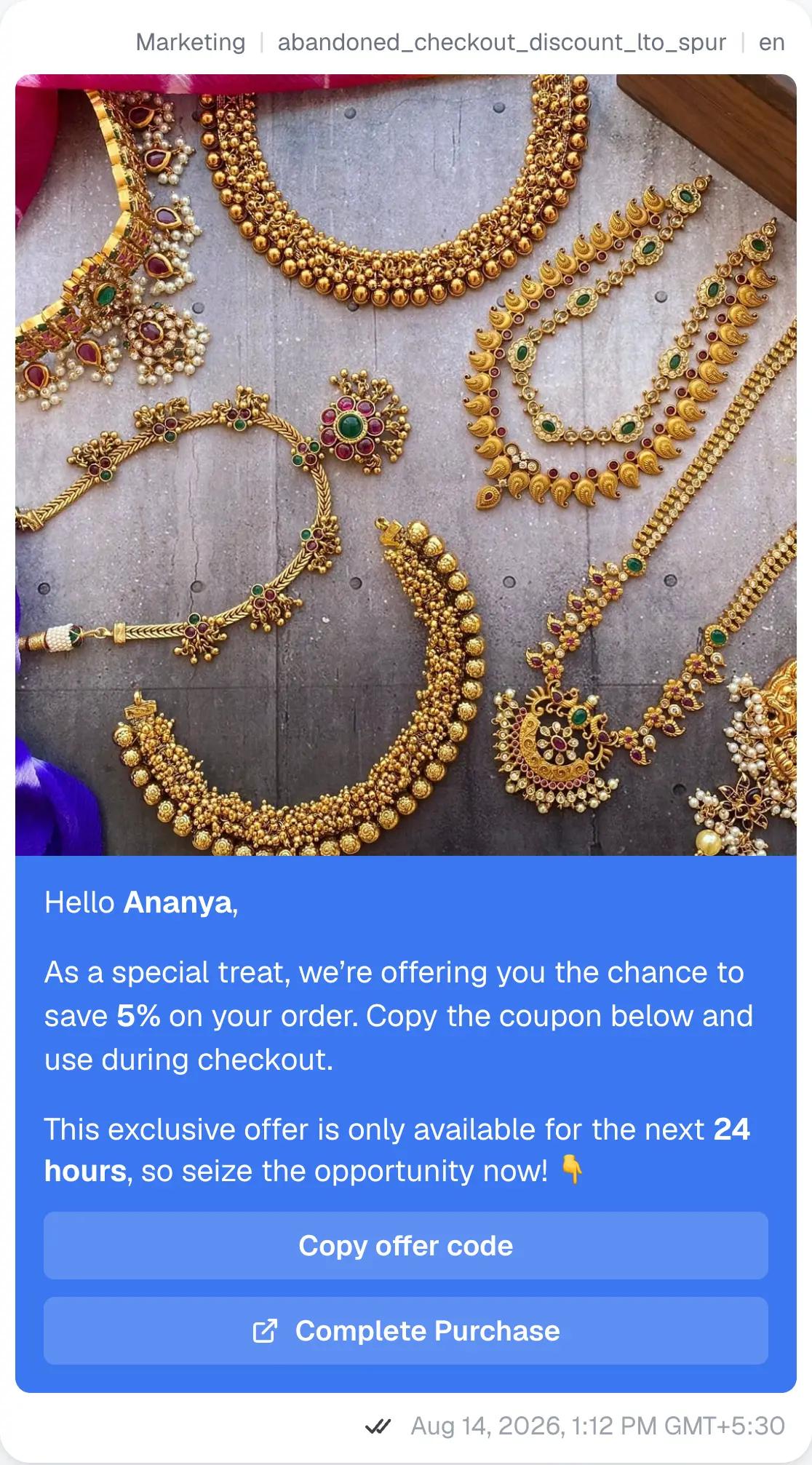
Message three, the only one carrying a discount. The offer window is an example.
What it returned
A 30 day snapshot, rounded, as Daivik reported it.
In the 30 days of the snapshot, the journey recovered 225 orders and ₹5.3 lakh of attributed revenue from about 4,500 delivered messages. Daivik reports the recovery rate at 5%.
Those are rounded figures from a single 30 day window, and jewellery is a category where a few high value pieces move the revenue total. What the numbers show clearly is that a journey which delays the discount to the last message still recovers carts at a healthy rate, without giving five percent away to the customers who only needed a nudge.
Abandoned checkout journey, 30 day snapshot
| Metric | Reported |
|---|---|
| Attributed revenue | ₹5.3 lakh |
| Orders recovered | 225 |
| Messages delivered | ~4,500 |
| Recovery rate | 5% |
| Revenue per recovered order ₹5,30,000 ÷ 225 | ~₹2,360 |
| Delivered messages per recovered order 4,500 ÷ 225 | ~20 |
Rounded results from a 30 day case study snapshot, as published by Spur with Daivik on 25 August 2026. The two derived rows are calculated from the rounded figures above them and are approximate.
Messages to orders
- Messages delivered ~4,500
Up to three per abandoned checkout
- Orders recovered 225
5% recovery rate, as reported
Daivik reports the recovery rate as 5%. The funnel is drawn from the two published counts; the rate is theirs and is not recomputed here.
Why it worked
Three things carried this result, and none of them are specific to jewellery.
The middle message answers the real objection
A hesitant jewellery buyer is asking whether the piece and the brand are what they appear to be. A review from someone who bought it answers that. A discount does not, and worse, it suggests the brand thinks the price is the problem. Putting the proof second means the doubt is addressed before any money is left on the table.
Each message reaches a smaller, more decided group
Because every message drops out anyone who has already ordered, the audience shrinks at each step to the people who still have not decided. By the time the discount goes out, it is reaching only the customers for whom the reminder and the proof were not enough. That is the smallest possible group to give margin to.
The discount stays small because it comes last
A flow that leads with a discount has to keep raising it. A flow that leads with a reminder and proof can afford a small one at the end, because by then the offer is closing a decision rather than making one. Customers who convert earlier pay full price, and nobody is taught to abandon a cart to wait for the code.
How to run this on your own store
For any considered purchase where the doubt is about the product, not the price.
-
Use abandoned cart messages, not plain sends
In Spur, abandoned cart message steps exit the customer the moment they buy. Build the journey from those so nobody who has ordered hears from it again.
-
Remind first, at full price
About an hour after the checkout is abandoned, send the items and a button back to the cart. Many people were only interrupted.
-
Put your proof second
A real review of the product in the cart, with the stars, about a day later. If you collect reviews on WhatsApp too, this is where they pay for themselves.
-
Make the offer small, late and short lived
A single digit discount at about two days, valid for a set number of hours, with a copy code button. It should read as a reason to act now, not as the price.
-
Read the snapshot honestly
Take a full 30 days, count recovered orders and attributed revenue, and note the recovery rate. In high value categories a handful of orders move the total, so watch the trend over several windows.
Questions people ask about this journey
From the reviews already on Daivik’s store. The message pulls one in rather than carrying a fixed line, so it speaks to what the customer was looking at rather than to the brand in general. Brands that collect reviews on WhatsApp through Spur, the way Debaans does, have a steady supply for exactly this message.
Because most of the people who convert on the reminder would have paid full price, and an early discount teaches everyone else to abandon and wait. Holding the offer to the third message means it reaches only the customers the reminder and the proof did not convince.
No. Every step is an abandoned cart message in Spur, and the customer leaves the journey the moment their order is placed. Someone who buys after the reminder never sees the review or the code.
All three are marketing templates. A cart is not a completed transaction, so Meta does not approve these as utility, and Spur’s built-in abandoned checkout template is a marketing template too. Each one carries an opt out line, and Spur respects the opt out across every flow.
It is a reported figure from one 30 day window in a high value category, where a few orders move the revenue total. The more useful reading is that the rate held while the discount was pushed to the end and kept small. Watch your own rate across several windows before changing the timing.
The abandoned checkout flow is built into Spur. Connecting Shopify, writing the three messages and getting the two marketing templates approved by Meta is an afternoon. Approval usually takes minutes and can take up to a day.
Was this page useful?
More customer stories
Other brands running the same channels, with the numbers they reported.


Put proof where the second discount used to be
Spur connects to Shopify, sends the reminder, the review and the offer in that order, and drops anyone who buys out of the journey. Daivik recovered 225 orders this way in 30 days.
7-day free trial
- Meta Business Partner
- Shopify Partner

- 7-day free trial
- Connects to Shopify in minutes
- Billed per conversation delivered
- Meta Business Partner
- Shopify Partner