Best WhatsApp API Provider in India (2026)

Discuss with AI
Get instant insights and ask questions about this topic with AI assistants.
💡 Pro tip: All options include context about this blog post. Feel free to modify the prompt to ask more specific questions!
TL;DR: Every comparison article shows you subscription prices and calls it a day. The real cost is the message-rate markup that turns a "cheap" ₹1,500/month platform into a far more expensive one once you're running real campaigns. For Indian businesses that want WhatsApp + Instagram + AI support in one place, Spur is the most complete option out there. Start your free trial here.
Most comparison articles about WhatsApp API providers in India do one thing: list subscription prices in a table, throw in a few bullet points, and close with a generic "it depends on your needs" conclusion. What they skip is the part that actually determines your real monthly cost (the message-rate markup), why your provider choice matters more in 2026 than it did two years ago (Meta updated its AI terms in March 2026), and why a WhatsApp-only tool is increasingly a limitation rather than a feature.
We've been building Spur since 2022, helping Indian D2C brands, real estate teams, education companies, and service businesses set up WhatsApp automation, Instagram lead flows, and AI support agents. We've seen the questions these teams ask, the mistakes they make, and the vendors they end up regretting. This guide is our honest attempt to give you a complete picture, including where Spur is the right choice and where a different tool might actually serve you better.
Best WhatsApp API Providers for Indian Businesses in 2026
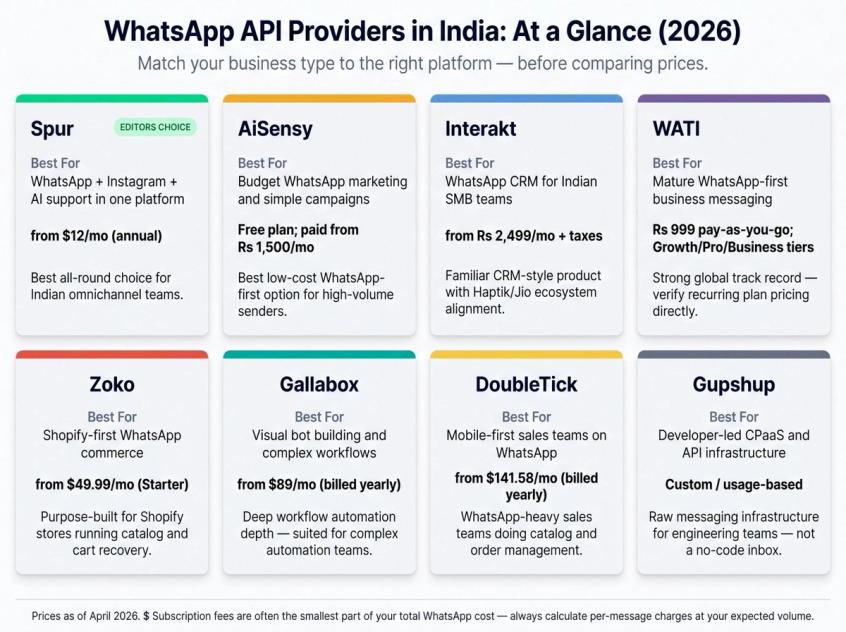
If you're looking for a fast shortlist, here it is. But read the sections below before picking purely on price. The subscription fee is often the smallest part of your actual cost.
| Provider | Best For | Starting Price (Apr 2026) | Quick Verdict |
|---|---|---|---|
| Spur | WhatsApp + Instagram + live chat + AI support in one platform | $12/mo (annual AI Acquire), $31/mo (annual AI Start) | Best all-round choice for omnichannel Indian businesses wanting marketing, support automation, AI agents, and ecommerce flows together |
| AiSensy | Budget WhatsApp marketing and simple campaigns | Free plan; paid from ₹1,500/mo | Strong low-cost WhatsApp-first option, but chatbot flows cost extra on top of the base plan |
| Interakt | WhatsApp CRM, inbox, campaigns, and Haptik/Jio ecosystem | ₹2,499/mo + taxes (Growth) | Good for Indian SMB teams that want a familiar WhatsApp CRM-style product |
| WATI | Mature WhatsApp-first business messaging | ₹999 pay-as-you-go; Growth/Pro/Business tiers | Strong feature set; verify current recurring plan pricing before committing |
| Zoko | Shopify-first WhatsApp commerce | $49.99/mo (Starter) | Excellent for Shopify stores focused on WhatsApp catalog, cart recovery, and ecommerce flows |
| Gallabox | Visual bot building and complex workflow automation | $89/mo (billed yearly) | Powerful workflow depth, but typically more expensive than India-focused entry-level tools |
| DoubleTick | Mobile-first sales teams and order workflows | $141.58/mo (billed yearly) | Useful for WhatsApp-heavy sales teams; not the cheapest for basic automation |
| Gupshup | Developer-led, high-volume CPaaS and API infrastructure | Custom / usage-based | Best when your engineering team needs raw messaging infrastructure, not a no-code business inbox |
Our recommendation: Choose Spur if you want WhatsApp API plus Instagram automation, AI customer support, live chat, broadcasts, shared inbox, and ecommerce automations in one platform. Choose AiSensy if your primary goal is low-cost WhatsApp campaigns and you don't need multi-channel support. Choose Zoko if you're Shopify-first and WhatsApp commerce is the main use case. Choose Gupshup if your engineering team wants programmable infrastructure rather than a ready-to-use business app.
Before you pick from that table, there are two things worth understanding first. Most comparison articles skip both of them.
What Does a WhatsApp API Provider Actually Do in 2026?
When businesses in India search for the best WhatsApp API provider, they're usually not shopping for the raw API itself. They're trying to answer a different set of questions:
- How do I officially use WhatsApp Business API without risking a ban?
- Which provider helps me send broadcasts, automate replies, and manage customer chats?
- What will this actually cost after Meta charges, platform fees, GST, wallets, and any markups?
- Can my team use it without developers?
- Can I connect Shopify, WooCommerce, Razorpay, CRM systems, and support workflows?
- Will the provider help with template approvals, number setup, and quality rating?
- Can I use AI safely on WhatsApp in 2026?
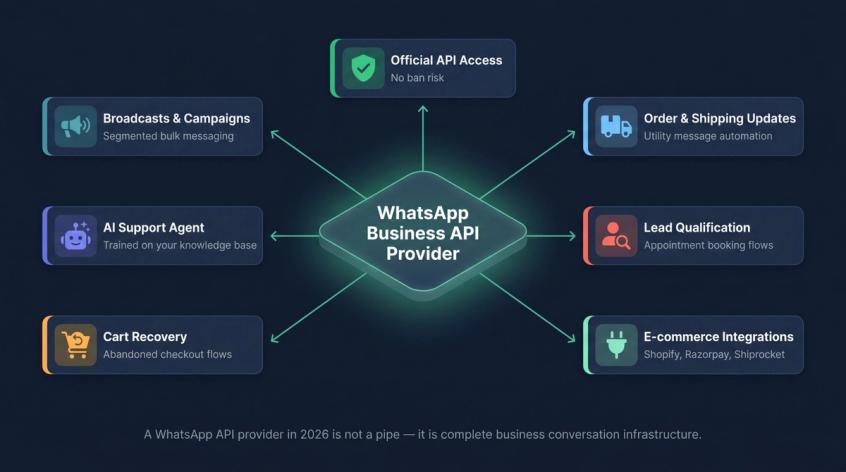
That last question matters more now than it did before. WhatsApp's Business Solution Terms were last modified on 6 March 2026, and the updated terms now include a specific "AI Providers" section. Broad, general-purpose AI assistants can't use WhatsApp Business Solution as the primary way to distribute those AI technologies. Businesses can still use AI providers as third-party service providers for business-specific workflows, but there are clear restrictions on how Business Solution Data can be used for AI model training.
So a "WhatsApp API provider" in 2026 isn't just a sending pipe. It should help you run compliant, useful business conversations: support, sales, order updates, lead qualification, appointment booking, cart recovery, and campaigns. That also means choosing a provider whose AI approach is grounded in your specific business data and workflows (not a generic chatbot), but one trained on your actual knowledge base.
Now that you understand what you're actually buying, the next thing to get right is the cost model. This is where most businesses make an expensive mistake.
What WhatsApp API Actually Costs in India (Beyond the Subscription Fee)
The part most comparison articles skip: your subscription fee is often the smallest line item on your monthly WhatsApp bill.
Meta now charges businesses per delivered template message. The charge depends on the recipient's country and the message category. There are four categories:
| Category | What It Covers | India Planning Rate (Apr 2026) |
|---|---|---|
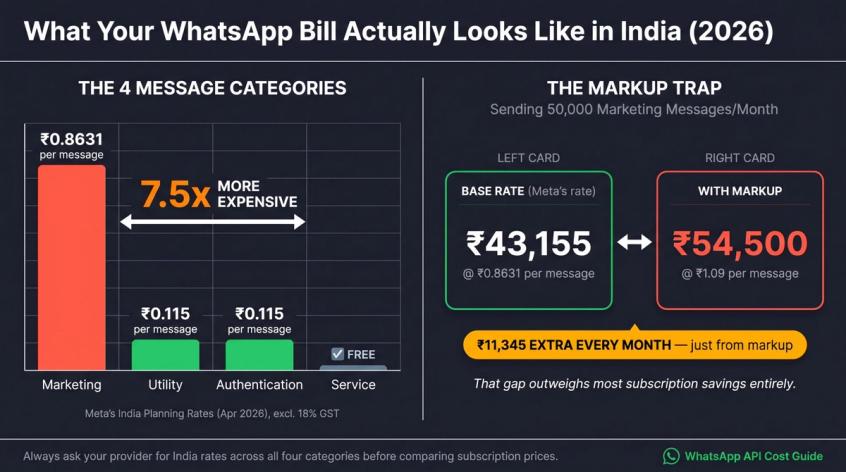
| Marketing | Offers, promotions, abandoned cart nudges, product drops, upsells | ~₹0.8631 per message |
| Utility | Order confirmations, shipping updates, payment reminders, account updates | ~₹0.115 per message |
| Authentication | OTPs and login verification | ~₹0.115 per message |
| Service | Replies inside the 24-hour customer service window | Free |
Published India rate data shows rates of ₹0.115 for utility and authentication, and ₹0.8631 for marketing, exclusive of 18% GST. Meta updated India marketing rates from $0.0107 to $0.0118 starting 1 January 2026. According to Meta's official platform pricing page, charges are based on delivered messages, category, and country.
Marketing messages are approximately 7.5x more expensive than utility messages in India. That gap matters enormously when you're planning campaign volumes.
Meta also maintains a 72-hour free entry point conversation window for interactions that start from click-to-WhatsApp ads or a Facebook Page call-to-action button.
How Message Rate Markups Make "Cheap" Providers Expensive
The rates above are Meta's base rates. Not every provider passes these through at cost. Some providers add a markup, some charge through a wallet at bundled rates, and some offer lower rates at higher plans or volumes.
A concrete example: AiSensy's India message charges are ₹1.09 for marketing and ₹0.145 for utility and authentication. Both are higher than the base planning rates listed above.
This isn't a criticism of AiSensy specifically. Pricing structures exist for valid business reasons. The point is:
If you send 50,000 marketing messages per month at ₹1.09 instead of ₹0.8631, that's ₹54,500 vs. ₹43,155. The gap of ₹11,345 per month more than offsets the savings from a cheaper subscription tier.
WhatsApp Message Cost Breakdown for India (2026)
| Scenario | Approximate Message Cost (before platform fee and GST) |
|---|---|
| 10,000 marketing messages at ₹0.8631 | ₹8,631 |
| 10,000 utility messages at ₹0.115 | ₹1,150 |
| 10,000 marketing messages at ₹1.09 markup rate | ₹10,900 |
| 5,000 support replies inside the service window | ₹0 (Meta doesn't charge) |
The practical takeaway: always ask any provider for their current India rates across all four categories, and confirm whether they add markup over Meta's base rates. Do this before you compare subscription prices. For a full breakdown of how these charges work across providers, see our WhatsApp API pricing guide. You can also use the WhatsApp pricing calculator to model your actual monthly cost.
With the cost model clear, here's what to actually look for in a provider.
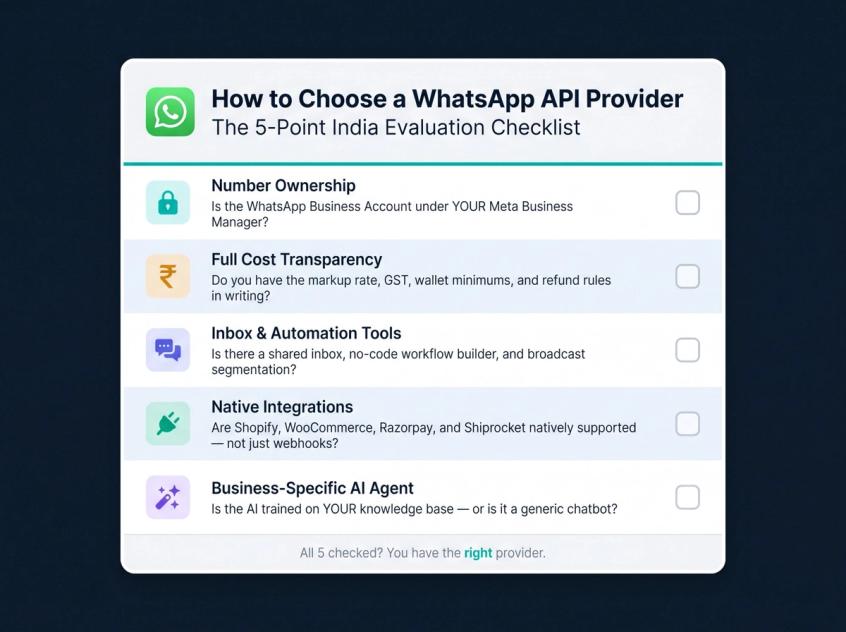
How to Choose a WhatsApp API Provider in India: 5 Things That Matter
Five criteria matter most for Indian businesses evaluating providers.
Does Your Provider Give You Full Ownership of Your WhatsApp Number?
You want an official WhatsApp Business API setup through Meta's approved process, not an unofficial automation layer built on top of WhatsApp Web. Ask whether you can use your existing number, whether the number is portable if you switch providers, who owns the WhatsApp Business Account (it should be under your Meta Business Manager, not the vendor's), and whether the provider supports embedded signup.
Watch-out: Understanding what causes WhatsApp template rejections early on will save you headaches with approvals.
Getting the Full Cost Picture Before You Sign Up
Get the full cost model in writing before you commit. The complete picture includes: monthly platform fee, Meta/WhatsApp message charges by category, any vendor markup on those charges, GST treatment, wallet recharge minimums, refund rules on unused balance, add-on costs for extra users, extra WhatsApp numbers, chatbot or AI functionality, webhooks, and any onboarding or support fees.
A provider that makes you ask for this information piecemeal during a sales conversation is often obscuring the part that'll surprise you later.
Does the Platform Have a Real Inbox and Automation Tools?
The API itself doesn't give your team a good working surface. Most teams need a shared inbox with agent assignment and internal notes, broadcast tools with segmentation, a no-code workflow builder for chatbot flows and drip sequences, template management, conversation history, tags, quick replies, and basic reporting. The depth of these tools varies significantly across providers.
Native Shopify, WooCommerce, and Razorpay Integrations That Actually Work
For D2C brands and Indian e-commerce teams, the integration list matters more than most platforms admit. Check for native Shopify, WooCommerce, Razorpay, Shiprocket, and Return Prime support. Some providers list these integrations but deliver only a webhook that requires developer configuration.
Spur, for instance, has a dedicated Shopify integration page covering order updates, abandoned cart recovery, product recommendations, support, order management, and WhatsApp marketing campaigns. No custom development needed for standard e-commerce flows.
AI Agents Trained on Your Business Data, Not Generic Chatbots
In 2026, an AI agent on WhatsApp should answer product-specific questions, track orders, handle returns, qualify leads, book appointments, and hand off to humans with full conversation context. It should be trained on your specific knowledge base, not a general-purpose model that might say anything. And given WhatsApp's 2026 AI Provider terms, it needs to operate as a business-specific tool, not as a general AI distribution platform.
The provider that consistently checks all five of these boxes is the one we built. Here's an honest look at it.
Why Spur Is the Best WhatsApp API Provider for Indian Businesses
We're being transparent here: this section is about our own product. We're writing it honestly, including the watch-outs, because we've seen how Indian businesses get burned by choosing the wrong tool based on incomplete information. You can see Spur's full product page here.
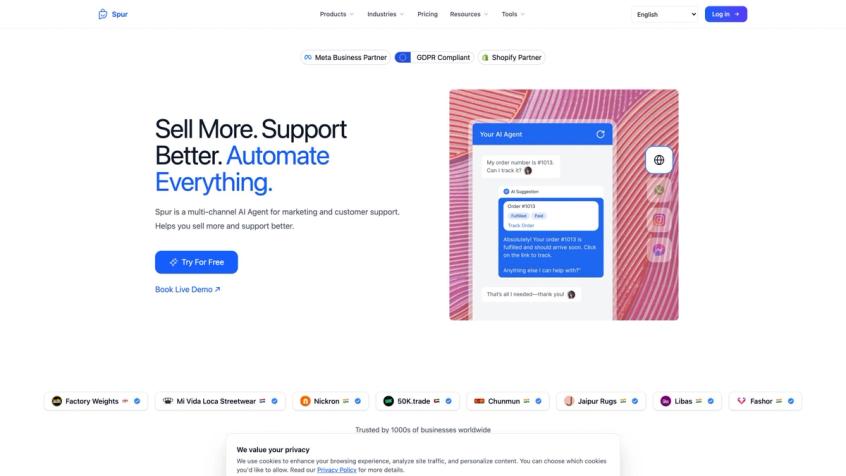
Spur's homepage captures the platform's core promise at a glance — a multi-channel AI agent for marketing and customer support, backed by Meta Business Partner and Shopify Partner credentials, with real Indian brands already running on it.
How Spur Combines WhatsApp API, Instagram, and AI Support in One Platform
Spur is built around two core capabilities that most platforms split between separate tools.
The first is an AI customer support agent: trained on your website, product catalog, help docs, and any other knowledge sources you connect. It deploys across WhatsApp, Instagram, Facebook Messenger, and your website's live chat widget. It can answer product questions, look up order status, handle FAQs, and hand off to a human agent when needed, with the full conversation context intact. This is meaningfully different from a keyword-trigger bot or a generic chatbot that isn't trained on your specific business data.
The second is a customer engagement and marketing automation platform: WhatsApp broadcasts with segmentation, abandoned cart recovery flows, order and shipping update sequences, click-to-WhatsApp ad capture, Instagram comment-to-DM automation, drip campaigns, and bulk outreach with DeliveryBoost technology for improved deliverability. Both capabilities live in one platform, with a shared inbox that covers WhatsApp, Instagram, Facebook, and live chat together.
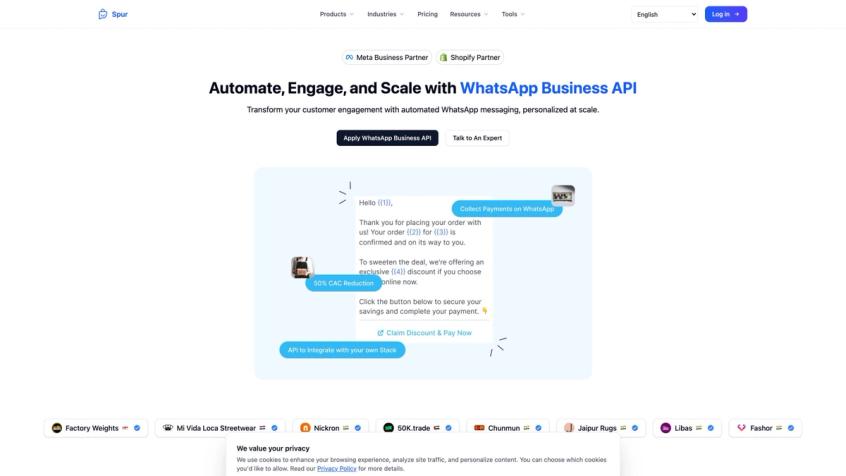
The WhatsApp Business API product page shows this in practice — from the apply CTA to a live message template demo with cart recovery and payment flows built in.
What Makes Spur Different from Other WhatsApp API Providers
The practical reason most Indian businesses find Spur useful is pretty straightforward: customers don't think in channels. A customer might find you through an Instagram post, DM you a question, click a WhatsApp ad, abandon their cart on your Shopify store, and later message your live chat widget for support. If each of those touchpoints is managed by a different tool, your team loses context at every handoff.
Spur is built to cover that full journey:
- WhatsApp broadcasts and cart recovery flows
- Instagram comment-to-DM and DM automation
- Click-to-WhatsApp and click-to-Instagram ad capture
- Shared inbox for WhatsApp, Instagram, Facebook, and live chat in one place
- AI agents trained on your specific knowledge base, not generic data
- E-commerce automation: cart recovery, order updates, shipping notifications, upsells, cross-sells
- Shopify, WooCommerce, Razorpay, Stripe, Shiprocket, and Return Prime integrations
Spur is also an official Meta Business Partner (approved by Meta on 15 July 2022 and listed in the Meta Partner Directory), which matters for template approvals, number setup, and API reliability.
Spur Pricing Plans for 2026: What You Get at Each Tier
Spur's annual plan prices as of April 2026 (with the 20% annual discount applied):
| Plan | Annual Price | Best For |
|---|---|---|
| AI Acquire | $12/mo | Entry-level AI, Instagram automation, click-to-DM |
| AI Start | $31/mo | Small teams: WhatsApp automation, Shopify, click-to-WhatsApp ads, 1 AI agent |
| AI Accelerate | $127/mo | Growing teams: more AI credits, 5 seats, 50 flows, webhooks, custom AI actions |
| AI Max | $399/mo | Larger teams: 10 seats, unlimited flows, dedicated account manager, bulk WhatsApp pricing |
All plans include unlimited contacts, unlimited broadcasts, unlimited automation executions, unlimited tags, and unlimited tickets. The limits by plan are AI agents, AI credits, channels, flows, and seats. WhatsApp conversation charges run through Spur's wallet (you don't pay Meta directly), and Spur publishes its rate card publicly.
For context: on the AI Start plan ($31/mo), if you send 2,000 Indian marketing messages in a month at Spur's published India marketing rate, the WhatsApp cost would be approximately $20.60, bringing your total monthly cost to about $51.60 before GST. That scales with your broadcast volume, so verify your actual rate inside the dashboard before large campaigns.
Built for Indian E-Commerce: Shopify, WooCommerce, and Razorpay
Spur's integrations are specifically built for Indian commerce stacks. The Shopify integration covers order updates, abandoned cart recovery, product recommendations, support automation, and WhatsApp marketing campaigns, all without developer setup for standard e-commerce flows.
The WooCommerce integration, Razorpay, Shiprocket, and Return Prime integrations are also available as first-class native connections.
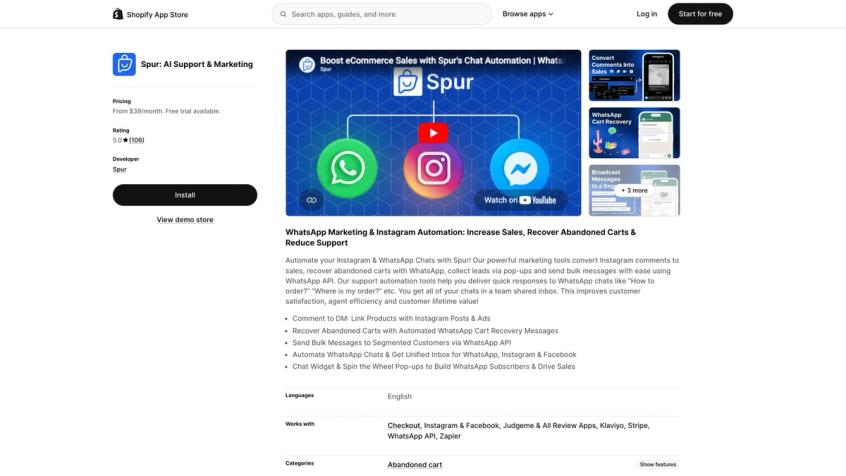
Spur also holds a 4.9/5 rating on the Shopify App Store (across 78 reviews as of mid-2025), which is a useful signal for how the product actually performs for Indian e-commerce teams in practice.
The Shopify App Store listing shows the product's real market standing — 5.0 stars, 100+ reviews, and integrations with Instagram & Facebook, Klaviyo, Stripe, WhatsApp API, and Zapier out of the box.
When Spur Might Not Be the Right Fit
Spur isn't the right choice in every situation. If you only want a raw messaging API for developer-built integrations and no dashboard, look at Gupshup, MSG91, or Twilio instead.
Spur prices in USD on the public website, so Indian buyers should confirm the exact INR billing, GST treatment, wallet terms, and WhatsApp message rates before a large rollout. Spur's terms also state that subscription fees and WhatsApp conversation charges are non-refundable if you cancel, and unused wallet balance isn't returned. That's a standard position in this industry, but worth knowing before you load a large wallet balance.
Try Spur Free for 7 Days
Start a free 7-day trial at Spur to explore the WhatsApp API setup, Instagram automation, AI agent configuration, and Shopify integration. No developer required to get started.
If Spur doesn't fit your exact use case, here's an honest look at the other options worth knowing about.
Other WhatsApp API Providers in India: Honest Reviews
AiSensy Review: Best Budget WhatsApp API Platform in India?
AiSensy is one of the most widely used WhatsApp API platforms in India, particularly popular with small businesses, education providers, healthcare practices, and teams running WhatsApp broadcast campaigns.
As of April 2026, AiSensy's current pricing is:
| Plan | Price | Key Inclusions |
|---|---|---|
| Free | ₹0 | WhatsApp API setup, ₹50 credits, live chat, template creation, unlimited free service conversations |
| Basic | ₹1,500/mo (or ₹1,350/mo annual) | 6 agents, broadcasts, segmentation, Shopify/WooCommerce, shared inbox |
| Pro | ₹3,200/mo (or ₹2,880/mo annual) | Tags, custom attributes, scheduler, click tracking, routing, analytics, APIs, rules |
| Enterprise | Custom | Higher scale, priority support, webhooks, dedicated manager |
AiSensy's India message charges are ₹1.09 for marketing and ₹0.145 for utility and authentication. Both are above Meta's base planning rates, which is worth calculating at your expected send volumes.
One watch-out worth flagging: AiSensy's no-code chatbot functionality is a separate add-on at ₹2,500/month monthly (or ₹2,250/month annually) for up to 5 chatbots. This isn't included in the base plan pricing. Factor this in before comparing the sticker price to alternatives.
AiSensy is the right choice if you want a WhatsApp-first platform, your monthly broadcast volume is relatively low, and you don't need deep omnichannel support across Instagram, website live chat, and AI-driven automation. If you're evaluating both options, see how Spur compares to AiSensy side by side.
Interakt Review: WhatsApp CRM for Indian SMB Teams
Interakt is backed by the Haptik/Jio ecosystem and is a well-known option for Indian businesses that want a WhatsApp-focused CRM, campaign management, shared inbox, and commerce features.
Interakt's pricing as of April 2026:
→ Growth at ₹2,499/mo + taxes: includes WhatsApp + Instagram, campaigns, shared inbox, basic chatbot, Shopify integration, public APIs/webhooks, and assisted setup
→ Advanced at ₹3,499/mo + taxes: adds advanced chatbot capability, routing, and incoming-message webhooks
→ Enterprise at custom pricing: no markup charges, dedicated account manager, and enterprise features
One thing to confirm upfront: Interakt has multiple product lines (Marketing & Support Hub and Sales CRM), so make sure you're comparing the exact product configuration you need. Also clarify whether your plan price includes or excludes any vendor markup on WhatsApp message charges before signing.
Interakt is the right choice if you want a familiar Indian WhatsApp CRM-style platform with INR pricing, Haptik/Jio ecosystem alignment, and you're comfortable with its product structure. If you're weighing Spur against Interakt, our Spur vs. Interakt comparison covers the key differences.
WATI Review: Is It Still the Best WhatsApp Business API Platform?
WATI is one of the most recognized WhatsApp Business API platforms globally, trusted by over 16,000 customers. It covers marketing, sales, support, team inbox, no-code chatbots, broadcasts, click-to-WhatsApp ads, automation, and AI functionality.
WATI's current pricing shows a single-user pay-as-you-go plan at ₹999 (which includes ₹999 in message credits, 3-month validity, and up to 500 messages) alongside Growth, Pro, and Business tiers with feature-based limits on users, broadcasts, automation triggers, integrations, API calls, webhooks, AI credits, and WhatsApp Pay API access.
The important caveat: WATI's recurring subscription pricing for the Growth/Pro/Business tiers isn't clearly exposed on the public pricing page. You'll need a direct conversation with their team to confirm the full recurring cost structure. Do that before committing.
WATI is the right choice if you want a mature, globally recognized WhatsApp-first platform and you're prepared to validate the full plan economics directly with their sales team. For a direct feature-by-feature breakdown, see our Spur vs. WATI comparison.
Zoko Review: Best WhatsApp API for Shopify Stores?
Zoko is purpose-built for Shopify stores that want WhatsApp commerce: catalog selling, abandoned checkout recovery, order notifications, broadcasts, chat automation, and team inbox. It has a strong review track record on the Shopify App Store.
Zoko's pricing:
| Plan | Price | Notes |
|---|---|---|
| Starter | $49.99/mo | WhatsApp rate card plus markup, unlimited agents |
| Plus | $79.99/mo | 5 agents, lower post-quota conversation fee |
| Elite | $139.99/mo | 10 agents, 100k no-markup conversations |
| Max | $499.99/mo | 30 agents, 5M no-markup conversations |
Add-ons include an Instagram platform fee, extra agents, premium flows, and AI agents at $24.99/mo each. Zoko prices in USD, so Indian buyers should account for tax and billing currency.
Zoko is the right choice if your store is on Shopify, WhatsApp commerce is your primary use case, and you want a platform with deep Shopify-specific functionality and a strong e-commerce review track record. To see how Spur's Shopify features compare, check the Spur vs. Zoko comparison.
Gallabox, DoubleTick, and Gupshup: Which Businesses Should Consider These?
Gallabox is a more workflow-intensive WhatsApp platform with visual chatbot building, integrations, webhooks, WhatsApp forms, and AI-powered chatbots on higher tiers. Pricing starts at $89/mo billed annually (Growth, 3 users), scaling to $197/mo (Scale) and $377/mo (Pro). It's a good fit for teams that need deep workflow automation and are comfortable with the premium pricing.
DoubleTick is focused on mobile-first sales teams using WhatsApp for selling, order management, and team collaboration. Pricing starts at $141.58/mo billed annually (Starter, 5 agents). It's not built for simple broadcast automation or omnichannel support.
Gupshup is a CPaaS/messaging infrastructure provider, not a no-code business inbox. Its documentation tracks Meta rate changes in detail, and it noted an additional 6% charge on Cloud API marketing messages starting January 2026. If your team has engineering resources and needs programmable messaging infrastructure at scale, Gupshup is worth evaluating. If you're a founder or marketer looking for a ready-to-use dashboard, it'll feel too infrastructure-heavy.
Here's all of that in a single comparison table.
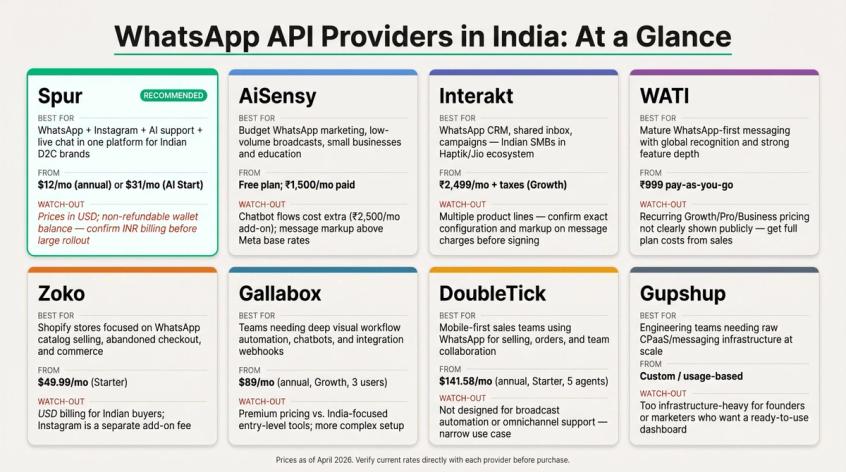
WhatsApp API Provider Feature Comparison (2026)
| Feature | Spur | AiSensy | Interakt | WATI | Zoko | Gallabox | DoubleTick | Gupshup |
|---|---|---|---|---|---|---|---|---|
| WhatsApp Business API | Yes | Yes | Yes | Yes | Yes | Yes | Yes | Yes |
| Shared inbox | Yes | Yes | Yes | Yes | Yes | Yes | Yes | Depends on product |
| Broadcasts | Yes | Yes | Yes | Yes | Yes | Yes | Yes | Via API/platform |
| No-code automation | Yes | Yes | Yes | Yes | Yes | Yes | Yes | Less no-code focused |
| AI support agent | Yes (knowledge base trained) | Available | Available | Yes | Paid add-on | Higher tiers only | Enterprise only | Depends |
| Instagram automation | Yes | Limited/depends | Yes | Yes | Paid/add-on | Depends | No/limited | No/depends |
| Website live chat | Yes | No/limited | No/limited | Yes | No/limited | No/limited | No/limited | No/depends |
| Shopify integration | Strong | Yes | Yes | Yes/add-on | Very strong | Yes | Limited | Custom |
| WooCommerce | Strong | Yes | Depends | Depends | Less central | Depends | Limited | Custom |
| Razorpay integration | Yes (native) | Depends | Depends | Depends | Depends | Yes | Depends | Custom |
| Developer APIs/webhooks | Yes (higher plans) | Yes (higher plans) | Yes | Yes | Yes | Yes | Yes | Very strong |
| INR pricing option | No (USD public pricing) | Yes | Yes | Yes | No (USD) | No (USD) | No (USD) | Custom |
| Best buyer | Omnichannel growth + support teams | Budget WhatsApp teams | WhatsApp CRM teams | Mature WhatsApp teams | Shopify stores | Workflow-heavy teams | Sales teams | Developers/enterprise |
The table tells you what each platform covers. The sections below tell you when to actually choose each one.
Which WhatsApp API Provider Should You Actually Choose?
Each of these platforms is genuinely good at something specific. The wrong choice usually comes from picking on price alone, without matching the tool to how your business actually acquires and supports customers.
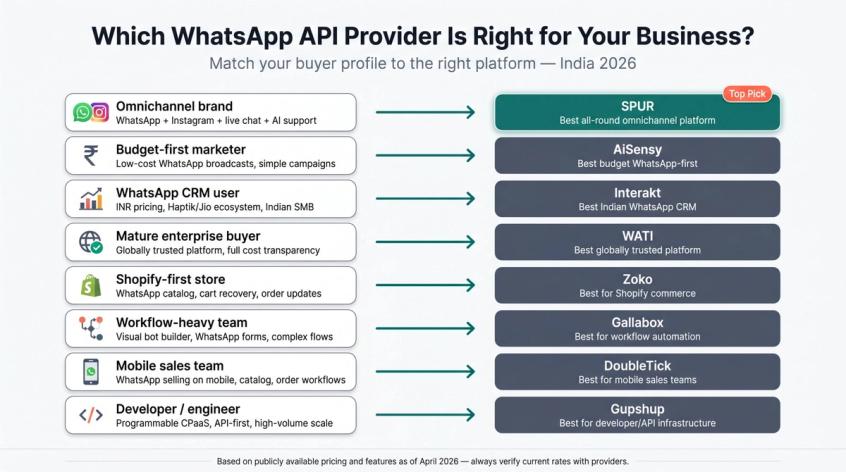
→ Choose Spur if...
You want one platform for WhatsApp + Instagram + live chat + AI support together. Specifically: WhatsApp broadcasts, abandoned cart recovery, order and shipping update flows, click-to-WhatsApp ad capture, Instagram comment-to-DM automation, website live chat with AI, AI agents trained on your knowledge base, a shared inbox for human handoff, and Shopify/WooCommerce/Razorpay/Shiprocket integrations: Spur covers all of it without requiring a developer for standard e-commerce flows. Best fit for D2C brands, real estate teams, education businesses, travel companies, event businesses, and service businesses.
→ Choose AiSensy if...
Your main goal is low-cost WhatsApp broadcasting and simple campaign management, your monthly message volumes aren't high enough to make the markup rate difference material, and you don't need Instagram automation or website live chat.
→ Choose Interakt if...
You want a WhatsApp-first CRM-style product with INR pricing and Indian ecosystem alignment (especially if you're already considering Haptik/Jio ecosystem products), and your team doesn't need deep omnichannel automation beyond WhatsApp and basic Instagram support.
→ Choose WATI if...
You want a mature, globally trusted WhatsApp-first platform, have the budget for a more established product, and you're comfortable doing a thorough sales conversation to validate the full cost structure.
→ Choose Zoko if...
Your store is on Shopify, WhatsApp commerce (catalog selling, cart recovery, order updates) is the core use case, and you want a platform with very strong Shopify-specific functionality and a proven e-commerce track record.
→ Choose Gallabox if...
You need deep visual workflow automation, WhatsApp forms, complex multi-step sales and support processes, and you're comfortable paying a premium for that workflow depth.
→ Choose DoubleTick if...
Your sales team sells through WhatsApp every day on mobile devices, and catalog/order workflows and mobile-first team collaboration are the top priorities.
→ Choose Gupshup if...
Your engineering team needs programmable messaging infrastructure at scale, WhatsApp is one component in a larger technical messaging architecture, and you don't need a no-code business dashboard.
Before you decide, there are five mistakes we see Indian businesses make repeatedly. Worth knowing before you sign anything.
Common Mistakes to Avoid When Choosing a WhatsApp API Provider
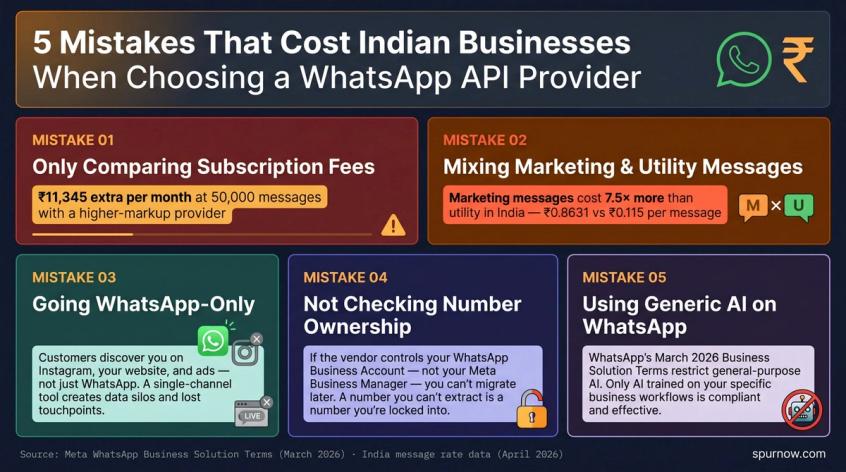
Mistake 1: Comparing Only Subscription Fees
The subscription fee matters, but it's rarely the biggest cost driver once you're running real campaigns. A provider that charges ₹1,500/month but applies a ₹1.09/message India marketing rate costs ₹54,500 in message charges alone at 50,000 messages, before the platform fee and GST. Another provider with a higher subscription but pass-through or near-pass-through message rates can be meaningfully cheaper at that volume. Always calculate total cost at your actual expected message volume, not just the monthly plan price.
Mistake 2: Treating Marketing and Utility Messages as the Same
Marketing messages cost approximately 7.5x more than utility messages in India (₹0.8631 vs ₹0.115 at base rates). Use utility templates for legitimate transactional updates (order confirmations, shipping notifications, payment reminders) and reserve marketing templates for actual promotional campaigns. Using marketing templates for transactional updates doesn't just cost more; it can also affect your template approval rate and quality rating with Meta.
Mistake 3: Choosing a WhatsApp-Only Tool and Ignoring Other Channels
Many customers don't start conversations on WhatsApp. They discover brands through Instagram posts, click on ads, ask questions through website chat, or reach out through multiple channels before settling on WhatsApp. If your provider handles only WhatsApp, you'll either lose those touchpoints entirely or end up managing two or three separate tools, each with their own pricing, their own inbox, and their own data silos.
Mistake 4: Not Checking Number Ownership and Migration Rules
Your WhatsApp number and Business Account are business assets. Before signing with any provider, confirm: who controls the WhatsApp Business Account (it should be under your own Meta Business Manager, not the vendor's), whether you can migrate the number to a different BSP later, whether templates transfer during migration, and what happens to chat history if you switch. A number you can't extract is a number you're locked into.
Mistake 5: Using Generic AI That Violates WhatsApp's 2026 Terms
WhatsApp's updated Business Solution Terms specifically restrict AI on the platform to business-specific workflows. More practically: a generic AI that confidently answers questions outside your product catalog will damage customer trust quickly. The right approach is an AI agent trained on your specific knowledge base, with clear escalation paths to human agents when it reaches the edge of what it knows. This is exactly how AI should work on WhatsApp in 2026.
Which WhatsApp API Provider Should Indian Businesses Choose in 2026?
The best WhatsApp API provider for Indian businesses in 2026 isn't the one with the lowest subscription price. It's the one that fits how your customers actually interact with you and how your team actually works.
If customers are finding you on Instagram, messaging you on WhatsApp, and coming back through your website's chat widget, a WhatsApp-only tool handles only one part of that journey. You'll end up buying more tools, managing more logins, and losing conversation context at every handoff.
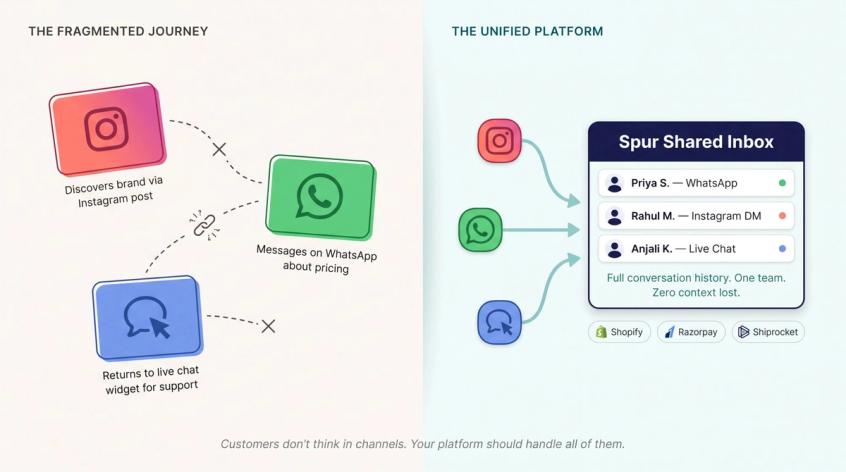
We built Spur specifically for the Indian business reality: multi-channel customer touchpoints, e-commerce stacks built on Shopify and WooCommerce, payments through Razorpay, logistics through Shiprocket, and support teams that can't afford to switch between five different dashboards.
Our AI agents are trained on your specific knowledge base, not generic data. Our broadcast and automation tools run across WhatsApp and Instagram in one workflow builder. Our shared inbox keeps your whole team on the same page.
For most Indian businesses doing D2C commerce, real estate, education, travel, or service delivery, and wanting serious WhatsApp + Instagram campaigns alongside automated support, Spur is the most balanced choice available in 2026.
Customers don't think in channels. They message wherever it's easiest. The platform that wins is the one that gives your team one place to automate, reply, route, recover revenue, and improve the customer experience across the whole journey.
Start your free 7-day trial at Spur and see how it works for your specific setup.
Frequently Asked Questions
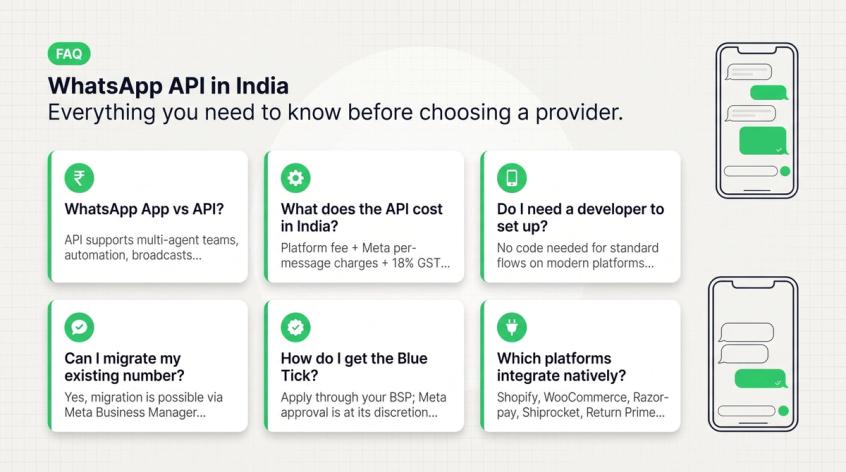
What is the difference between WhatsApp Business App and WhatsApp Business API?
The WhatsApp Business App is a free mobile app for small businesses. It supports a single device, one user, and doesn't allow automated broadcasts or chatbot flows. The WhatsApp Business API is Meta's programmatic interface designed for businesses that need multi-agent team access, automated messaging, broadcast campaigns, chatbot automation, and integration with CRM and e-commerce systems. The API doesn't come with a built-in interface, which is why businesses use providers like Spur to get a complete platform on top of it.
How much does WhatsApp Business API cost in India in 2026?
Your total WhatsApp API cost has two parts: a platform fee to your Business Solution Provider (BSP), and Meta's per-delivered-template-message charge. For India, the planning rates as of April 2026 are approximately ₹0.8631 for marketing messages, ₹0.115 for utility and authentication messages, and free for service messages (replies inside the 24-hour customer window). Platform fees vary by provider: Spur's AI Start plan is $31/month on annual billing, AiSensy's Basic plan starts at ₹1,500/month, and Interakt's Growth plan is ₹2,499/month plus taxes. Always calculate your expected message volumes to determine real monthly cost, and add 18% GST on top. Our WhatsApp API pricing guide walks through all the cost components in detail.
Do I need a developer to set up WhatsApp Business API?
Not with modern no-code platforms. With Spur, you can connect your WhatsApp number, set up automation flows, configure AI agents, and integrate with Shopify without writing any code. The process involves completing Meta's business verification and connecting your number through the platform's embedded signup flow. Some advanced features (webhooks, custom API integrations) may need developer involvement, but standard business use cases (broadcasts, chatbots, shared inbox, e-commerce flows) don't.
Can I use my existing WhatsApp number with a new API provider?
Yes, you can migrate an existing WhatsApp Business number to the API. The migration process involves verifying ownership through Meta's Business Manager. You'll need to check whether your current setup allows a clean migration, whether your templates carry over, and what happens to existing chat history. Always confirm migration rules with the provider before signing up. Make sure the WhatsApp Business Account is registered under your own Meta Business Manager, not the vendor's.
What is the difference between marketing, utility, authentication, and service messages on WhatsApp?
These are Meta's four template message categories, and the pricing difference is significant. Marketing messages are for promotional content: offers, product launches, abandoned cart recovery, and campaign broadcasts. Utility messages are transactional: order confirmations, shipping updates, payment reminders, and account alerts. Authentication messages are for OTPs and security verification. Service messages are replies within the 24-hour customer service window after a user initiates contact. These are currently free. In India, marketing messages cost approximately 7.5x more than utility or authentication messages, so categorizing your templates correctly saves real money. See our WhatsApp pricing breakdown for the full cost model.
How do I get a WhatsApp Blue Tick (verified business badge) in India?
WhatsApp's blue tick verification (previously called the green tick) is available to businesses that meet Meta's eligibility criteria, typically businesses with a significant online presence and verified contact information. The process involves submitting your business for verification through your BSP or through Meta's Business Manager. Spur offers a WhatsApp Blue Tick Verification service that handles the application process. You can also read our complete guide to WhatsApp Blue Tick verification for a step-by-step walkthrough. Approval is at Meta's discretion and isn't guaranteed.
Can I integrate WhatsApp API with Shopify, Razorpay, or Shiprocket?
Yes, and this is one of the key differentiators between platforms. Spur has native integrations with Shopify, WooCommerce, Razorpay, Shiprocket, Stripe, and Return Prime. These integrations enable real-time order updates, abandoned cart recovery messages, payment confirmations, and shipping notifications through WhatsApp, without developer setup for standard use cases. Other platforms like AiSensy, Interakt, WATI, and Zoko also offer Shopify connectivity, though the depth and native support vary.
Is Spur an official Meta Business Partner?
Yes. Spur was approved by Meta on 15 July 2022 and is listed as an official Meta Tech Partner. This matters for template approvals, WhatsApp number setup, and API reliability. As an official partner, Spur uses Meta's WhatsApp Cloud API infrastructure, which means your WhatsApp Business Account connects directly through Meta's approved channel rather than through unofficial workarounds.
What is a WhatsApp Business Solution Provider (BSP)?
A Business Solution Provider (BSP) is a company that Meta has officially authorized to provide access to the WhatsApp Business API. Instead of working directly with Meta's API (which requires significant technical resources), businesses work with a BSP that provides a ready-made platform with an inbox, automation builder, broadcast tools, and support. BSPs like Spur, AiSensy, Interakt, WATI, and Zoko are all authorized through Meta's partner program. The BSP manages the API connectivity, template submissions, number registration, and ongoing platform maintenance on your behalf.