Key takeaways
- There is no single best omnichannel platform. Choose by the customer journey you run, such as enterprise ticketing, SaaS in-app support, Shopify support or WhatsApp and Instagram messaging.
- Omnichannel means your channels share customer identity, context and history, so customers never repeat themselves. Separate tools for each channel is only multichannel.
- Judge platforms on six things: native support for your channels, AI trained on your data that can take actions, a shared inbox with handoff, ecommerce and CRM integrations, outbound campaigns, and total cost.
- Budget beyond the subscription: WhatsApp per-message fees by country and category, AI credits, per-seat charges, and add-ons such as extra numbers or branding removal.
- Test for 5 to 7 days on your real channels before buying: ask 50 real customer questions, force a human handoff and run one real action, such as an order status check.
Ask an AI about this article
There's no single best omnichannel customer engagement platform.
There's only the best one for your actual customer motion.
A D2C brand recovering abandoned carts on WhatsApp and turning Instagram comments into sales doesn't need the same stack as a 500-agent support center. A SaaS company automating web chat with an AI agent doesn't need the same stack as an enterprise team running push notifications, email, in-app, and SMS lifecycle campaigns.
That's why most "best omnichannel platform" lists aren't very useful. They mix helpdesks, chatbot builders, WhatsApp tools, CRM systems, and enterprise lifecycle marketing suites into one table, then act like they're interchangeable. They're not.
The better question isn't "what's the best platform?" It's: "what customer journey do we need to run, and which platform runs it end to end?"
This guide breaks the market into the actual jobs buyers hire these platforms to do, so you can match the tool to the work, not the other way around.
What is an omnichannel customer engagement platform?
"Omnichannel" is one of those words that's been used so broadly it's almost lost meaning. So let's start with the real definition, because it matters for choosing correctly.
An omnichannel customer engagement platform isn't just "a tool with many channels." That's the shallow version.
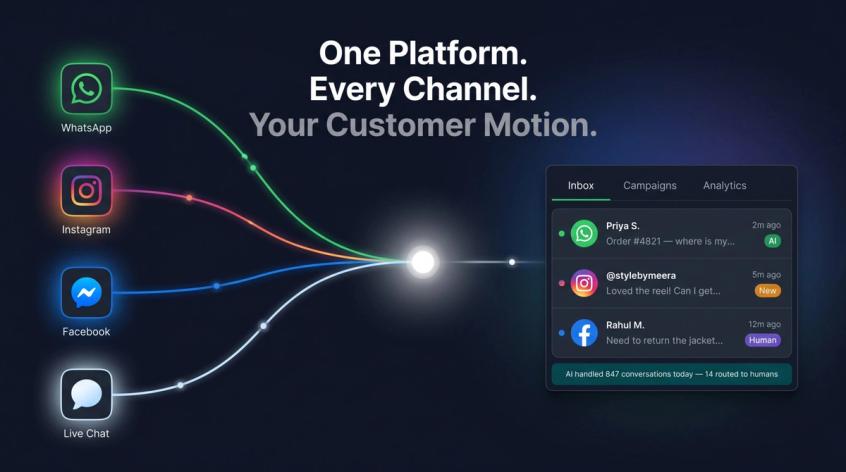
The real definition: an omnichannel customer engagement platform lets a business recognize the same customer across channels, continue the conversation without losing context, automate repetitive work, hand off to humans when needed, and measure the outcome.
In practice, a real platform needs five layers:
- Channel layer: WhatsApp, Instagram, Facebook Messenger, website chat, email, SMS, phone, in-app, push, or whichever channels your customers actually use.
- Identity layer: The platform should know that the person who clicked an Instagram ad, chatted on WhatsApp, and opened a support ticket is the same customer.
- Conversation layer: A shared inbox, tickets, assignments, internal notes, tags, CSAT, routing rules, and conversation history.
- Automation and AI layer: Chatbots, workflows, AI agents that take real business actions, knowledge-base answers, AI copilot suggestions, intent detection, and custom actions.
- Business action layer: This is the one most tools skip. The system shouldn't just answer "where is my order?" It should actually check the order, update a CRM field, book a meeting, trigger a refund workflow, send a payment link, or recover an abandoned cart.
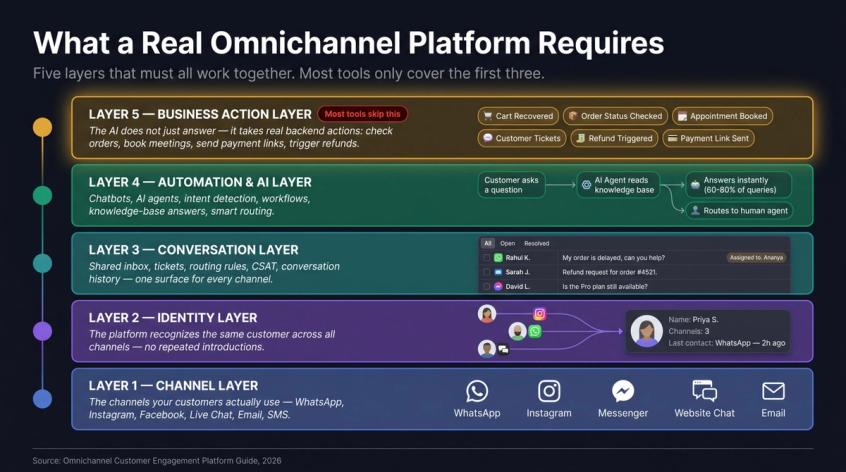
That last layer is where the market is moving. Forrester's recent conversational AI coverage frames conversational AI platforms as tools for improving service, lowering costs, and improving agent experiences, and the recurring theme is bridging AI with real operational workflows, not just answering FAQs.
The difference between an omnichannel platform and a multichannel tool comes down to one thing: shared context. Multichannel means you're present on many channels. Omnichannel means those channels work together, with shared customer context, shared identity, and the ability to take real business actions. See real omnichannel marketing examples to understand how this looks in practice.
Why omnichannel customer engagement matters more in 2026
Three things have shifted the stakes.
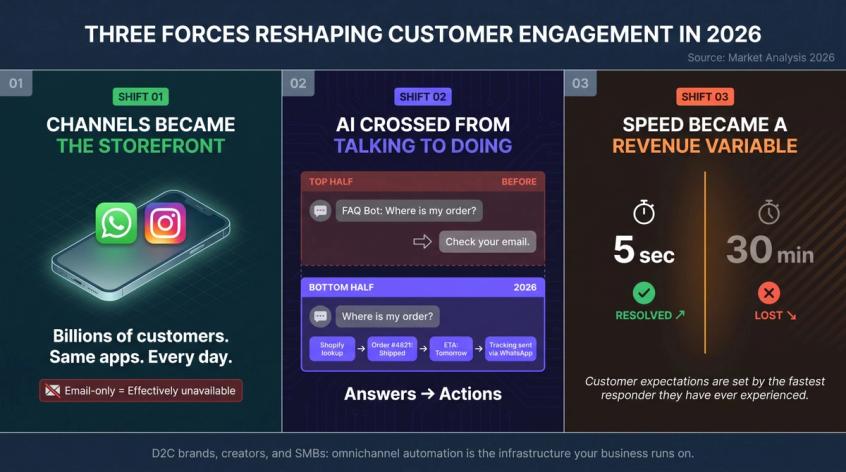
First, WhatsApp and Instagram moved from being marketing channels to being primary customer service channels for billions of users. Customers now expect to get support, make purchases, and resolve issues in the same apps where they already spend their time. A business that only offers email support is, for a large portion of its audience, effectively unavailable.
Second, AI agents in 2026 aren't just FAQ bots. The tools that actually move metrics are the ones where AI can call external systems: check an order status from Shopify, book a meeting via your calendar API, issue a refund via Razorpay, or update a contact field in your CRM. The jump from "answer questions" to "take actions" is the real difference between a bot and an agent, and it's why the business action layer matters so much.
Third, customer expectations are calibrated against the fastest responders they've experienced. If a competitor's AI answers in five seconds and resolves the request end to end, a 30-minute human response time loses the sale. Speed and resolution quality now compound directly into revenue, not just satisfaction scores.
For D2C brands, creators, service businesses, and SMBs that run on social and messaging channels, an omnichannel marketing automation strategy isn't a nice-to-have. It's the infrastructure the business runs on.
What to look for in a digital customer engagement platform
When you're evaluating platforms, these are the six dimensions that actually determine fit.
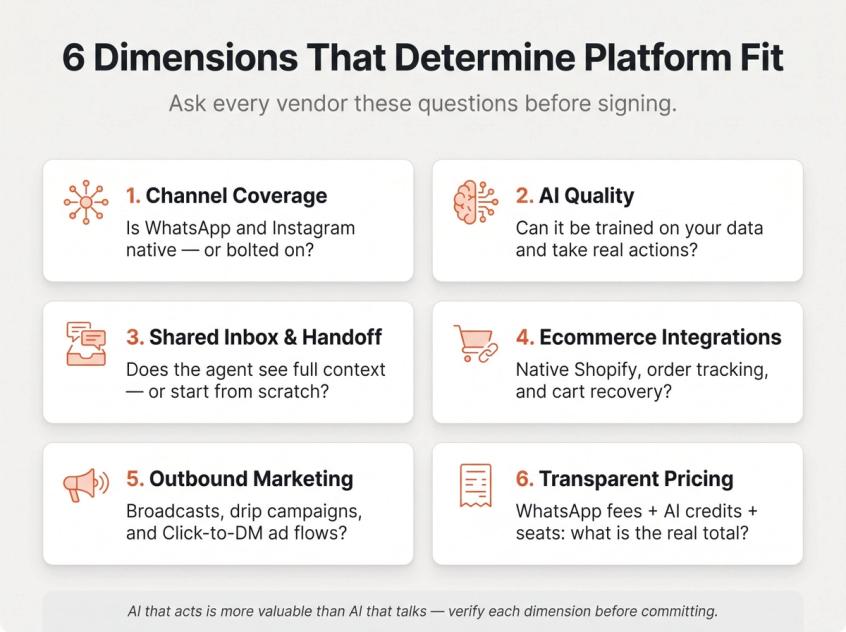
1. Channel coverage that matches your customers.
Native WhatsApp Business API support is very different from a bolt-on integration. Same with Instagram. If your customers primarily live on social and messaging, make sure the platform treats those channels as first-class, not afterthoughts.
2. AI quality (trained on your data, able to take actions).
The most important distinction is whether the AI can use your own knowledge base (your product docs, FAQs, return policies, pricing pages) rather than a generic model. Even more important: can it take real business actions: check orders, create tickets, book appointments, send payment links? Or can it only answer questions? AI that acts is dramatically more valuable than AI that talks.
For context, our AI live chat at Spur is trained on your knowledge base and can execute custom actions connected to your backend systems, including checking inventory, processing basic requests, and routing to the right human when needed.
3. Shared inbox and human handoff.
When AI can't resolve something, the human agent needs to see the full conversation history, customer details, tags, and context in one place. A handoff that forces the customer to start over isn't a handoff. It's a restart.
4. Ecommerce and CRM integrations.
For Shopify stores and D2C brands, native integrations for order tracking, abandoned cart recovery, and post-purchase updates are non-negotiable. The more the platform knows about a customer's purchase history, the more useful every conversation becomes.
5. Outbound marketing capability.
WhatsApp broadcasts, Instagram DM campaigns, drip sequences, and Click-to-Instagram ad flows are how brands proactively reach customers rather than waiting for inbound queries. A platform that only handles incoming messages is missing half the revenue opportunity.
6. Transparent pricing.
Platform subscription is rarely the full cost. WhatsApp message fees, AI credit pricing, per-seat charges, channel add-ons, and broadcast limits are the variables that make a seemingly affordable platform expensive at scale. Ask every vendor to show you total cost for your actual usage before signing.
How Spur works as an omnichannel engagement platform
We built Spur around two core jobs that most businesses struggle to handle with one tool.
The first is AI-powered customer support. The AI agent is trained directly on your business data: your website, help docs, product pages, FAQs, return policies, pricing. You deploy it across your live chat widget, Instagram DMs, WhatsApp, and Facebook Messenger. It handles the repetitive 60-80% of queries immediately, and routes the complex ones to your human team in a shared inbox with full conversation context. Customers get fast, accurate answers. Your team focuses on the conversations that actually need a human.
What makes the AI agent different from a typical chatbot is the action layer. It doesn't just retrieve answers. It checks order status from Shopify, books appointments, sends payment links via Razorpay or Stripe, and triggers backend workflows through custom actions. When someone asks "where's my order?" they get the actual tracking status, not a generic "check your email" response.
The second is customer engagement. This is the proactive side: reaching customers before they reach you, and turning passive audience interactions into revenue.
On WhatsApp:
→ Broadcast campaigns to segmented contact lists
→ Abandoned cart recovery flows that message customers who left products behind
→ Click-to-WhatsApp ads that move interest from a Facebook or Instagram ad directly into a WhatsApp conversation
→ Drip sequences for nurturing leads over time
WhatsApp message charges are separate from the platform subscription and follow WhatsApp's per-message pricing by category and country. Service messages within the 24-hour customer window are free for the first 1,000 a month per business phone number, and click-to-WhatsApp entry points open a free messaging window of up to 7 days. See our WhatsApp conversation charges by country and category for the full rate card.
On Instagram:
→ Comment-to-DM automation (someone comments on your reel, they instantly get a DM with a product link or lead form)
→ Story mention and reaction auto-replies
→ AI-powered DM flows that qualify leads without manual effort
We're an official Meta Business Partner, and our Instagram automation works with comment-to-WhatsApp flows so you can move social engagement directly into your highest-converting channel.
Everything lands in one shared inbox: WhatsApp, Instagram, Facebook, and live chat together. Your team sees every conversation, assigns tickets, adds internal notes, tags customers, and tracks resolution without switching between four different tools.
Who gets the most value from Spur:
→ D2C and Shopify brands using our Shopify integration to connect cart recovery, order tracking, and customer support in one place.
→ Real estate and service businesses using WhatsApp and Instagram as primary lead channels, where fast response time is the difference between winning and losing a deal.
→ Creators and coaches running Comment-to-DM campaigns to convert audience engagement into direct sales.
→ Businesses that want to deploy an AI support agent on their website chat without hiring additional support staff.
The results we've seen back this up. Eves & Gray achieved 88.75x ROI in 24 hours using WhatsApp broadcast campaigns. Muffynn recorded 73x ROI on a targeted broadcast campaign. Libas generated 64 orders directly from an Instagram Live event using Comment automation and DM flows.
Where Spur isn't the right fit:
We're honest about this. If your main need is a 500-seat enterprise ticketing operation with workforce management, SLA governance, voice routing, and enterprise compliance workflows, Zendesk or Salesforce are better fits. If your business is a SaaS product that needs deep in-app messaging and AI-first support across web and email, Intercom is worth evaluating. If lifecycle marketing across push, email, SMS, and in-app is the core job, Braze or MoEngage are purpose-built for that.
Spur is the right choice when your customer journey is conversational and your channels are WhatsApp, Instagram, Facebook, and web chat.
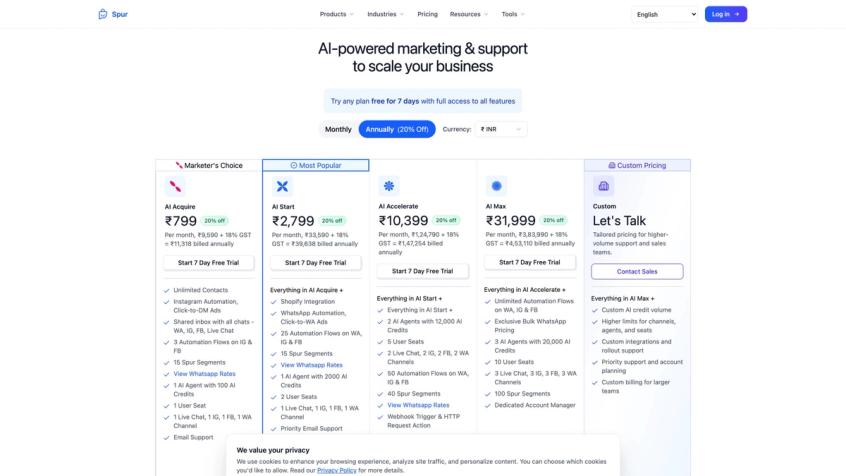
Current pricing (annual plans, 20% off monthly rate):
| Plan | Price | Best For |
|---|---|---|
| AI Acquire | $12/month | Instagram automation, Click-to-DM, entry-level AI |
| AI Start | $31/month | WhatsApp automation, Shopify, 25 flows, 1 AI agent |
| AI Accelerate | $127/month | Webhooks, HTTP actions, custom AI actions, higher volume |
| AI Max | $399/month | Unlimited flows, dedicated account manager, bulk WhatsApp |
All plans include unlimited contacts, unlimited broadcasts, and a 7-day free trial. The full pricing page breaks down seats, AI credits, channel limits, and add-ons in detail.
Start your free trial or explore pricing in detail.
Omnichannel customer engagement platforms compared
The "omnichannel customer engagement" market is actually six or seven different markets using the same phrase. Helpdesks, chatbot builders, WhatsApp tools, social automation platforms, CRM-first inbox tools, and enterprise lifecycle marketing suites all call themselves "omnichannel." Understanding which category fits your use case is the first step in a useful evaluation.
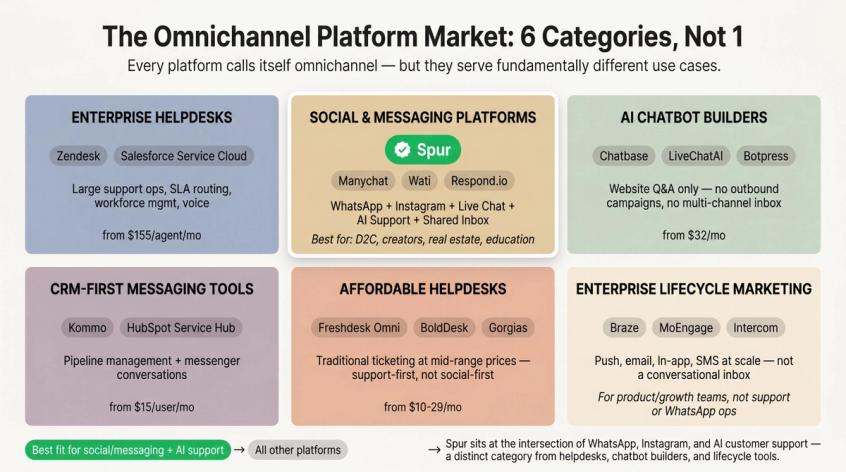
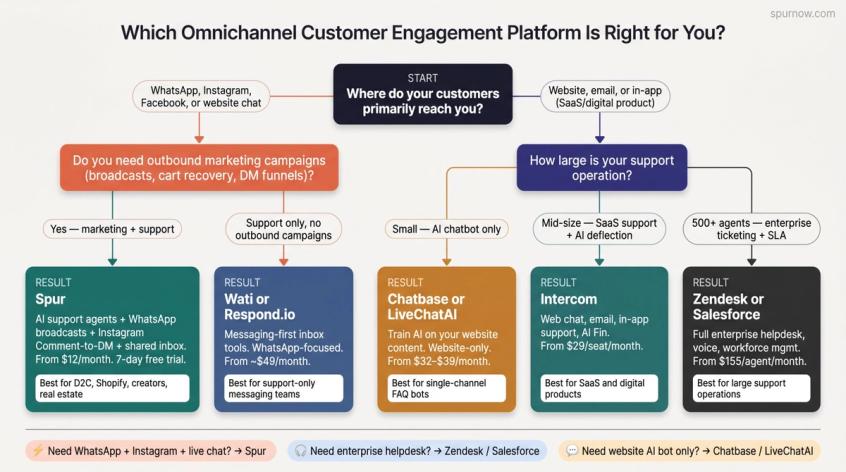
Best-fit quick reference:
| Your Situation | Best-Fit Platform(s) |
|---|---|
| WhatsApp + Instagram + live chat AI for D2C, creators, real estate, education, service | Spur |
| AI-first support for SaaS and web/app products | Intercom |
| Mature enterprise helpdesk and support operations | Zendesk |
| Affordable omnichannel helpdesk | Freshdesk Omni |
| Shopify/ecommerce support desk (support-first) | Gorgias |
| Instagram DM automation and creator funnels | Manychat |
| Multi-channel messaging inbox for revenue teams | Respond.io, Kommo, Wati |
| Agent-heavy helpdesk with transparent bundle pricing | BoldDesk |
| Enterprise CRM/service operations | Salesforce Service Cloud |
| Companies already living inside HubSpot CRM | HubSpot Service Hub |
| AI chatbot/knowledge-base bot for website only | Chatbase, LiveChatAI |
| Technical AI agent builder | Botpress |
| No-code chatbot builder across many channels | UChat, BotPenguin |
| Enterprise lifecycle marketing (push/email/in-app/SMS) | Braze, MoEngage |
Major omnichannel customer engagement platforms and their strengths
Enterprise Helpdesks: Zendesk and Salesforce Service Cloud
Purpose-built for large support operations with complex ticketing, SLA routing, workforce management, quality assurance, voice, and enterprise compliance. Zendesk suite + copilot bundles start at $155/agent/month (professional tier). Salesforce Service Cloud ranges from $25/user/month (starter) to $550/user/month (Agentforce 1 Service). The right choice when support operations at scale are the center of gravity. Not built for Instagram comment-to-DM funnels or WhatsApp cart recovery campaigns. See how Spur compares to Zendesk for conversational-first businesses.
Intercom
Strongest for SaaS and digital product companies that want premium web chat, in-app support, AI deflection, and email support. Fin, their AI agent, is available standalone at $0.99 per resolved outcome. Intercom pricing starts at $29/seat/month. Not the natural pick if WhatsApp and Instagram marketing automation are central to your business. See our full list of Intercom alternatives if you're evaluating options.
Gorgias
Built specifically for ecommerce support, with Shopify context (orders, customers, revenue) embedded in the agent workflow. Gorgias pricing is ticket-based, starting at $10/month for 50 tickets. Strong for pure support operations around Shopify orders, but less suited for conversational marketing, Instagram engagement, and WhatsApp campaigns. For a more complete comparison, see our guide to Gorgias alternatives.
Manychat
A solid option for creators, influencers, and social-first businesses that primarily need Instagram comment-to-DM automation and simple chatbot flows. Manychat pro plan starts at $15/month by contact count. The gap worth noting: Manychat's AI features can't be trained on your own knowledge base the same way a purpose-built AI agent can, and it doesn't include a full shared inbox for multi-channel customer support across WhatsApp, Instagram, and live chat. See how Spur compares to Manychat for teams that need the full stack.
Wati and Respond.io
Both solid messaging-first platforms. Wati focuses on WhatsApp Business API, broadcast campaigns, and team inbox. Respond.io covers multi-channel messaging (WhatsApp, Messenger, Instagram, Telegram, web chat) with workflows and AI agents. Their growth plan starts at $159/month. Respond.io is more configuration-heavy than Spur for D2C and social-commerce use cases, but a solid fit for more complex messaging operations.
AI chatbot builder vs. full customer engagement platform: which to choose
For teams whose core need is "a bot that answers questions on our website," there's a clear tier of simpler, more affordable options. Here's how they compare:
| Tool | Starting Price | Best For | Key Limitation |
|---|---|---|---|
| Chatbase | $32/month (annual) | AI chatbot trained on website content | Website only; no outbound campaigns or multi-channel inbox |
| LiveChatAI | $39/month | Website AI chat | Same scope as Chatbase |
| Botpress | Free + AI spend; from $79/month paid | Technical teams wanting custom AI agent control | Requires developer knowledge; not for non-technical teams |
A chatbot handles inbound Q&A. A customer engagement platform also covers outbound campaigns, ecommerce flows, multi-channel inbox operations, and attribution analytics. The scope difference is real.
Affordable helpdesks and omnichannel alternatives to Zendesk
Freshdesk Omni and BoldDesk both deliver helpdesk depth at more accessible price points than Zendesk.
Freshdesk Omni starts at $29/agent/month (annual) with AI agent sessions included. BoldDesk bundles by agent count rather than per seat, starting at $99/month for 5 agents with all features included. Neither is built around Instagram DM funnels or WhatsApp cart recovery as core workflows.
HubSpot Service Hub is best for companies already running HubSpot CRM, where the value comes from connecting service, sales, marketing, and customer data in one system. Professional tier is $100/seat/month. If WhatsApp and Instagram automation matter more than CRM unification, a specialist platform is usually the better fit.
No-code chatbot builders and CRM-first messaging tools
UChat and BotPenguin are no-code chatbot builders that work across many channels. UChat supports 15+ channels including WhatsApp, Instagram, Facebook, Telegram, and web chat, with flexible pricing plans. BotPenguin positions similarly at a lower entry cost with message-pack based pricing. Both are useful for agencies and automation-first teams, though neither has the same depth of built-in knowledge base AI and ecommerce action layer that makes a platform genuinely autonomous.
Kommo is a CRM built around messenger-based selling, combining pipeline management with WhatsApp, Instagram, Messenger, and email conversations. Kommo pricing starts at $15/user/month (minimum 6-month subscription). Best fit for sales teams where conversations and CRM pipeline are tightly coupled.
Braze and MoEngage are enterprise lifecycle marketing platforms for consumer apps, fintech, and large brands. Braze and MoEngage handle push, email, SMS, in-app, and web campaigns at scale, with journey orchestration and AI/ML optimization. Neither is a conversational support inbox. These are marketing automation tools for product and growth teams, not customer engagement platforms in the WhatsApp/Instagram/live chat sense.
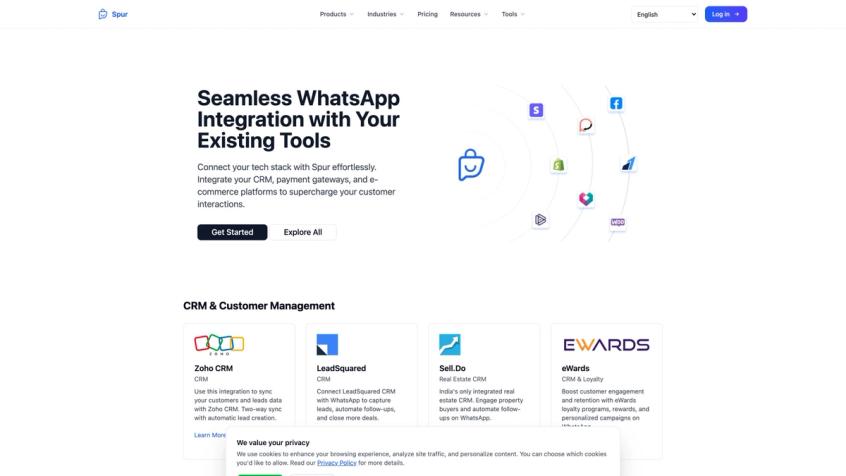
If your customers are reaching you on WhatsApp, discovering products on Instagram, or chatting via your website widget, Spur connects all three channels with AI support and marketing automation in one platform. Check our full integrations list for Shopify, WooCommerce, Razorpay, Stripe, Zoho CRM, LeadSquared, Shiprocket, and more.
How to choose the right omnichannel customer engagement platform
How to score and compare omnichannel platforms before buying
Before you commit to demos or trials, score platforms against these criteria. Weight them by what your business actually needs:
| Criterion | Weight | What to Check |
|---|---|---|
| Channel fit | 20% | Does it natively support the channels your customers actually use? |
| AI quality | 20% | Can the AI use your knowledge base, hand off safely, and take real actions? |
| Automation depth | 15% | Can you build real workflows without engineering every change? |
| Human handoff | 10% | Can agents see history, assign, tag, note, route, and resolve in one inbox? |
| Marketing capability | 10% | Broadcasts, segmentation, drips, abandoned cart, ad flows, analytics |
| Integrations | 10% | Shopify, CRM, payments, logistics, webhooks, API |
| Reporting | 5% | Conversation, campaign, agent, AI, revenue, and attribution analytics |
| Security/compliance | 5% | DPA, sub-processors, data residency, audit logs, SSO, permissions |
| Pricing transparency | 5% | Seats, channels, AI credits, messages, overages, add-ons, rate cards |
A platform that scores 80% for your actual use case beats a well-known platform that scores 95% for someone else's.
Hidden costs of omnichannel customer engagement platforms
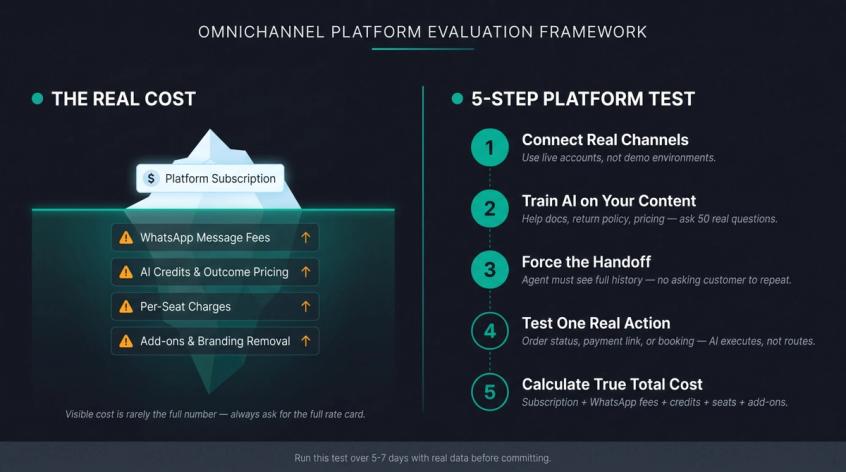
The platform subscription is rarely the full number. Here's where the surprises come from:
WhatsApp message fees. WhatsApp's per-message pricing varies by country and message category (marketing, utility, authentication, service). Service messages during the 24-hour customer window are free only for the first 1,000 a month per business phone number. Marketing broadcasts to large contact lists add up quickly. Ask every vendor for their live rate card and whether they mark up Meta's rates.
AI credits and outcome pricing. Some platforms charge per AI "resolution," some per session, some per message. Ask specifically: what counts as a credit? Do failed or escalated answers count? Do test conversations count?
Seat pricing. Classic support tools charge per agent. Ask whether admins, part-time agents, and view-only users all require paid seats.
Add-ons. Removing branding, extra WhatsApp numbers, extra channels, SSO, AI copilot, advanced analytics. These add-ons compound fast and are rarely visible in the headline price.
How to test an omnichannel platform before committing
Before committing to any platform, run a 5-7 day test with real conditions:
① Connect your real channels, not demo channels. Fake test environments hide real integration issues and latency.
② Train the AI on your actual content: help docs, return policy, pricing page, and product FAQs. Ask 50 real customer questions and score: correct, wrong but confident, correctly escalated, or unclear.
③ Force the handoff: ask edge-case questions, check that the human agent sees the full conversation history and customer context without having to ask the customer to start over.
④ Test one real business action: an order status check, appointment booking, or payment link. The AI should execute it, not just route to a human for it.
⑤ Calculate real total cost including subscription, WhatsApp message fees, AI credits, seats, and add-ons. Compare on cost per resolved query, not just monthly subscription.
Frequently asked questions about omnichannel customer engagement platforms
It's software that helps businesses communicate with customers across multiple channels while keeping context, identity, and history connected across channels, with automation and reporting unified. The key is continuity. If a customer starts on Instagram, continues on WhatsApp, and later opens a support ticket via live chat, the team should see the full picture without starting from zero. Most tools handle multiple channels; truly omnichannel platforms share data, context, and customer identity across all of them.
Multichannel means you're present on many channels. Omnichannel means those channels work together. A business with separate WhatsApp, Instagram, email, and live chat tools is multichannel. Each channel operates in isolation. A business where all those conversations share customer context, automation, routing, and reporting is omnichannel. The difference shows up most clearly in customer experience: omnichannel customers don't have to repeat themselves when they switch channels. See how omnichannel and multichannel marketing automation differ for a deeper comparison.
For small businesses using WhatsApp, Instagram, and website chat, Spur is a strong fit, starting at $12/month with a 7-day free trial, with AI support agents, marketing automation, and shared inbox in one platform. See what small businesses have achieved with Spur across D2C, real estate, and creator categories. For social-only automation on a tight budget, Manychat is worth evaluating. For a traditional support desk, Freshdesk Omni or BoldDesk offer accessible pricing. For a simple AI website chatbot, Chatbase or LiveChatAI may be sufficient.
The six that actually matter: (1) native support for your customers' actual channels, (2) AI trained on your own data with the ability to take real backend actions, (3) a shared inbox with human handoff that preserves full conversation context, (4) ecommerce and CRM integrations, (5) outbound marketing capability including WhatsApp broadcasts and drip sequences, and (6) transparent total-cost pricing that includes message fees, AI credits, and add-ons. AI that can check orders and book appointments delivers far more value than AI that only answers questions.
Costs range from free entry plans to $550+/user/month for enterprise suites. The real total cost is: platform subscription + seats + AI usage + channel fees + WhatsApp message fees + add-ons + implementation + overages.
For SMBs and D2C brands, Spur starts at $12/month (annual) for Instagram automation and entry-level AI, or $31/month for WhatsApp + Shopify + a full AI agent. WhatsApp message fees are separate and scale with broadcast volume and country. Enterprise platforms like Zendesk start at $155/agent/month for the full bundle, and Salesforce starts at $25/user/month but scales significantly with add-ons.
Spur is one of the strongest options if you want WhatsApp + Instagram + live chat + shared inbox + AI agents in one platform. The combination of Comment-to-DM on Instagram, WhatsApp marketing automation and abandoned cart flows, Click-to-WhatsApp and Click-to-Instagram ad automation, and a unified inbox across all four channels is hard to match with a single alternative. Manychat is strong for Instagram and social DM automation if you don't need WhatsApp marketing or a full support inbox. Wati is a solid choice for WhatsApp-first teams.
Choose a chatbot builder if your only need is "automatically answer questions on our website." Choose a full customer engagement platform if you also need a shared inbox for your team, human handoff with context, outbound broadcast campaigns, ecommerce flows like abandoned cart recovery and order updates, CRM integration, and multi-channel reporting. The scope difference is substantial: a chatbot handles inbound Q&A, while a platform handles the entire customer engagement lifecycle from first message to repeat purchase.
The features that make a real difference: AI trained on your own knowledge base (not just a generic model), safe fallback and smooth human handoff, the ability to execute custom backend actions (order lookups, appointment booking, payment links), intent detection for smart routing, conversation summaries that give human agents full context, and analytics that show which questions the AI couldn't answer. An AI agent that only handles FAQs is useful. An AI agent that can resolve customer requests end to end (including actions, not just answers) changes the unit economics of customer support.
Sources
The pages this article links out to, in the order they appear.
- Forrester's recent conversational AI coverage forrester.com
- WhatsApp's per-message pricing business.whatsapp.com
Was this article useful?