Key takeaways
RCS brings rich interactive messaging with buttons and cards. SMS guarantees delivery. Learn when to use each and how to build hybrid flows.
Ask an AI about this article
RCS brings rich, interactive experiences to your text messages (think branded cards, buttons, read receipts). SMS still wins on universal reach. The smart move? Run both in a hybrid strategy where RCS delivers the experience and SMS guarantees delivery. We'll show you exactly how to choose, implement, and avoid the costly mistakes most businesses make.
Why Businesses Search "RCS vs SMS" in 2026
You're not here for a Wikipedia-style comparison. You're trying to make actual business decisions, probably around some combination of these questions:
• Will RCS actually reach my customers in 2026, or is it still half-baked?
• Is RCS worth the investment vs sticking with SMS for marketing, OTPs, or order updates?
• What will it cost in the real world (not just the per-message price, but fees, carrier add-ons, compliance costs)?
• Will carriers block me, mark me as spam, or force me through painful registration?
• How do I implement this without breaking everything that's working?
• How do I measure outcomes beyond just clicks and delivery rates?
Success for your business looks like this: You pick the right channel for each message type. You build one coherent system where RCS handles the rich experiences and SMS provides the fallback. You stay compliant with opt-ins, registrations, and spam rules. And you get better conversion or reduced support load without nasty surprises in your billing or deliverability.
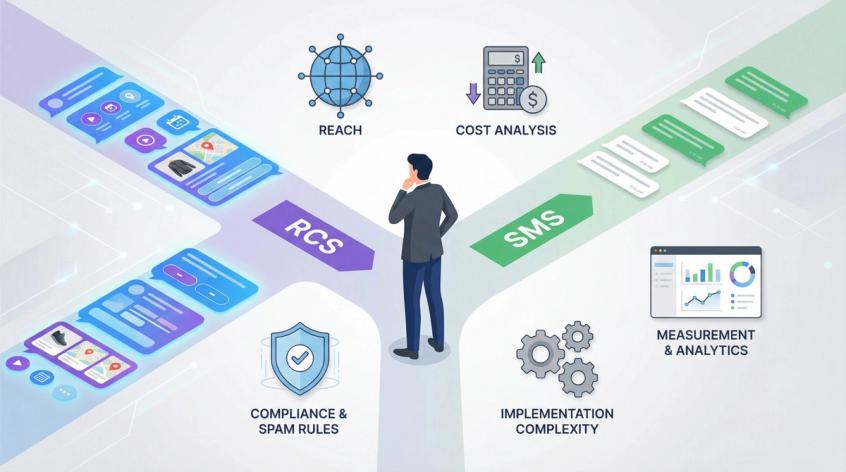
RCS vs SMS: 60-Second Quick Answer
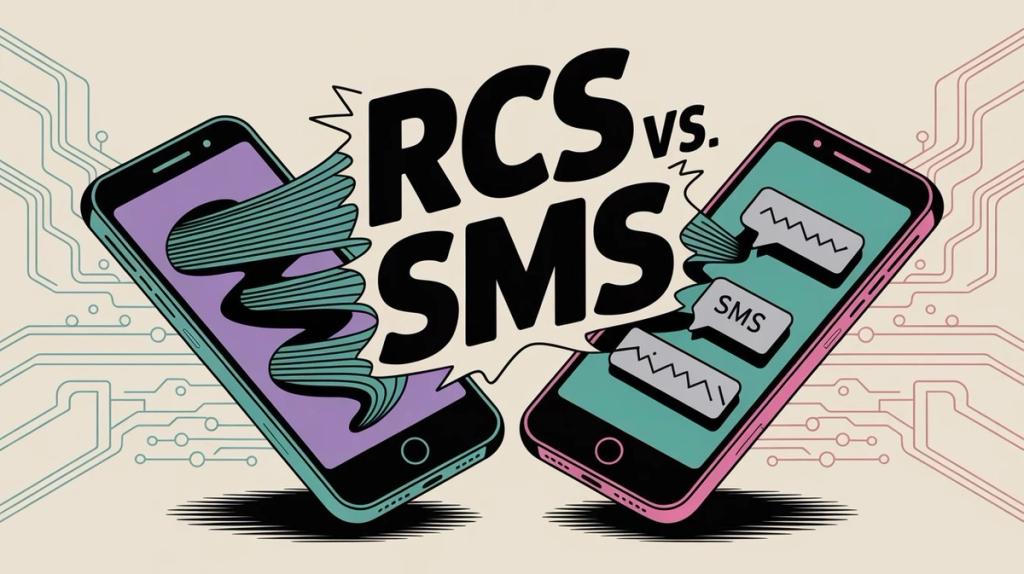
SMS is your baseline. It reaches basically every phone number on the planet, works without mobile data, and delivers with brutal reliability. But it's a "dumb pipe" with no native buttons, cards, or read receipts. Plus, carriers are aggressively filtering non-compliant traffic in 2026.
RCS is the upgrade. It can be branded and interactive, like embedding a mini landing page right inside the inbox. You get high-res images, suggested reply buttons, delivery tracking, and brand verification. But it's not universal. On iPhone, Apple explicitly treats RCS as a network-provided service, meaning availability varies by carrier and region.
The best strategy in 2026 is almost never "RCS or SMS." It's RCS with automatic fallback to SMS, using routing rules based on reach, message type, and economics.
What SMS and RCS Actually Are (First Principles)
SMS: The Universal Text Messaging Standard
SMS is a carrier-native text service designed for short, reliable delivery over cellular networks. It's store-and-forward, which means it works even when the recipient has no data plan and is on basic coverage. Nearly 5.8 billion mobile phone users worldwide send roughly 16 million SMS texts every minute, which tells you everything about its staying power.
The hard constraint that actually matters for businesses: SMS has encoding limits. If you use GSM 7-bit characters, you get 160 characters per message. But if you include unicode (emojis, curly quotes, many non-Latin scripts), that limit drops to just 70 characters. Long messages get split into multiple billable segments, and AWS documentation confirms this is a real cost multiplier if you're not careful.
SMS also delivers stunning performance metrics. Studies show SMS has around a 98% open rate, with 90% of texts read within 3 minutes. That's why banks use it for OTPs, retailers use it for flash sales, and service businesses use it for appointment reminders. When you absolutely need someone to see your message immediately, SMS is unmatched.
What Is RCS Messaging and How Does It Work?
RCS (Rich Communication Services) is an IP-based messaging standard meant to modernize carrier messaging. Think of it as the telecom industry's answer to WhatsApp and iMessage, but built into your phone's native messaging app.
On iPhone, Apple's own support docs describe RCS as network-provided, sent over Wi-Fi or mobile data, supporting high-res photos and videos, links, delivery and read receipts, typing indicators, with availability varying by region and provider.
For businesses, RCS usually means RCS Business Messaging (RBM). You create a "brand agent" with verification, and your agent appears inside RCS-enabled apps with your name, logo, description, and contact info. You can send everything from simple notifications to full conversations with rich cards and interactive buttons.
The game-changer? Apple's adoption of RCS in iOS 18 means hundreds of millions of iPhone users can now participate. Before this, RCS was mostly an Android thing. Now it's becoming the new default for cross-platform rich messaging. Industry data shows 550% global growth in RCS message volume in 2024 after Apple joined the party.
RCS vs SMS: 7 Critical Differences That Matter
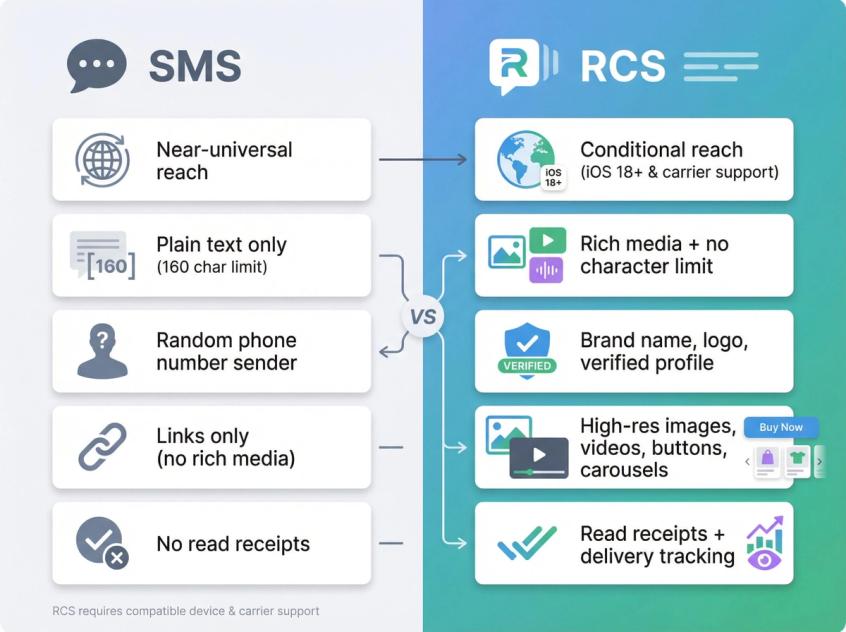
Reach: Who Can You Message With Each Platform?
SMS reach: Near-universal for phone numbers. If someone has a phone, they can receive SMS.
RCS reach: Conditional. You need iOS 18+ on iPhone with a carrier that supports RCS. On Android, you generally have better RCS availability (most modern Android phones from the past few years support it). But older phones, basic feature phones, or smartphones on carriers that haven't enabled RCS will not use RCS. They'll default to SMS.
Real-world implication: If you can't tolerate "some percentage of users won't get the rich experience," you must design fallback routing from day one.
User Experience: What Customers See and Can Do
| Capability | SMS | RCS |
|---|---|---|
| Text | Plain text (160 char limit) | No character limit |
| Media | Links only (via shorteners) | High-resolution images & videos |
| Branding | Random phone number | Brand name, logo, verified profile |
| Interactivity | Basic two-way replies | Rich cards, carousels, suggested replies |
| Actions | Click link to leave app | Buttons for immediate action in-thread |
| Experience | Minimal friction | Reduces distance between attention and action |
The first-principles insight: RCS reduces the distance between attention and action. SMS often forces users to click out to the web. RCS lets them take action right inside the thread, which usually lifts conversion when you implement it well.
Real proof: Industry data shows messaging platforms achieving 10x increases in click-through rates and 115% jumps in revenue when switching marketing messages from SMS to RCS. Another campaign achieved 17x more customer interactions compared to SMS for the same promotion.
How to Track RCS vs SMS Performance
SMS: Delivery status is standard. But "open rate" is basically guessing because there are no read receipts in standard SMS. You can track link clicks if you use URL shorteners.
RCS: Read receipts and rich interaction events are built-in (depending on implementation, carrier, and app). You can see when messages are delivered, read, and which buttons get clicked. This gives you native attribution signals, but only where RCS is supported.
If your organization lives and dies by attribution data, RCS gives you significantly better signals than SMS ever could. Customer communication platforms that support both channels can help you compare performance across your messaging mix.
Trust, Spam Control, and Compliance
SMS has been flooded with spam for years, so carriers and regulators have tightened enforcement. In the US, A2P (application-to-person) messaging now expects registration, and enforcement is real. You'll face fees, filtering, and outright blocks if you're not compliant.
RCS is built to be more "brand-safe" via verification and richer identity. But users can still report messages as junk, and Apple explicitly notes you can report RCS business messages as junk.
Practical takeaway: RCS isn't a loophole around compliance. It's a higher-trust surface, but if you run it like a spam cannon, you'll get punished just the same. Understanding customer service best practices helps ensure your messaging respects user preferences.
Is RCS Encrypted? Security Differences Explained
SMS is not end-to-end encrypted. Messages travel in plaintext over the carrier network, which means sophisticated attackers could potentially intercept them.
RCS historically had a messy encryption story. The RCS Universal Profile has evolved toward interoperable end-to-end encryption using Messaging Layer Security (MLS), and the GSMA has published updated E2EE specs. But the catch: Apple's implementation of RCS is NOT end-to-end encrypted. For business messaging, RCS messages are encrypted in transit but not E2E, which means carriers and servers can access content.
Practical take: Assume SMS is plaintext. Assume RCS security depends on the exact client, carrier, and version. If you're sending truly sensitive info, don't rely on "it's probably encrypted." Design your flow so sensitive details happen behind authenticated sessions or secure apps.
Real-World RCS vs SMS Costs (The Silent Budget Killers)
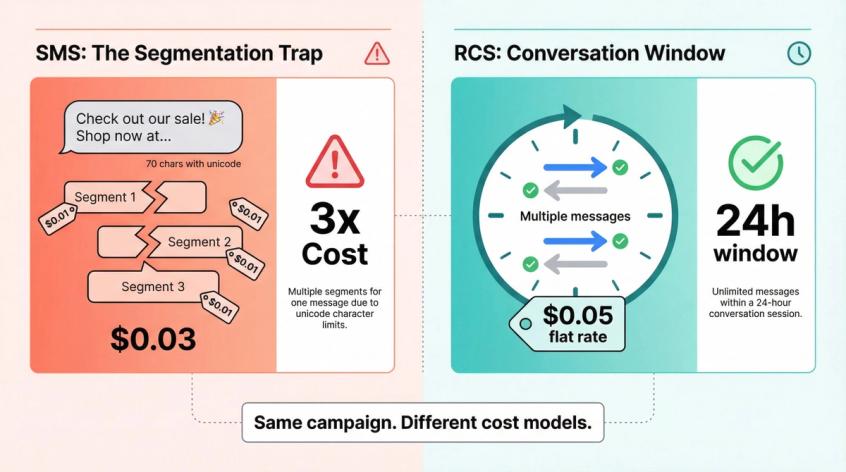
This is where most "RCS vs SMS" content falls apart. They compare "$X per SMS" vs "$Y per RCS" and ignore all the multipliers that actually affect your budget:
→ SMS is often billed per segment (not per message)
→ RCS billing can be per message or per conversation window
→ Both channels include carrier fees
→ SMS in the US includes registration and campaign fees (10DLC)
→ RCS can include onboarding fees with carriers
SMS Segmentation: The Silent Tax
If your SMS contains unicode (emojis, curly quotes, non-English characters), your single-message limit drops from 160 to 70 characters. That means your messages fragment more easily, and you pay for each segment.
AWS documentation extensively covers this 160 vs 70 character behavior.
The rule: If you run SMS at scale, you need a segment counter in your tooling and message templates written to stay in 1 segment whenever possible. One emoji can double your cost if it pushes you over the limit.
How RCS Billing Works: Message vs Conversation Model
Google's RBM billing FAQ spells out a key concept that changed recently:
| Agent Type | Billing Model | Details |
|---|---|---|
| Non-conversational | Per delivered message | One-way blasts (OTPs, alerts, promos) |
| Conversational | Conversation window | If either side replies within 24 hours, flat rate for that window |
| No reply in 24h | Falls back to per-message | Billing reverts to message-based logic |
As of November 20, 2025, Google simplified legacy categories into "conversational vs non-conversational," with an API transition window through February 18, 2026 (yes, that's happening right now).
Why you care: The same creative can be cheap or expensive depending on whether you're triggering conversations and whether your provider's pricing aligns with this model in your region.
Real RCS vs SMS Pricing Example (US Market)
You should always price using your provider and your country, but messaging platforms publish baseline rates that vary significantly. The key is to understand the structure: base rate plus carrier fees, multiplied by your volume.
Real-world consideration: For certain auth and utility use cases, WhatsApp Business API pricing can actually be more cost-effective than SMS. A US OTP sent via WhatsApp often costs less than the equivalent SMS.
This is directional (validate with your provider and geography), but it shows why a multi-channel strategy matters. You're not locked into one channel's pricing or limitations.
The Compliance Tax on SMS (Especially US 10DLC)
In the US, A2P SMS isn't just "buy a number and send texts" anymore. You're dealing with:
✓ Brand registration
✓ Campaign registration
✓ Vetting processes
✓ Recurring fees
✓ Carrier surcharges
✓ Penalties for unregistered or misclassified traffic
The Campaign Registry publishes a brand and campaign fees schedule (last updated January 19, 2026), and carriers keep updating enforcement. Messaging providers publish updates to A2P 10DLC penalty fees regularly.
Practical takeaway: If you're choosing SMS purely because it "seems simpler," you might be underestimating the compliance and ops overhead in 2026. RCS has its own registration process, but SMS isn't the free-for-all it used to be.
RCS vs SMS Compliance: What You Must Know
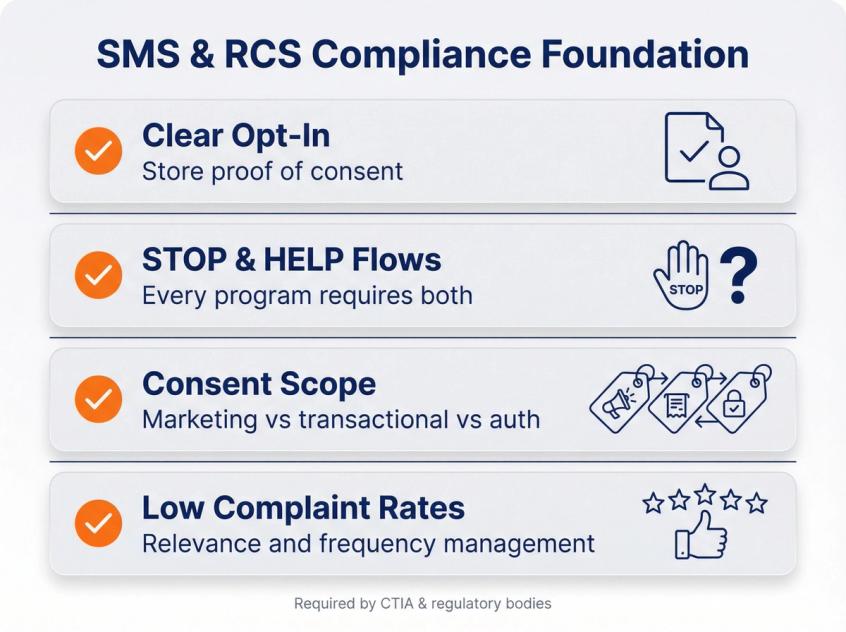
Non-Negotiables (SMS and RCS)
Both channels require the same foundation:
✓ Get clear opt-in (and store proof of consent)
✓ Every program needs STOP (unsubscribe) and HELP flows
✓ Don't send outside the consent scope (marketing vs transactional vs auth)
✓ Keep complaint rates low through relevance and frequency management
The CTIA publishes messaging security and best-practice guidance for the US ecosystem. Follow it or risk getting filtered.
Regional Reality Check: India Example
India has its own heavily regulated messaging environment. Enterprise messaging and sender headers go through strict registration processes. The Telecom Regulatory Authority of India publishes compiled lists of SMS headers, which signals just how registration-heavy the regime is.
Translation: Don't copy-paste a US SMS playbook into India (or vice versa). Your aggregator will force you through the local compliance maze. Understanding marketing automation best practices for your specific region is essential.
How to Implement RCS: It's Not "Just Turn It On"
How to Set Up RCS Business Messaging
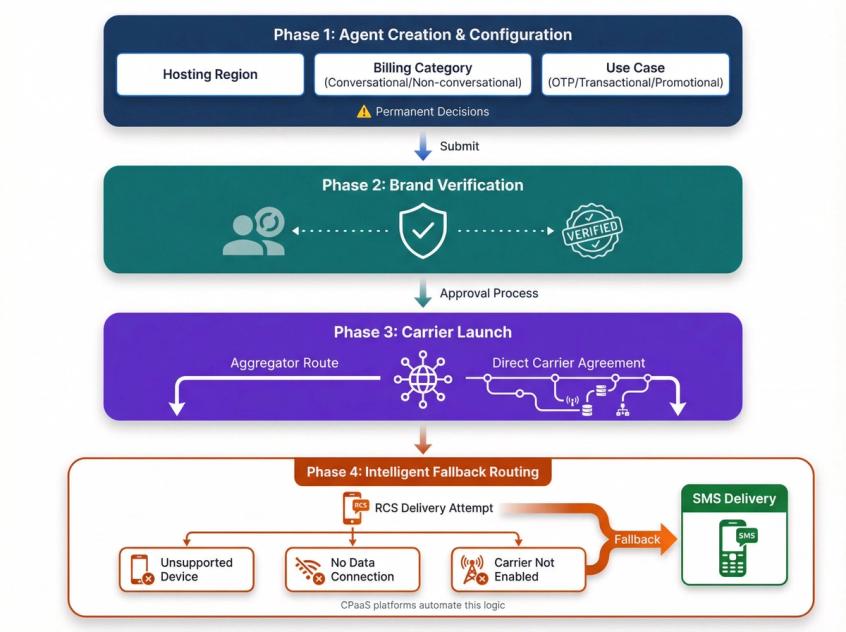
For RCS Business Messaging, you don't just "get a number." You create an agent and go through verification and approvals.
Google's RBM docs describe that agent creation includes decisions like hosting region, billing category, and use case (OTP, transactional, promotional, multi-use). Some choices are permanent, so you need to get them right the first time.
The launch process includes brand verification and launch approval. Some carriers require carrier-managed launches, meaning you may need a direct carrier agreement rather than going through an aggregator.
RCS is closer to "launching a mini product surface" than "sending texts." It's similar in complexity to setting up Instagram automation or WhatsApp Business API, which means you need proper planning and configuration.
Building RCS to SMS Fallback Routing
You need RCS-to-SMS fallback from day one. If the RCS message fails to deliver (unsupported device, no data connection, carrier doesn't support it), your system should automatically send an SMS version.
Most modern CPaaS platforms can handle this routing automatically, but you need to design your message templates to work in both formats. The RCS version can be rich with cards and buttons. The SMS version should be a simplified text with a link if needed.
This is where customer communication management systems shine. They handle the complexity of multi-channel routing so you don't have to build it yourself.
When to Use RCS vs SMS: Complete Decision Framework
Step 1: Classify Your Messages (Don't Skip This)
Put every message into one of these buckets:
① Authentication (OTP, login codes, 2FA)
② Utility/Transactional (order updates, appointment reminders, delivery status)
③ Marketing (promotions, abandoned cart, winback campaigns, launches)
④ Support Conversation (help requests, troubleshooting, returns)
If you mix these up, you'll pay more, get filtered more, and annoy users more.
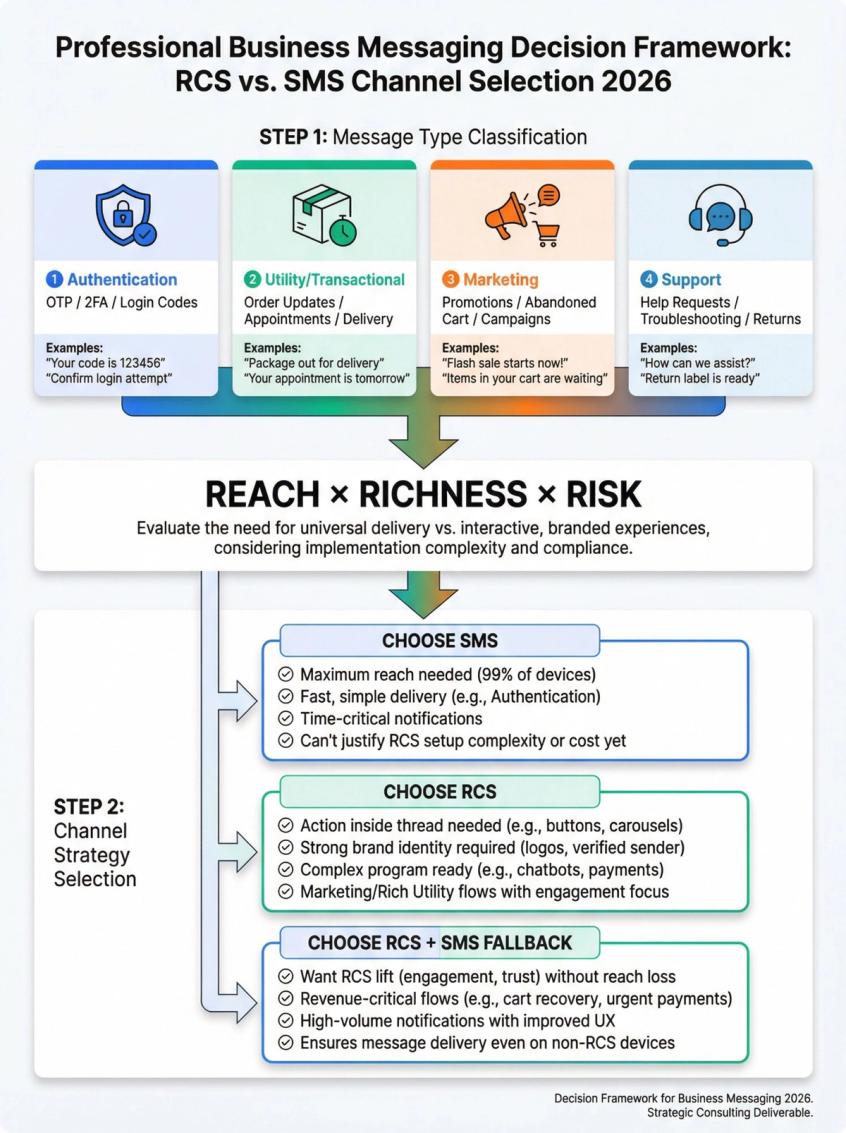
Step 2: Pick the Channel by "Reach × Richness × Risk"
| Choose This | When |
|---|---|
| SMS | • Maximum reach needed (including users without data) • Fast, simple delivery for short content • Can't justify heavier RCS setup yet • Message type is authentication or time-critical alerts |
| RCS | • Want users to take action inside thread (buttons, cards) • Want stronger brand identity signals • Ready to manage complex program (agent, approvals, creative QA) • Targeting marketing, rich utility updates, or guided support flows |
| RCS + SMS fallback | • Want RCS lift but can't afford reach loss • Revenue-critical flows (abandoned cart, checkout recovery) • High-volume notifications where improved UX reduces support load |
Understanding chatbot use cases can help you decide which message types benefit most from rich interactive experiences.
RCS vs SMS Use Cases: What Works Best Where
OTP and Account Security: RCS or SMS?
Default: SMS (for maximum reach).
Upgrade: RCS where possible (better brand identity, richer UI), but always keep SMS fallback.
Tips:
→ Keep OTP messages short (1 segment).
→ Don't put marketing in auth messages. Ever.
→ If you care about phishing resistance, push users toward authenticated in-app confirmation where possible.
Google's RBM system explicitly supports OTP as a use case category for agents.
Order and Shipping Updates: RCS Advantage
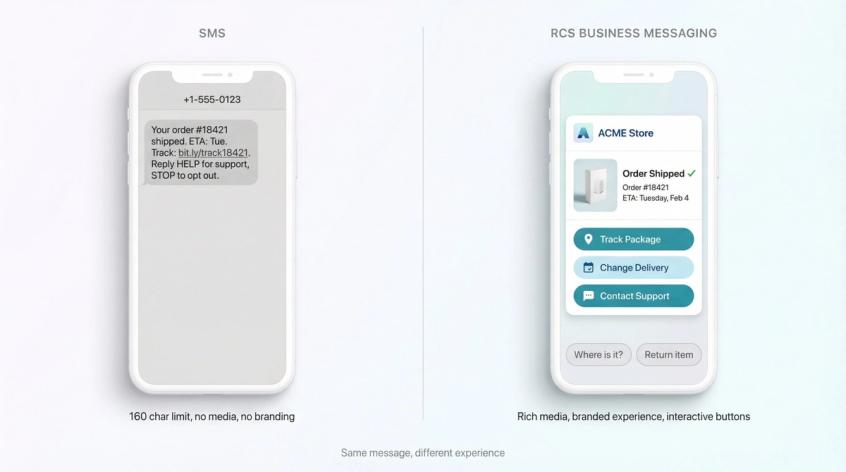
This is where RCS shines because you can reduce "where is my order?" support tickets, similar to how automated order processing reduces manual workload.
SMS version (1 segment target):
"Your order #18421 shipped. ETA: Tue. Track: . Reply HELP for support, STOP to opt out."
RCS version (rich card):
→ Card: "Order Shipped ✅"
→ Image: Product photo
→ Buttons: "Track Package", "Change Delivery", "Contact Support"
→ Suggested replies: "Where is it?", "Return item"
The Apple support doc notes RCS supports links, high-res media, and receipts/typing indicators, making this experience seamless.
Abandoned Cart Recovery: RCS vs SMS Strategy
What works: RCS can show the product right there (image, price, quick-buy button), instead of forcing a click to a landing page. Learn more about cart abandonment solutions that work across channels.
Best pattern:
① Send RCS to supported users with product carousel and "Checkout" button
② Send SMS to everyone else with a single deep link
③ Route replies into a real conversation flow (automation with human handoff)
Appointment Reminders: RCS Features That Help
RCS can include:
→ Add-to-calendar suggestion
→ Map/location action
→ Reschedule button right in the message
If your reminder program generates lots of "can I reschedule?" replies, pay attention to the 24-hour conversation window billing logic. You might be triggering conversational billing without realizing it.
How Spur Fits Into Your Messaging Strategy
SMS and RCS are just two channels in a much larger conversational ecosystem. You're probably also managing WhatsApp, Instagram DMs, Facebook Messenger, and website live chat. Trying to juggle all of these separately is a nightmare.
That's where Spur comes in. We're built around conversational channels (WhatsApp Business API, Instagram DM automation, and website live chat), plus automation and AI agent handoff to handle the volume.
Multi-Channel Customer Communication Strategy
The pieces fit together like this:
→ Use SMS/RCS as your "reach layer" for alerts, nudges, and reactivation campaigns
→ The moment a user shows intent (reply, click, needs support), move them into a real conversation channel you can automate deeply (WhatsApp, Instagram DM, web chat)
→ Manage those conversations with routing, AI agents trained on your knowledge base, and human handoff when needed
This isn't about replacing SMS or RCS. It's about using them strategically as part of a unified multi-channel marketing automation strategy.
What Spur Brings to the Table
Unified inbox across all channels: Your team sees WhatsApp messages, Instagram DMs, live chat conversations, and (if you integrate) SMS/RCS replies in one place. No more switching between six different tools. Learn how to automate customer support across all these channels seamlessly.
AI agents trained on your knowledge base: Unlike basic chatbots that just answer FAQs, Spur's actionable AI can track orders, update records, book appointments, and take real actions. We're simpler and more user-friendly than technical tools, but more powerful than basic automation because you can train the AI on your own knowledge base.
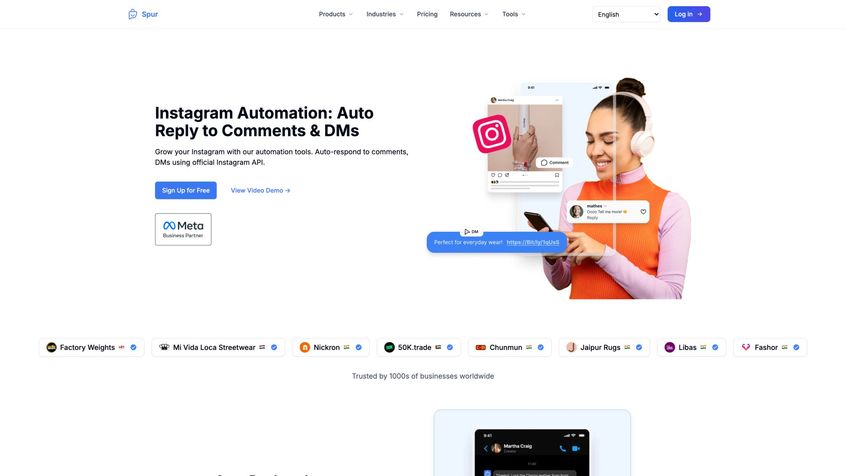
Marketing automation on WhatsApp and Instagram: Abandoned cart recovery, post-purchase follow-ups, broadcast campaigns. All the stuff you'd want to do with RCS, but on channels where your customers already spend time.
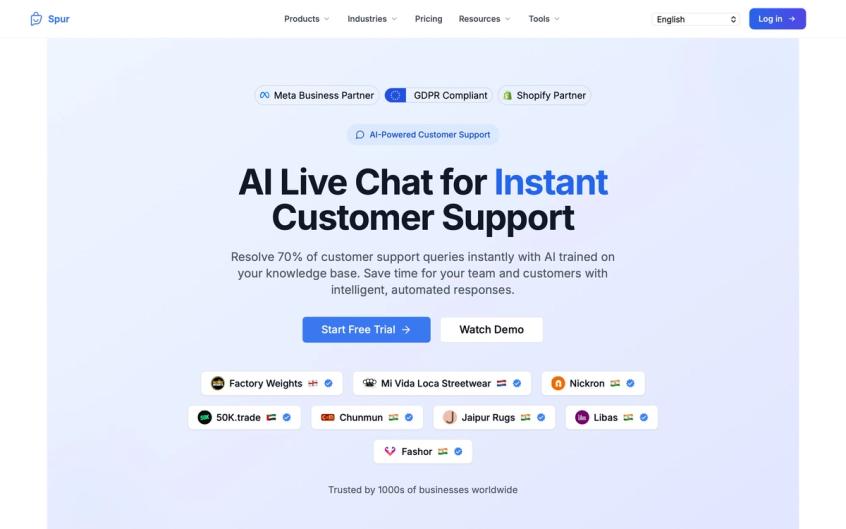
Routing and handoff: AI handles the repetitive queries (which is usually 60-80% of volume). Complex issues get routed to humans in the shared inbox with full context. This chatbot to human handoff capability is essential for maintaining service quality.
Real-World Multi-Channel Implementation Example
Say you're an e-commerce brand:
① Send an SMS or RCS for cart abandonment: "You left something behind. Complete your order: [link]"
② User clicks and lands on your site, where they see Spur's live chat widget
③ They ask a question about sizing or shipping
④ Spur's AI agent answers instantly using your knowledge base
⑤ If they need help with a return or exchange, the AI routes to a human who sees the full conversation history
⑥ Follow-up happens on WhatsApp because it's cheaper than SMS for ongoing support and you can send richer media
You used SMS/RCS for the initial reach, but the actual conversation and relationship-building happened on channels you can manage at scale with marketing automation.
WhatsApp vs SMS Cost Comparison
Interesting side note: WhatsApp Business API pricing analysis shows that WhatsApp templates can actually be cheaper than SMS for certain auth and utility use cases. For example, a US OTP sent via WhatsApp costs less than the equivalent SMS in many scenarios.
This is directional (validate with your provider and geography), but it shows why a multi-channel strategy matters. You're not locked into one channel's pricing or limitations.
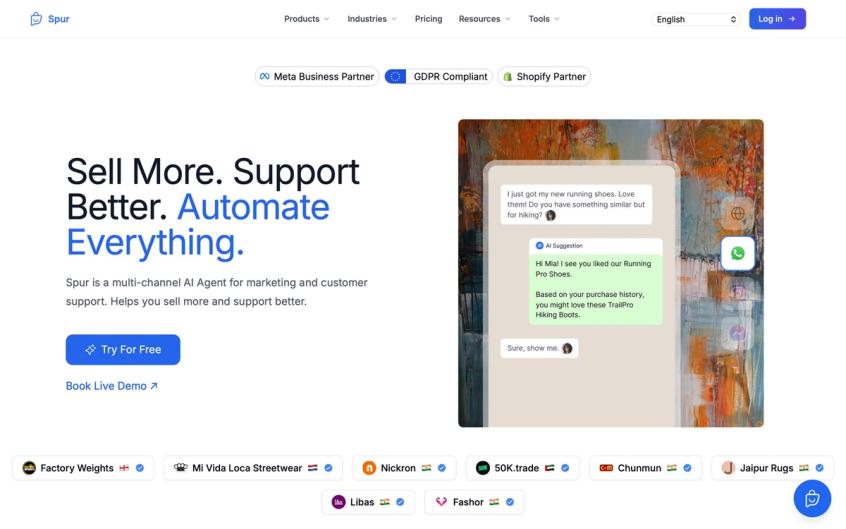
How to Get Started with Spur
Setting up Spur is straightforward:
① Connect your channels (WhatsApp Business API, Instagram, Facebook, Live Chat)
② Add knowledge sources (your website, help docs, product catalog)
③ Train your AI agent on common queries
④ Set up routing rules (AI for simple stuff, humans for complex)
⑤ Launch campaigns (abandoned cart, broadcasts, drip sequences)
We handle the technical complexity. You get a unified system for managing customer conversations across every channel that matters. Check out our pricing to find a plan that fits your needs.
What Happens Next
The messaging landscape in 2026 is more dynamic than it's been in a decade. RCS is finally real, SMS is more regulated but still essential, and businesses that master both will win.
Your next step: Pick one use case (abandoned cart, appointment reminders, order updates) and design it for both RCS and SMS. Test with a small audience. Measure the results. Then expand.
And if you're managing multiple messaging channels and want them unified in one system, check out Spur. We make it easy to handle WhatsApp, Instagram, Live Chat, and yes, even integrate with your SMS/RCS providers so everything flows through one platform.
The era of "just send texts" is over. The era of strategic, omnichannel marketing automation is here. Build it right.
RCS vs SMS FAQs: Your Questions Answered
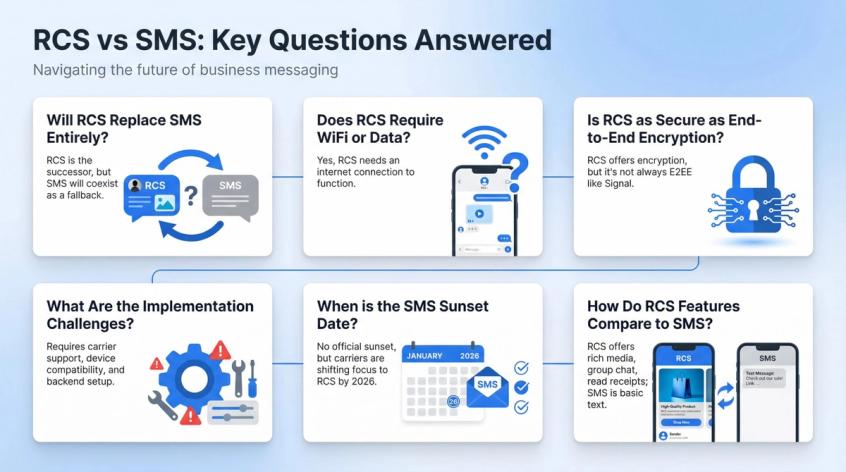
Not anytime soon. SMS is a universal fallback rail that works on literally every phone. RCS is the richer rail where it's supported. The likely endgame is "RCS where possible, SMS otherwise," not "SMS disappears." Think of it like how websites adapted to mobile: you design for the best experience, but you don't abandon compatibility.
No. Apple explicitly says RCS messages send over Wi-Fi or mobile data, and it's network-provided. If the user has no data or WiFi path, don't count on RCS working. That's why SMS fallback is essential.
Not universally. The GSMA has published updated RCS E2EE specs, and the ecosystem is moving toward interoperable encryption using MLS. But implementation varies. Apple's RCS is NOT end-to-end encrypted. Don't assume "RCS = E2EE everywhere."
Thinking it's "just richer SMS." RCS is closer to launching a new messaging surface. You need agent setup, brand verification, approvals, creative QA across devices, and routing/fallback logic. Plan for a multi-week implementation, not a quick toggle. It's similar to implementing WhatsApp marketing automation. Proper setup takes time but pays off.
Underestimating compliance and cost multipliers:
→ Segmentation (emojis and unicode can fragment messages)
→ 10DLC program fees and registration costs
→ Carrier filtering and changing penalty structures
You can't just blast SMS like it's 2015. The compliance landscape has teeth now. Understanding customer service automation helps ensure your messaging stays compliant and effective.
Not directly. RCS can have rich cards, images, and buttons. SMS needs to be plain text, ideally under 160 characters. Best practice: Design the RCS experience first (rich, interactive), then create a simplified SMS fallback that captures the essential information with a link if needed.
Start with a small audience segment where you know device support is high (Android users in major markets, or iPhone users on iOS 18+ with RCS-enabled carriers). Send RCS with SMS fallback to this group. Measure engagement, conversion, and delivery rates. Once you're confident, expand gradually. This is similar to testing Instagram automation before scaling.
iPhone RCS requires iOS 18+ and carrier support. Not all carriers have flipped the switch yet for iPhone RCS (especially for business messaging / A2P). Check your target markets: Major European carriers support RCS for P2P and A2P. In the US, carriers like AT&T, Verizon, and T-Mobile are rolling out support, but there may be gaps in business messaging coverage.
No. The adoption curve is steep right now. Analysts project RCS traffic will quadruple from 2024 to 2029 (from about 1.5 trillion messages to over 6 trillion). Early adopters get competitive advantage. Plus, with SMS fallback, you don't sacrifice reach while you experiment with RCS. Learn from early adopter case studies to accelerate your implementation.
Massively. The US has 10DLC registration and Campaign Registry requirements. India has strict sender header regulations. Europe has GDPR considerations. Always work with a local messaging provider or aggregator who understands the regional compliance landscape. Don't assume what works in one market will work globally.
Understanding GDPR compliance for messaging is crucial if you operate in Europe.
Sources
The pages this article links out to, in the order they appear.
- Apple explicitly treats RCS as a network-provided service support.apple.com
- AWS documentation docs.aws.amazon.com
- your agent appears inside RCS-enabled apps with your name, logo, description, and contact info developers.google.com
- Apple's adoption of RCS in iOS 18 support.apple.com
- The RCS Universal Profile has evolved toward interoperable end-to-end encryption using Messaging Layer Security (MLS), and the GSMA has published updated E2EE specs gsma.com
- Google's RBM billing FAQ developers.google.com
- The Campaign Registry publishes a brand and campaign fees schedule campaignregistry.com
- The CTIA publishes messaging security and best-practice guidance api.ctia.org
- launch process developers.google.com
Was this article useful?