What is Messenger Marketing? Complete Guide (2025)

Discuss with AI
Get instant insights and ask questions about this topic with AI assistants.
💡 Pro tip: All options include context about this blog post. Feel free to modify the prompt to ask more specific questions!
TL;DR: Customer messages are drowning your business in chaos. Messenger marketing solves this with AI agents that actually do things (track orders, book calls) across WhatsApp, Instagram, and Live Chat. Spur unifies it all in one platform with 80%+ open rates and instant response times.
Your customer just commented on your Instagram post. Another one messaged you on WhatsApp. Three more are waiting in Facebook Messenger. And your website live chat is pinging nonstop. Welcome to 2025, where customer conversations happen everywhere except email.
Messenger marketing is how businesses finally make sense of this chaos. It's the practice of using messaging apps (WhatsApp, Facebook Messenger, Instagram Direct, Telegram, and others) to communicate with prospects and customers for business purposes. But it's not just about sending messages. It's about creating two-way conversations that feel personal, automated flows that actually help people, and AI agents that can take real actions.
This guide breaks down everything you need to know about messenger marketing in 2025: what it is, why it matters, how it works, and how to get started without losing your mind in the process.
Think of messenger marketing as meeting your customers where they already are: in their chat apps. It's not limited to Facebook Messenger (though that's where the name comes from). It's about connecting with customers via direct message on their platform of choice.
Whether someone prefers WhatsApp, Instagram DMs, Facebook Messenger, or Telegram, messenger marketing means showing up in that channel. You're not forcing them to check another inbox. You're sliding into the conversations they're already having.
A messenger marketing strategy allows companies to share helpful content, answer questions, and even facilitate transactions within these chat apps. For example, a business might handle appointment bookings, product recommendations, order confirmations, or event signups through an automated chat interface.
What makes this different from email or social posts? Immediacy and intimacy. Messages arrive on someone's phone just like a note from a friend. They're often read within minutes. There's a sense of a personal conversation rather than a mass broadcast.
It's marketing by having a conversation, not just blasting an ad.
→ WhatsApp dominates globally with roughly 3 billion monthly active users in 2025 (source). Businesses can send rich messages (text, images, PDF invoices) to customers who opt in, using tools like the WhatsApp Business API for automation.
→ Facebook Messenger reaches close to 1 billion users globally (source). Companies can chat with customers from their Facebook Page, deploy chatbot flows, and run click-to-Messenger ads to initiate conversations using Facebook automation tools.
→ Instagram Direct is hugely popular for brands and creators. Billions of DMs are exchanged on Instagram every month. Messenger marketing here might involve an auto-reply to story mentions or post comments (like "Comment 🔥 to get a discount code in your DMs") to engage followers one-on-one through Instagram automation.
→ Other platforms matter regionally. WeChat has about 1.38 billion users (mostly in China) as of 2024 (source). Telegram and Viber have hundreds of millions of users and offer bots and channels for outreach.
A good messenger marketing strategy meets your audience on whichever chat apps they prefer. Instead of hoping they open an email or see a social post, you're delivering it straight into their ongoing conversations.
In 2025, messenger marketing has moved from a novel idea to a must-have strategy for many businesses. Here's why:
Messaging apps boast engagement rates that email and other channels simply can't touch.
| Metric | Email Marketing | Messenger Marketing |
|---|---|---|
| Open Rate | 19-21% | 80-90% |
| Click-Through Rate | 2-3% | 20%+ |
| Response Time | Hours/Days | Seconds/Minutes |
The average email open rate across industries is around 19-21%, with tiny click-through rates of 2-3%. Messenger marketing regularly sees open rates of 80-90% and strong click-through rates of 20% or higher.

One study famously saw an 88% open rate and 56% CTR from a Messenger bot campaign. Users tend to notice and read chat messages almost immediately, whereas emails might sit ignored. Research indicates that messenger messages often achieve 70-80% open rates in the first hour.
The engagement difference is striking: Your marketing messages actually get seen and acted on through messenger channels, not buried in crowded email inboxes.
Many customers prefer messaging when interacting with businesses.
56% of people would choose a message over a phone call for customer support. Plus, 61% appreciate personalized messages from businesses, and over 50% of shoppers (especially younger buyers) would rather use messaging than a voice call when shopping or making inquiries.
The comfort and convenience of chat makes customers more receptive to your outreach. Instead of being seen as intrusive, a well-crafted message can feel helpful.
The top messaging platforms have billions of users, now even surpassing social networks in usage.
Consider these numbers:
• WhatsApp alone has nearly 3 billion monthly users worldwide, making it the #1 messaging app (source)
• Facebook Messenger reaches around 947 million users globally as of early 2025 (source)
• WeChat (China) has 1.3+ billion users (source)
• Instagram has over 2 billion users with a thriving DM culture
There are now more active users on messaging apps than on traditional social media apps. Messenger marketing lets you tap into this massive audience. It's essentially meeting customers where they already spend their time (inside chat threads).
Messenger marketing allows tailored, one-to-one communication at scale.
With chatbot automation, a single marketer can simulate thousands of individual conversations. Each conversation can be personalized with the user's name and context. This creates a sense of personal touch that mass advertising lacks.
Two-way conversations also give businesses instant feedback and richer data on customer preferences. It's a far cry from blasting a one-size email to everyone. You can tailor offers and responses in real time based on what the person says.
And if AI is integrated, the chatbot can handle complex queries or pull info from databases (like checking an order status) automatically. The result: customers feel heard and catered to, and businesses save time by automating repetitive interactions.
Critical insight: The difference between simple Q&A bots and actionable AI agents will determine whether your customer support scales or struggles.
Traditional chatbots just answer questions. Actionable AI agents can actually do things: track orders, update records, book meetings, or pull customer data from your systems. This is the difference between a frustrating "I can't help with that" response and a seamless "Let me check that order for you... found it! It ships tomorrow."
(Spur's platform exemplifies this with actionable AI agents that can be trained on your knowledge base and connect to your backend systems to take real actions, not just answer FAQs.)
With messenger channels, communication is instantaneous.
Customers get quick answers (often 24/7 if bots handle after-hours), which boosts satisfaction. For marketers, this immediacy means you can strike while the iron is hot. For instance, sending an abandoned cart reminder on WhatsApp 30 minutes after a user leaves your site, when purchase intent is still high.
Compare that to email, where your message might be read days later (if at all). Quick, convenient communication via chat can shorten sales cycles and resolve support issues faster, leading to higher conversion rates and happier customers.
Studies show 30% better ROI from Messenger conversations with customers compared to traditional retargeting ads.
The combination of high open rates, personalization, and quick responses often translates into better conversion metrics.
Users are more likely to click a link or respond to a call-to-action in a chat. For example, Facebook's data has shown astonishing performance for Messenger outreach. One report noted open rates of 88% and CTR of 56% in Messenger campaigns.
Many businesses see improved lead generation and sales via messaging. Whether it's collecting more webinar signups through a DM campaign or directly closing sales within a chat (taking an order via Messenger), the engagement boost drives real results.
Research indicates 47% of consumers would even be open to buying items entirely through a chatbot conversation, start to finish. Those are conversions that email or display ads might never get you.
Messenger marketing operates on a simple premise: you need permission to talk to someone on a messaging app, and once you have it, you can carry on a conversation just like any chat.
Here's a step-by-step look at how businesses typically run messenger marketing campaigns or programs:
Before you can message a user, they often need to initiate contact or subscribe, due to platform rules (to prevent spam). There are several common ways to get that first interaction:
① Click-to-Chat Ads
Run ads on Facebook or Instagram that, when clicked, open a Messenger or WhatsApp chat with your business. For example, a Click-to-Messenger ad on Facebook can target users and invite them to "Message us to learn more," launching a conversation thread instantly.
Similarly, Click-to-WhatsApp ads on Instagram or Facebook allow users to start a WhatsApp chat with one tap. This is a great way to move people from seeing an ad to engaging in a personal dialogue, and it signals clear intent.
② Chat Widgets and QR Codes
On your website or physical store, you can invite visitors to connect via chat. A website live chat widget might let them choose Messenger or WhatsApp to talk to you. Likewise, a QR code on packaging or at a storefront can open a WhatsApp or WeChat session when scanned.
For instance, putting a "Chat with us on WhatsApp" link or QR code generator tool in your emails, site, or social bio can funnel interested users into a chat.
③ Social Media Engagement (Comment-to-DM)
On platforms like Instagram and Facebook, there are tools to automatically message users who engage with your content.
A popular tactic is "Comment to DM": for example, "Comment 👉 SALE on this post, and we'll DM you a 20% off coupon." When users comment the trigger word, a chatbot sends them a pre-set Direct Message. This turns public engagement into a private conversation that you can nurture through Instagram DM automation.
④ Opt-in Messages and Keywords
In some cases, users can send a specific message to opt in. For example, texting a keyword to a WhatsApp number (or replying "START" to a Facebook Page's Messenger) can subscribe them to updates.
Some brands use SMS or email to drive people to chat: "Reply YES to chat with our bot on Messenger for real-time tips." The key is the user consents or requests to chat, which opens the door for further messaging.

Once the conversation is initiated, businesses often use chatbots to handle the interaction (especially for the first messages). A chatbot is an automated program that can send messages and respond based on user input.
Modern messenger marketing relies heavily on these bots to scale. You can't have a human manually chatting with thousands of people simultaneously.
Rule-Based Chatbots
These follow a decision tree or script. For example, the bot might greet: "Hi! I'm Anna, virtual assistant for XYZ Brand. What can I help you with today? (1️⃣ Track an Order, 2️⃣ Browse Products, 3️⃣ Talk to Support)."
If the user presses "1", the bot asks for an order number and then fetches status via an integration. If "2", it might showcase categories or a product catalog inside the chat.
This kind of bot uses predefined menus and keyword triggers (if user says "price" or "shipping", the bot responds accordingly). Many early messenger marketing strategies used these rule-based bots to automate FAQs and guide users through funnels.
Platforms with chatbot development frameworks provided visual flow builders for Messenger bots. And now similar no-code builders exist for WhatsApp and Instagram DMs.
AI-Powered Chatbots (Conversational AI)
In 2025, AI has taken chatbots to the next level.
Instead of just rule-based replies, AI chatbots can understand natural language and handle more complex, free-form questions. For instance, an AI assistant can be trained on your website data or knowledge base content, so it can answer customer queries in a conversational way (not just pick from a script).
This means a user can type "I have an issue with my order" and the AI bot can interpret that, ask for details, and provide a relevant answer or solution.
AI bots also enable more personalization. They can recall user preferences and context from earlier in the chat. Many businesses are now deploying hybrid chatbots: simple flows for common tasks, with an AI hand-off for open-ended questions. This improves the customer experience by not limiting them to rigid menus.
For example, Spur's platform offers "Custom AI Actions" where bots can call on GPT-based AI to answer questions or perform tasks using your business data. This is the difference between a bot that says "I don't understand" and one that actually solves the problem.
Broadcast and Drip Messages
Beyond one-on-one query handling, messenger marketing often involves proactively sending out messages to users who have opted in.
This could be a broadcast (like a bulk message blast). For instance, sending a WhatsApp campaign to 2,000 subscribers announcing a new collection drop.
Or it could be a drip sequence: a series of timed messages that nurture a lead. An example drip might be:
• User signs up via Messenger
• Day 1 they get a "Welcome!" message
• Day 3 a useful tip or blog link
• Day 5 a promotional offer
Each platform has its rules. Facebook Messenger had a 24-hour window rule for promotional messages (with some exceptions like one-time notifications or the new Recurring Notifications / Marketing Messages feature). WhatsApp Business API allows templated outbound messages to opted-in users but may charge per message.
Despite differences, the strategy is similar: treat chat subscribers somewhat like an email list. Segment them and send relevant content, but do it in a conversational style and sparingly to respect the user's inbox.

While bots handle volume and routine interactions, human agents are still vital for complex or high-stakes conversations.
Effective messenger marketing blends automation with live support through a shared inbox.
For example, if a bot on Instagram DM cannot parse a customer's unique question, it can seamlessly tag in a human through chatbot to human handoff. The conversation then appears in your team's inbox software for a live agent to continue.
This handover is usually smooth. The agent sees the chat history, so the customer doesn't have to repeat themselves.
Many messaging platforms support an official handover protocol or at least let the bot be paused when a human joins. By setting up triggers (like certain keywords or negative feedback) to alert a human, businesses ensure that high-value leads or upset customers get personal attention.
This AI + human combo means you cover the easy 80% of queries with automation, and allocate staff time to the 20% of cases that need nuance or empathy.
The result is scalable conversations that still feel friendly and responsive.
(Spur offers a unified inbox that brings WhatsApp, Instagram, Facebook Messenger, and Live Chat into one dashboard where your team can seamlessly take over from AI when needed.)
Messenger marketing works best when you leverage context.
Since these apps often tie to a user's profile, you at least have a name and maybe basic info. But as you chat, you can also ask questions or track behavior to segment users.
For instance, a Messenger bot might ask "Are you interested in [A] Sports or [B] Casual shoes?" Capturing that preference using psychographic segmentation to send targeted offers later. Or your WhatsApp workflow might detect that a user clicked a product link you sent, indicating interest, so it follows up accordingly ("Would you like 10% off that item you viewed?").
Because messenger conversations are inherently interactive, you can gather zero-party data directly (information the customer voluntarily shares) and then use it to tailor future messages.
This is powerful. You can build customer profiles right within your chat system with customer data integration.
Modern platforms often integrate with CRM systems or e-commerce systems too, so your chatbot knows, for example, a user's past orders or location and can adjust its responses. Personalization can be as simple as using the person's first name in messages (which significantly increases engagement rates) or as advanced as recommending the exact size of clothing they last bought.
The more context you use, the more helpful (and less "spammy") your messenger marketing will feel.
Messenger marketing isn't limited to plain text chat. All major messaging apps support rich media and interactive elements that marketers can utilize:
Images, GIFs, Video, Audio
You can send product photos, demo videos, voice notes, etc., to make the conversation engaging. For example, a travel agency bot might send a 30-second clip of a resort when the user asks about vacation packages. Rich media often conveys more than text and grabs attention in the chat feed.
Quick Reply Buttons
These are buttons the user can tap instead of typing a response. For instance, a chatbot asks "What do you want to do next?" and shows buttons like "View Pricing" or "Talk to Support."
Quick replies streamline the UX and guide the user's journey. Facebook Messenger, Telegram, WhatsApp (through interactive message templates) all allow such buttons.
Carousels and Lists
Especially in Facebook Messenger (and now in Instagram via the API), you can present multiple options in a swipeable carousel or a list with images. For example, a bot could display a carousel of 5 products with images, each clickable for details. This effectively creates a mini storefront inside the chat.
This turns messaging into a point-of-sale.
Forms and Inputs
Some platforms let you collect structured data. For example, Messenger can use "user input" flows to get email or phone number and confirm it. WhatsApp templates now allow quick reply buttons and even list menus for choices.
These interactive elements help you capture leads or info seamlessly in chat (way more engaging than a web form) through lead generation chatbot strategies.
Payment Integration
Certain chat apps have payment capabilities. For instance, WeChat and LINE have deeply integrated payments. Facebook Messenger has supported payments in some regions, and WhatsApp is piloting payments in-app.
This means messenger marketing can potentially drive a sale without leaving the chat. The user can complete a purchase right there, which reduces friction.
Even if in-app payment isn't used, a bot could generate an invoice or a checkout link on the fly with e-commerce integrations. For example, a restaurant's Messenger bot could let a user order a meal and pay via a link, all during the chat session.
Each messaging platform has its own rules for businesses. Successful messenger marketing works within these guidelines to maintain trust (and avoid getting your account blocked).
A few general principles:
User Consent
Don't message people who haven't agreed to chat. Most platforms require the user to initiate or opt in (as discussed in step 1). Cold-messaging users is a quick way to violate terms and annoy customers.
Messenger marketing is often called "permission marketing". You must earn the opt-in, then respect it.
Content Restrictions
WhatsApp, for instance, has strict template approval for outbound messages. You must stick to certain categories (like updates, alerts, etc.) unless in the 24-hour window after a user's last message.
Facebook Messenger doesn't allow promotional messages after 24 hours of last user interaction, unless you have a special opt-in (Recurring Notifications).
Always check current policies. By 2025 these rules evolve (WhatsApp opened a new Marketing Messages API for easier promotional messaging, and Messenger introduced "Messaging Topics" for allowed follow-ups).
When in doubt, focus on providing value. Send content the user actually finds useful, and you'll likely be within acceptable use.
Frequency and Timing
Just because you can message someone doesn't mean you should do it incessantly.
A best practice is to limit how often you broadcast marketing messages and to allow easy opt-out. Treat a chat subscriber's attention as carefully as an email subscriber.
Also, consider time zones and convenience. An after-hours ping might be fine for some contexts (like a shipping notification) but not for a sales promo. Some platforms even enforce "quiet hours."
Use common sense and perhaps ask users for preferences (like "When would you like to receive updates?").
Privacy
Messaging may feel informal, but users still expect their data to be handled respectfully. Comply with privacy laws (like GDPR for WhatsApp API). For example, WhatsApp requires informing users how you'll use their number.
Don't share sensitive info insecurely over chat. Many companies include a brief notice or a link to privacy policy when a user first engages on Messenger or WhatsApp. Building trust is crucial. One misstep can make a user block your chat or report spam.
By following these steps and principles, you create a robust messenger marketing system: you bring users into a conversation, use automation to serve them at scale, involve humans when needed, personalize the experience, and abide by the rules of the road.
It's tempting to ask: is messenger marketing better than email marketing or social media marketing?
The reality is each channel has its strengths, and they can complement each other. Here's how messenger marketing differs:
Email and traditional ads are mostly one-to-many broadcasts. They deliver a message, but the conversation is not in real time (if the customer replies to an email, they might wait days for a response, if any).
Messenger marketing is inherently two-way.
It's a live thread where the user can respond immediately and get answers through customer communication platforms. This makes it more like a dialogue or an ongoing relationship, rather than just periodic announcements.
Customers tend to check messages far more often than email inboxes, and they can ask questions in the same channel. This is a game changer for engagement.
It's the difference between talking with your customer versus talking at your customer.
As discussed, messages on chat apps are far more likely to be seen.
The average email open rate is around 20%, whereas messenger messages might hit 80%+.
Social media posts (like a Facebook Page post) might only reach a single-digit percentage of your followers due to algorithms. In contrast, a message in Messenger or WhatsApp goes directly to the user with a notification.
In that sense, messenger marketing can guarantee much higher visibility than traditional channels.
Important caveat: Don't abuse that visibility. If you spam users, they'll mute or block you faster than they would unsubscribe from an email. But done right, the engagement metrics are clearly in favor of messaging.
Email allows long-form content and rich design (images, HTML). It's basically a digital letter. Messenger messages are usually short and conversational.
It would be odd to send a 500-word newsletter as a WhatsApp message.
So, the content strategy differs. Messenger marketing excels at byte-sized updates, quick questions, reminders, and interactive content ("tap a button for more info"). Email might be better for delivering a detailed announcement or a multi-section newsletter.
Many businesses use email for in-depth content but use messenger for timely nudges and interactive prompts.
For example, announce a big product guide via email, then two days later send a Messenger follow-up like "Hey, have you checked out our new guide? I can send you the section relevant to you, just ask!"
Combining channels can lift overall engagement with multi-channel marketing automation. You might warm a customer through email and then invite them to continue on chat for a more personal touch.
Emails can sit in an inbox indefinitely until read (or deleted), and social posts have a short feed lifespan unless someone scrolls way back.
Chat messages are typically most effective in the moment. They are timely. If not read within a day or two, that chat might never be scrolled up to.
This is why timing and context are critical for messenger marketing. It shines for real-time communication:
• "Your order is out for delivery now"
• "Event starting in 1 hour!"
• "Flash sale today only"
And for immediate feedback loops (you ask, customer answers right away).
It's less useful for long-term content that you expect users to refer back to. In practice, many companies use messenger marketing to initiate or resume a conversation and then send longer content via email or web when needed.
For example, a bot might ask for an email to send a PDF brochure, rather than dumping the whole PDF into the chat.
Think of messaging as the conversational glue that holds the customer journey together, while other channels provide the heavier content.
Not everyone uses every messenger app, and not everyone opts into brand messages. Meanwhile, virtually all internet users have an email address.
If you have a very broad or older demographic, email might still cover more ground.
Messenger marketing tends to be especially potent for millennial and Gen Z audiences, who heavily use chat apps and prefer quick communication. That said, WhatsApp and SMS are ubiquitous across age groups in many countries.
It's wise to survey your customer base: if, say, 90% of them are active on WhatsApp, that's a huge opportunity.
In some B2B contexts, LinkedIn messaging or email might be more appropriate than say Instagram DM. Always align the channel with where your target audience is most comfortable.
Messenger marketing isn't here to kill email or other channels. It's here to fill the gaps and boost interaction.
The best strategies combine channels with omnichannel marketing automation.
For example, you might use email for monthly newsletters, SMS for urgent alerts, and WhatsApp for interactive customer service and upsells. Each plays a role in a cohesive customer communication plan.
A 2025 marketing playbook might look like: capture email and phone on signup (for traditional outreach), but then also prompt the user to connect on WhatsApp or Messenger for more personalized updates. This way you have multiple touchpoints.
Companies using a multichannel approach report higher overall engagement. For example, you could send a campaign via email and follow up with a shorter reminder in Messenger to those who didn't open the email.
The key is to respect each medium's etiquette and strengths.
To truly succeed with messenger marketing, you need more than just tech. You need the right strategy and tactics.
Here are some battle-tested chatbot best practices to ensure your campaigns are effective and user-friendly:
This is the golden rule. Every message you send should have a clear benefit to the recipient (be it useful information, a relevant offer, or timely support).
Because messaging feels personal, users are even less tolerant of spam than in email.
Avoid sending generic blast promotions too frequently. Instead, segment your audience and tailor messages. For example, send a back-in-stock alert only to those who asked about that item, rather than to all.
Value-driven messaging wins: If you consistently deliver value (like "Hi [Name], your flight to LA is delayed 30 mins. We thought you'd want to know!" or "Hey [Name], here's a 1-click reorder link for your favorite coffee, since you might be running low."), users will keep the channel open.
The moment you abuse it with irrelevant or overly salesy messages, you risk being blocked.
Remember that messenger marketing is permission-based. You need to earn the right to continue the conversation.
Write in a friendly, human tone as if you were talking to the customer one-on-one (even if it's automated).
Messenger chats are informal by nature. Use the customer's name, use emojis if appropriate to your brand, and don't be too stiff or corporate.
For example, instead of:
"NOTICE: YOUR ORDER #12345 HAS SHIPPED"
Say:
"🎉 Hi Sam! Great news (your order is on its way 🚚). You can track it here: [link]. Anything else I can help with?"
The latter feels like a helpful update from a real person.
Being conversational also means listening: give users chances to respond and ask questions. If they reply or express an emotion, acknowledge it.
Don't ignore user messages in your bot flow. Always have a default catch-all reply like, "I'm sorry, I didn't catch that. Could you rephrase?" so the user isn't met with silence if they go off-script.
The more your messenger interactions feel like a natural chat, the better the engagement and trust.
Take advantage of the data you have to make messages more relevant.
Basic personalization includes using the person's name and perhaps past purchase ("Hi John, hope you're loving the sneakers you bought last month!").
But you can go further. If you've collected info about preferences, segment your broadcasts accordingly.
For instance, if you run a fitness brand and know half your contacts are interested in yoga and the other half in running, tailor different messenger campaigns for each group with content that resonates.
Time-based personalization is great too. For example, send a "Good morning" message with a tip to start the day, or a weekend-only sale alert on Friday.
If a user was browsing a product on your site and didn't buy, a personalized follow-up in chat ("Still thinking about that laptop? Here's a 5% discount if you have any questions, I'm here.") can gently nudge them.
The goal is to make each user feel like the messages were crafted just for them, not part of a mass blast.
Done right, research indicates that 79% of consumers say they are more loyal to brands with conversational, personalized customer support via chatbots.
In messaging, brevity is key. People don't want to read a wall of text in a chat bubble.
Aim to keep messages scannable. One or two short sentences or a single question at a time. Use line breaks to separate thoughts, making it easier on the eyes.
If you have more to say, break it into a sequence of messages rather than one big paragraph.
For example, a bot explaining a product could send:
"Our Pro Plan includes unlimited chats and integrations. (1/3)"
Then next message:
"It's best for growing teams who need advanced automation. (2/3)"
And so on, so the user isn't overwhelmed.
Also, be responsive. If the user replies, ensure your bot or team answers quickly. Users expect near-instant responses on chat (within seconds or minutes).
Even if a human needs to step in but can't immediately, have the bot acknowledge:
"Thanks for your message! Connecting you with a human agent… (Our team typically replies within 5 minutes during business hours)."
This manages expectations with proper customer service skills.
Consider typing indicators ("Agent is typing…") or short delays for realism when a bot is responding with a longer answer. These small UX touches can make the experience feel more natural and less robotic.
Images, videos, and buttons can significantly enhance messenger interactions, but use them thoughtfully.
Visuals are great to showcase products or clarify information (an image of a menu, a PDF of a brochure, etc.). They also grab attention. A colorful image with your message might get noticed faster than text alone.
But don't overload every message with media as it can become noisy (and data-heavy for the user's device). Make sure media files are optimized for quick loading.
Interactive buttons and quick replies should be utilized to simplify choices for the user, but keep menus succinct. Offering 3-4 quick reply options is better than a list of 10, which can overwhelm.
Also, test how your rich content appears on different devices. What looks good on a desktop Messenger might be tiny on a phone.
Many successful bots send a mix of text-only messages for simple updates and then a carousel or image when they really want to showcase something (like a new product line or a travel destination). The variety keeps the user engaged.
When a user first starts chatting with you (or subscribes), it's smart to let them know what to expect.
For instance, your bot's welcome message could say:
"Hi! I can help with FAQs and give you updates about your orders. Type 'menu' anytime to see options. 🔔 If you'd like, I can also send you sale alerts once a week (you can reply STOP to opt out)."
This transparency builds trust. Users appreciate knowing they're interacting with an automation (so they don't feel duped) and how often you might message them.
Always allow an exit: honor "STOP" or "Unsubscribe" commands by immediately ceasing marketing messages to that user (you can still confirm "You won't receive further messages.").
Facebook Messenger and WhatsApp both mandate providing a way for users to opt out.
If you get an unsubscribe, make sure your system tags that and doesn't accidentally include them in future broadcasts. It's far better to lose one subscriber gracefully than to keep messaging someone who's annoyed. That could lead to spam reports and damage your sender reputation on the platform.
Also, if your chatbot can't handle something, be upfront:
"Sorry, I'm just a bot and I'm not sure about that. 🤖💦 Let me get a human to help you!"
Users prefer honesty over a bot that goes in circles.
Treat your messenger campaigns with the same rigor as any marketing channel.
A/B test your approaches. Try different message copy for a broadcast (maybe one version with a casual tone vs. one more formal) to see which gets better response rates.
Experiment with sending times (perhaps lunchtime vs. evening) to gauge when your audience is most responsive.
Monitor metrics like open rate (if the platform provides it), click-through rate on any links you send, and especially response rate (did the user actually interact with your message?).
Also, pay attention to qualitative feedback: what questions are users asking that your bot couldn't answer? That's a clue to update your bot's knowledge.
If users keep dropping off at a certain point in a conversation flow, examine that step and refine it.
The great thing about messenger marketing is the feedback loop is immediate. You can see transcripts and data in real time. Use that to iterate.
Chatbot analytics tools can show you conversion funnels (for example, out of 100 who started the quiz flow, 60 finished, 40 dropped at question 3 (why?). Tweak the copy or logic and try again.
Over time, these optimizations can significantly improve your engagement and conversion rates.
Keep an eye on platform changes too. For example, if Meta introduces a new messaging feature or rule, adjust your strategy to take advantage or remain compliant.
If you operate on multiple messaging apps (say WhatsApp and Facebook Messenger and a website live chat), try to integrate the experience through omnichannel marketing examples.
A customer might start on one channel and move to another. It's ideal if their history or context can follow.
Using a unified inbox or CRM that gathers conversations from all channels helps your team have a 360° view.
From the user's perspective, it shouldn't matter if they emailed you or WhatsApped you. The support agent should know both happened.
Many businesses choose a platform that aggregates chats from WhatsApp, Instagram, Facebook, web, etc., into one dashboard.
(Spur is an example of this (it brings all your messaging channels into a single shared inbox where AI agents and human agents can collaborate seamlessly).)
This way, your AI chatbots and human agents can ensure a consistent tone and avoid duplicating efforts. It also prevents the scenario where, for example, marketing is blasting the user with a Messenger promo while support is handling their complaint on WhatsApp. Coordination is key.
Plan out the role of each channel: perhaps use WhatsApp for transactional messages (receipts, 2FA codes), Facebook Messenger for content engagement (quizzes, surveys), and Instagram DM for influencer/brand community interactions.
A cohesive strategy means the channels reinforce each other rather than compete.
By following these best practices, you set yourself up to maximize the upside and minimize the pitfalls of messenger marketing.
It's a channel that rewards thoughtfulness. Treat users like individuals, converse with them naturally, and continually refine your approach based on feedback.
Messenger marketing is versatile. It can be adapted to various industries and goals.
Here are a few common use cases (with real-world style examples) to illustrate how powerful it can be in action:
Online retailers use messenger marketing to boost conversions and recover lost sales through e-commerce marketing automation.
For instance, if a shopper adds items to their cart but leaves without purchasing, you can send an abandoned cart message on WhatsApp after a short delay:
"👋 Hi! You left some items in your cart (we saved them for you). Ready to check out? Here's a 10% off code to sweeten the deal: SAVE10. Tap to complete your order 👉 [Checkout Link]."
This gentle nudge via chat feels more immediate than an email reminder.
One clothing boutique using WhatsApp broadcasts achieved over 70x ROI by sending personalized back-in-stock alerts and cart reminders to its subscriber list.
Plus, during big sales (Black Friday, Cyber Monday), an e-commerce brand might broadcast a Messenger notification to subscribers when the sale goes live, ensuring loyal customers don't miss out.
Rich media can show product images, and quick-reply buttons can let users select size or ask a question, streamlining the purchase flow.
Many companies deploy support chatbots on Messenger or website chat to handle frequently asked questions instantly through chatbot for FAQ strategies.
For example, an airline's Messenger bot can answer "What is the baggage allowance for economy?" or "Is flight AC123 on time?" by pulling from a knowledge base.
This reduces load on call centers and gives customers help 24/7 with automated customer service.
A well-trained support bot can reportedly handle 80% of routine questions, freeing human agents for complex issues. If the question is beyond the bot, it can seamlessly escalate to a live agent in the same chat, maintaining conversation history.
Users appreciate getting quick answers without waiting on hold. 69% of consumers like chatbots for simple queries because of the speedy response.
For more technical industries, messenger marketing can be used for fielding support tickets or scheduling service appointments through a guided conversation following help desk best practices.
Messenger conversations are an excellent way to collect leads in a more engaging manner than web forms through automated lead generation.
For instance, a real estate agency can run Instagram ads that open a DM chat. The chatbot then asks the user a series of questions in a friendly way:
"Hi! Looking for a home? 🏡 I can help. First, what neighborhood are you interested in?"
→ (user chooses from buttons)
"Great, and what's your budget range?"
→ etc.
This qualifies the lead conversationally. At the end, the bot might say:
"Thanks! I have a list of 5 properties that match your criteria. Would you like me to email it to you or schedule a virtual tour with an agent?"
Now the business has gathered contact info and preferences in a natural, interactive flow, and the user feels like they had a helpful chat, not like they filled a dull form.
Educational services, consultants, B2B companies (any business that relies on lead capture) can use messenger bots similarly with lead generation techniques.
Facebook's own data has shown Messenger interactions can sometimes outperform landing pages for conversion. Conversations inside Messenger between companies and customers delivered 30% better ROI than traditional retargeting ads in one analysis.
The leads tend to be warmer because they've engaged actively with Instagram Conversions API. Plus, once the conversation is open, sales reps can follow up in the same thread later ("Hi, just checking (did you get a chance to look at those listings? Any questions I can answer?").
If you host events, webinars, or live streams, messenger marketing can significantly improve attendance and engagement.
For example, suppose people register for your webinar. You can give them the option to get reminders via WhatsApp or Messenger.
Those who opt in will receive automated pings:
"Your webinar starts in 1 hour (click here to join: [link] 🎥)"
And maybe a follow-up:
"We're live now! Join us, or reply with questions you want answered."
This real-time reminder in chat is far more likely to be seen than a reminder email.
During live events, you could use messenger to collect questions ("Reply here with any questions for our Q&A"), creating an interactive experience.
For conferences or community events, a WhatsApp or Telegram broadcast group can keep attendees informed:
"Room change for the 2 PM session (now in Hall B)."
People appreciate this convenience.
After the event, you can follow up via the same channel with highlights or a feedback survey through ways to collect customer feedback, extending the engagement.
Messenger is great for delivering content in bite-sized pieces, which lends itself to educational or onboarding sequences.
For example, a fitness coach might use a WhatsApp automation to run a 7-day fitness challenge.
Day 1, the bot messages:
"Welcome to Day 1 of your Fitness Jumpstart 💪! Today's challenge: 15 minutes of cardio. Reply DONE when you've completed it!"
Day 2 might share a nutrition tip, Day 3 a short video demonstration of an exercise, etc.
Users can interact, ask questions, and get motivating responses ("Great job on Day 1! Keep it up!").
This kind of drip-feed via chat keeps users engaged and accountable in a way that email courses often can't.
Another example: SaaS companies using messenger for customer onboarding automation. A bot could walk a new user through key features over their first week, responding to their inputs.
Education tech, language learning apps, financial coaching (many have found success using chatbots to deliver micro-learning or prompts that nudge the user along a journey).
The interactivity makes it feel like a personal coach in your pocket.
One caveat: use this only for users who consent, and make it easy to pause if it becomes too much.
Messenger marketing isn't just for acquiring customers. It's also powerful for keeping them with e-commerce customer retention strategies.
A classic use case is re-engaging dormant customers with a conversational approach.
For instance, a SaaS product whose user hasn't logged in for 30 days might send a friendly WhatsApp message:
"Hi Alex, we've missed you at [Product]. Everything okay? If you need help or want to see what's new (we just launched a cool feature), just let me know. 👋"
This feels more personal than a generic email like "We noticed you haven't logged in."
Similarly, ecommerce brands use chat to retain customers by providing value beyond transactions. For example, a beauty brand's chatbot could send weekly skincare tips or let customers set up a replenishment reminder:
"It's been 2 months since your last order of moisturizer (would you like to reorder? Tap yes to get it by Friday with free shipping)."
These are helpful nudges that drive repeat business. The key is to focus on service and value, not just "Buy again!" messages.
If customers feel you're assisting them (even if it's automated), they're more likely to stick around.
52% of consumers say they're more likely to make repeat purchases from a company that offers support via live chat or messaging.
So, retaining customers can be as simple as staying available to them on chat and reaching out when appropriate with retention marketing with WhatsApp.
Messenger opens up creative campaign ideas that wouldn't be possible over email or ads.
For example, a travel agency could run a "Vacation Finder Quiz" in Facebook Messenger: the bot asks the user a series of fun questions ("Do you prefer mountains or beaches?", "Are you more foodie or adventure seeker?", etc.) and then "calculates" and presents the ideal travel package at the end.
This gamified approach not only entertains the user but also gathers their preferences for future targeting.
Another idea is a scavenger hunt via messenger. Some brands have done multi-day story games where each day the user gets a clue through the chatbot, making the campaign highly engaging.
These kinds of interactive experiences generate buzz and differentiate your brand. They're essentially marketing, but they feel like a game or a unique experience for the consumer.
If it fits your audience, don't be afraid to get creative with messenger marketing beyond straightforward chat. The medium is flexible!
As you can see, the possibilities are broad. From driving direct sales to nurturing leads to delighting customers with interactive content, messenger marketing can be applied across the customer lifecycle.
It's being used by fashion retailers, banks, healthcare providers, nonprofits, content creators, restaurants, and more. Anytime you need to communicate with an audience in a targeted, timely way (especially if you want a response or action), messaging can likely play a role.
Ready to dive in? Implementing messenger marketing may sound complex, but you can start small and build up.
Here's a step-by-step roadmap for getting started:
First, decide which messenger app(s) align with your audience and goals.
Where do your customers tend to communicate? If you're a local business in a WhatsApp-heavy country (like India or Brazil), WhatsApp Business is a no-brainer. If you have a strong Facebook or Instagram following, Messenger and IG DMs could be your starting point.
You don't have to launch on all channels at once. It's often wise to pilot one, learn, and expand.
Also consider your use case: for interactive campaigns, Facebook Messenger's rich features might be ideal. For alert-type use, SMS or WhatsApp might suffice.
Research the rules and costs of each platform as well. For example, WhatsApp Business API has a conversation-based fee structure, while Facebook Messenger is free unless you use ads.
Prioritize platforms where the majority of your customers are reachable and where the messaging experience suits your content (visual vs text, etc.).
You'll likely need a third-party tool or platform to create and manage your chatbot and campaigns (unless you have coding resources to build on the raw APIs).
There are many no-code automation tools available.
When evaluating tools, consider:
Supported Channels
Does it support the messenger app you want (WhatsApp, IG, FB, Telegram, etc.)? Some are specialized. Others handle many channels including your web live chat.
Chatbot Builder
Is it easy to design conversation flows, quick replies, and automations with their interface? Look for a visual flow builder or a straightforward rule system.
AI Integration
If you want an AI chatbot, check if the platform integrates with AI engines (OpenAI GPT, etc.) or allows a knowledge base upload for training.
For example, Spur's platform lets you train an AI assistant on your website FAQs to handle support queries across channels. This is a differentiator compared to some basic bot builders that only offer scripted responses.
Broadcast / Marketing Features
Ensure it can handle sending bulk messages or drip campaigns if that's your use case. Check how it manages opt-ins and opt-outs for compliance.
Integration and Data
Does it connect with your CRM, e-commerce platform, or other systems? For instance, connecting to Shopify or Stripe if you want to send order updates or accept payments. Webhooks or API access is a plus for custom integration.
Team Inbox
If you will have live agents, see if the tool provides a unified inbox to manage conversations and if it supports things like agent assignment, notes, and multi-agent collision avoidance.
Analytics
Good tools offer dashboard analytics: open rates (if available), click rates, user drop-off points in flows, subscriber counts, etc. This will help you optimize.
Cost
Messenger marketing tools range from free (with limited features) to enterprise pricing. Many have tiered plans based on number of subscribers or messages. Also, factor in any messaging fees.
Compare pricing and choose what fits your scale. If you're just testing the waters, a free tier or trial is ideal.
Start with a specific objective.
For example, "Answer common customer questions on Facebook Messenger," or "Collect 50 leads from Instagram DMs," or "Send an event reminder on WhatsApp to improve attendance by 20%."
Clarity will guide your chatbot design.
Here's a simple approach for a first bot:
Define the conversation flow on paper or a whiteboard. If it's a FAQ bot, list top questions and how the bot should respond. If it's a lead gen quiz, outline the questions and branching logic based on answers. Keep it as straightforward as possible initially. You can always expand.
Use templates if available. Many platforms offer pre-built templates (for example, a "Customer Support FAQ bot" template or a "Holiday Promotion" chatbot template). These can save time and give you a framework which you then customize to your content.
Craft the bot's personality and messages. Write the bot dialogue in a friendly tone, as discussed in best practices. Make sure to include a greeting that introduces the bot (or the fact that it's automated), some default error handling ("Sorry, I didn't get that…"), and a graceful exit option ("Type MENU to go back" or "Ok, let us know if you need anything else!").
Set up any integrations. For instance, connect your e-commerce store if you want the bot to pull order statuses, or connect your calendar app if the bot will book appointments. Many tools have one-click integrations for popular apps like Shopify, WooCommerce, or Razorpay.
Test the flow thoroughly. Most platforms let you test your bot in a preview mode or with a test user account. Do this from the user's perspective: try to break it by asking odd questions, make sure the quick reply buttons work, ensure the handoff to human triggers correctly.
It's like QA testing for software. Catching issues now will save user frustration later.
A chatbot without users is like a phone that never rings. You need to drive people into these messaging conversations.
Depending on the platform, here are ways to grow your messenger subscriber list:
Promote Entry Points Everywhere
Add a "Message Us" call-to-action on your website ("Chat with us on WhatsApp" button or a popup offering "Get support via instant chat" through your live chat widget).
On Facebook, use the Page CTA button "Send Message." On Instagram, include in your bio "💬 DM us for help."
If you have an email list, email them inviting them to opt in: "We're now on WhatsApp (get exclusive deals and updates, click here to join our list)."
Use QR codes in physical locations or product packaging to invite people to start a chat.
Essentially, treat your messenger channel as a channel to subscribe to, just like one would subscribe to a newsletter.
Incentivize the Chat
Give people a reason to initiate contact. For example:
• "Text us on Telegram to get a free PDF guide"
• "Message us 'HELLO' on Messenger for a 15% discount code"
These incentives can significantly boost opt-ins.
One caution: attract people who truly are interested in your brand, not just freebie chasers, or they won't stick around. But a well-chosen incentive aligned to your product can filter in quality leads.
Click-to-Message Ads
If you have an ad budget, allocate some to acquiring messenger subscribers.
As mentioned earlier, Facebook and Instagram ads can open directly into chats. Run an ad campaign with the objective set to messages (for Facebook) or using the WhatsApp/Instagram Direct click-to-chat format.
Target your desired audience and craft the ad such that clicking it promises a benefit via chat (for example, "Chat with our style assistant to find your perfect fit!" or "Have questions? Message us for instant answers and a special offer.").
This not only generates a lead but starts a conversation that your bot/agents can continue.
Leverage Existing Contacts
If you have a customer phone list (with appropriate permissions), you could send an SMS inviting them to a richer WhatsApp experience.
Or during checkout on your site, add a checkbox like "Keep me updated via Facebook Messenger." If checked, you can send an opt-in link.
Facebook also introduced features that can be embedded on websites to get Messenger opt-ins.
Use these tools to convert existing engaged users into messenger contacts.
Offer Value Through Consistent Content
People will stay subscribed if they find your messages valuable.
So plan a content calendar: maybe a weekly tip, or monthly exclusive Q&A via chat, or first-access to new products for Messenger subscribers.
If users see that being on your messenger list gives them VIP treatment or useful info they don't get elsewhere, they'll not only remain, but they might encourage friends to join too (word-of-mouth) with community building strategies.
For example, some brands create a sense of community on Telegram channels or WhatsApp groups by sharing behind-the-scenes content or flash deals just for that audience.
Once everything is set (your bot is built, you have some subscribers rolling in), it's showtime!
Announce the new channel to your audience (soft launch to a small group if you prefer) and then go live.
In the first days and weeks, monitor closely:
• Watch how people are interacting. Read through conversation logs or bot analytics. Are they asking unexpected questions that the bot can't answer? If so, teach the bot those answers or adjust the conversation path.
• Check for errors or drop-offs. If many users are, say, not completing a flow or are expressing frustration, investigate why. You might discover a confusingly worded question or a technical bug.
• Solicit feedback with analyzing customer feedback techniques. You can even ask users, "How was your experience chatting with us today?" with a quick thumbs up/down or a 1-5 rating. This direct feedback can be gold for improving.
• Ensure any human-agent processes are running smoothly following customer service quality assurance. Are agents receiving notifications when they need to step in? Is response time good? Perhaps set up internal SLAs for chat response (for example, respond within 2 minutes during business hours).
• Measure against your goals. If your goal was lead gen, how many leads came in via chat this week? If cart recovery, how many carts were recovered (and revenue from them)? Compare these numbers to your previous benchmarks or to other channels. You might be surprised. Sometimes a small number of chat interactions can drive significant revenue due to high conversion rates.
• Continue A/B testing elements of your messaging. Try different wording for your welcome message and see which yields longer conversations. Experiment with image-based vs text-based reminders. Tweak timing of sequences.
Messenger marketing is still relatively new for many audiences, so you might find counterintuitive things. For example, maybe your audience actually prefers a slightly formal tone on WhatsApp (depending on culture) rather than emojis. Let the data guide you.
After ironing out initial kinks and proving the value, consider scaling your messenger marketing program:
Expand to new platforms (if it makes sense). For example, if you started on Messenger, you might add WhatsApp once you have resources, so you cover more user preferences with multi-channel Instagram and Facebook integration. An omnichannel platform can help unify this.
Add more automation and AI. Perhaps start incorporating an AI FAQ assistant to handle long-tail questions, or integrate with more backend systems to offer self-service (for example, allowing users to modify orders or check loyalty points via chat by pulling from your database).
Segment your audience more as it grows. You might create different chatbot experiences for different customer segments (new prospect vs returning customer, high-value vs low-value customer, etc.).
Many platforms let you tag users based on attributes or behavior, which you can use to send more targeted messages. For instance, send a VIP-only promotion on Messenger to your top spenders with a personal note.
Consider richer campaigns: now that basic support and simple campaigns are running, venture into those interactive campaigns or advanced use cases we described earlier (quizzes, referral incentives via chat, etc.).
Use the momentum and data from your initial efforts to justify these experiments.
Train your team. Ensure your marketing, sales, and support teams are all aware of and proficient in using the messenger channel through customer service skills training. They should know the tone to use, how to pick up chats in the inbox, how to escalate issues.
Messenger marketing often blurs departmental lines (is it marketing or customer service?), so collaboration is key with a proper customer service escalation process.
A well-integrated approach yields the best customer experience. For example, a support chat could end with a gentle marketing offer: "Glad I could resolve that issue. By the way, we have a new feature that might interest you (can I send you details?)"
This kind of cross-functional use of chat can increase customer lifetime value.
Keep up with updates. Messaging platforms evolve rapidly. New API features, new policy changes, new ad formats. Subscribe to updates from the platforms or your chatbot provider so you can take advantage.
For example, if WhatsApp releases a feature for easier broadcast to many users, consider if it fits your strategy. Early adopters of new features often get a publicity or engagement boost.
Launching messenger marketing may feel like a lot of pieces to coordinate, but you can absolutely start small. Even something as simple as adding a live chat widget to your site with a basic bot greeting is a step into the world of conversational marketing.
The key is to start and learn.
Many businesses that started with just one automated FAQ on Facebook Messenger eventually expanded to full-fledged conversational commerce across multiple channels, because they saw the impact.
Remember: always keep the customer's experience at the center following customer experience design principles. If you use messenger marketing to genuinely assist, engage, and delight your audience, you'll build loyalty and see tangible returns (sales, retention, satisfaction) as a result.
If you misuse it with spammy tactics, you'll quickly burn your reach. But given you've read this far, you're well equipped to avoid that!
At this point, you understand what messenger marketing is, why it matters, and how to execute it.
But here's the reality: managing conversations across WhatsApp, Instagram, Facebook Messenger, and your website live chat while juggling AI automation, human handoffs, and customer data is chaos without the right platform.
That's where Spur comes in.
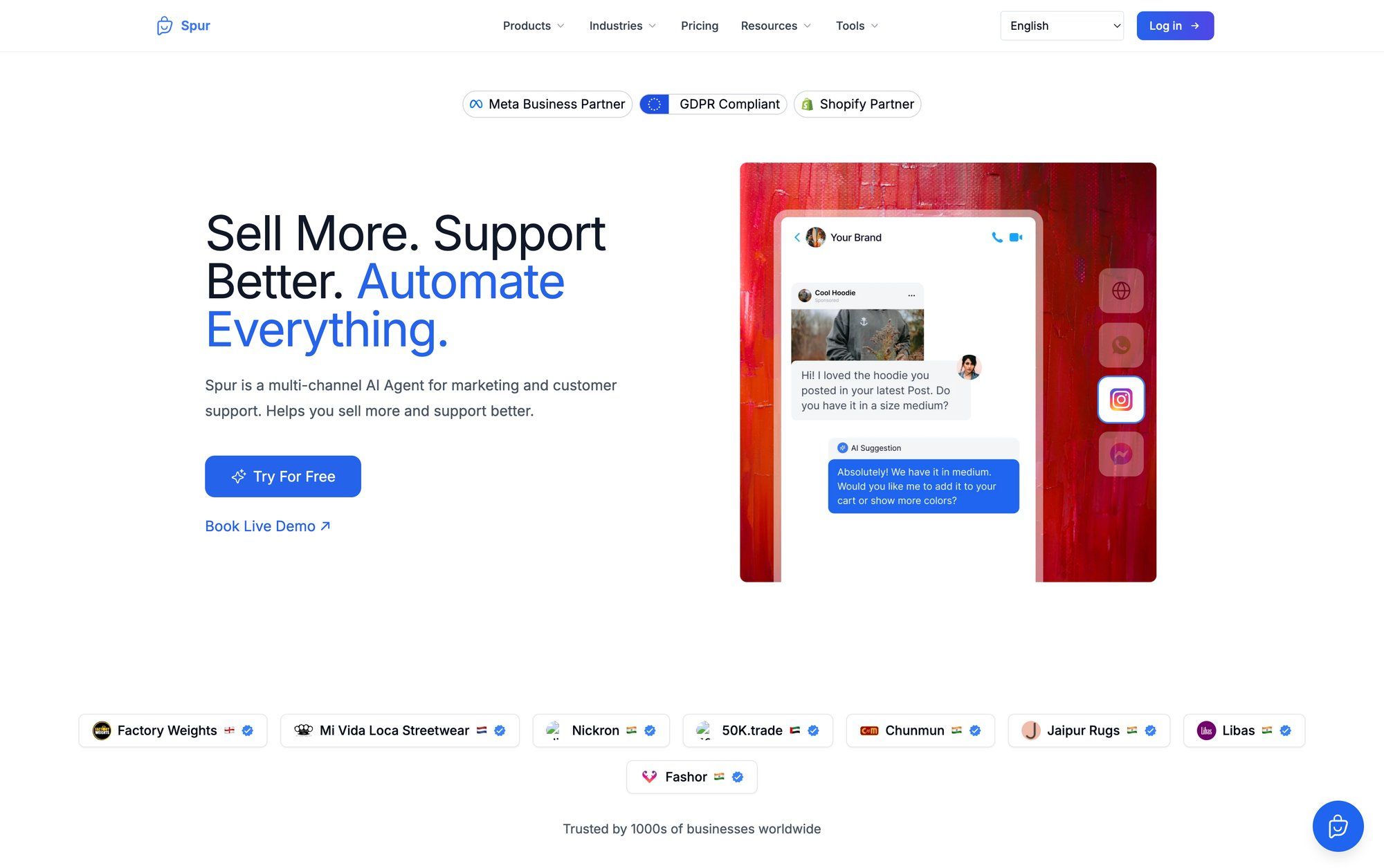
Spur is a multi-channel AI messaging platform built specifically for this challenge. It unifies all your customer conversations into one shared inbox, deploys AI agents that can actually take actions (not just answer questions), and gives you the tools to run broadcasts, drip campaigns, and automated flows across every major messaging channel.
Actionable AI Agents
Most chatbots are glorified FAQ machines. They answer questions but can't do anything.
Spur's AI agents are different. They can be trained on your knowledge base (your website content, product docs, support articles) and then deployed across WhatsApp, Instagram, Facebook Messenger, and Live Chat.
More importantly, they can take Custom AI Actions. This means your AI agent can track order status, book appointments, update customer records, or pull data from your backend systems.
It's the difference between:
"I'm sorry, I can't help with order tracking" (frustrating)
And:
"Let me check that for you... Your order #12345 shipped today and arrives Friday!" (helpful)
Unified Inbox Across All Channels
Your customers don't care which app they use to message you. But you probably care about the chaos of juggling four different inboxes.
Spur brings WhatsApp, Instagram, Facebook Messenger, and Live Chat into a single shared inbox where your team can:
• See full conversation history across channels
• Assign conversations to specific agents
• Set up automated ticketing and routing
• Seamlessly switch between AI and human responses
No more context-switching between apps. No more missed messages.
Marketing Automation That Actually Works
Spur isn't just for support. It's built for customer engagement and growth:
• Abandoned cart recovery on WhatsApp with personalized nudges
• Comment-to-DM automation on Instagram to turn engagement into conversations
• Click-to-WhatsApp and Click-to-Instagram Ads that open directly into chat
• Broadcast campaigns with segmentation and scheduling
• Drip sequences to nurture leads over time
All with the high open rates (80%+) and engagement that messenger marketing delivers.
E-Commerce Integrations
If you run an online store, Spur integrates natively with:
• Shopify
• Stripe
• Razorpay
This means your AI agents can pull real-time order data, send shipping updates automatically, and even facilitate returns (all through chat).
User-Friendly for Non-Technical Teams
Unlike technical platforms that require developers, Spur is built with a visual automation builder. Your marketing or support team can create flows, set up triggers, and launch campaigns without touching code.
This is a huge advantage over platforms that cater to developers. You can move fast and iterate without waiting for engineering resources.
Companies using Spur have achieved impressive outcomes documented in our case studies:
• 88.75x ROI in 24 hours (Eves & Gray case study (carousel messages + broadcast))
• 73x ROI (Muffynn case study (targeted WhatsApp broadcast))
• 64 orders from Instagram Live with 6% conversion (Libas case study (comment automation))
These aren't aspirational numbers. They're results from businesses using messenger marketing through Spur's platform.
You can start with a 7-day free trial to test the platform across all channels.
Plans start at $12/month (billed annually) for the AI Acquire plan, which includes:
• 1 AI agent with 100 credits
• Instagram automation
• Click-to-Instagram Direct ads
• 1 seat and 3 automation flows
As you scale, higher plans add WhatsApp automation, more AI credits, team seats, webhooks, and priority support.
Visit Spur's pricing page to see all plans and features.
If you want to unify your customer conversations, deploy AI that actually helps (not just talks), and run marketing campaigns with 80%+ open rates, Spur is purpose-built for exactly that.
Start your free trial and see the difference actionable AI makes.
Messenger marketing represents a shift from traditional "push" marketing toward conversational, customer-centric engagement.
It's marketing that feels like a helpful chat rather than an advertisement.
In 2025 and beyond, as consumers continue to gravitate towards instant messaging as their preferred communication method, businesses that master this channel will have a distinct advantage.
You've seen the stats:
• Billions of users on chat apps
• 80%+ open rates vs 20% for email
• Significant portions of consumers preferring to interact via messaging
It's a channel you can't ignore if you want to meet customers where they are.
By understanding what messenger marketing is and how it works, you can now envision how it fits into your organization. Whether you're a small e-commerce store looking to recover carts via WhatsApp or a large enterprise aiming to streamline support across continents with AI chatbots, the principles remain the same:
Be present in the conversation, be helpful, be human (even when automated), and respect the relationship.
As you implement the techniques and best practices outlined in this guide, you'll likely find not only improved metrics (higher conversion rates, faster response times, lower support costs), but also better relationships with your customers.
Many companies report that after adopting messenger channels, their customers feel closer to the brand, almost as if they have a direct line to a friend at the company. That kind of loyalty is priceless.
Finally, remember that messenger marketing is not a set-and-forget tactic. It's an evolving practice at the cutting edge of marketing and communication.
Keep learning from your audience and from industry innovations. Stay agile and be willing to tweak your approach as chat apps add new features or user behavior shifts.
The brands that remain authentic and responsive in these one-to-one conversations will reap the benefits in customer satisfaction and business growth.
So ask yourself: what conversation could you be having with your customers right now?
Chances are, they'd love to hear from you (via Messenger or WhatsApp or their favorite chat app) if you have something relevant to say.
With the knowledge from this guide, you're well on your way to making that connection.
Happy chatting, and here's to your success in messenger marketing! 🚀
What is the difference between messenger marketing and email marketing?
Messenger marketing is two-way and conversational (you chat in real time), while email is mostly one-way broadcasting. Messenger messages get 80%+ open rates vs 20% for email, and responses are instant rather than hours or days later. Email is better for long-form content, while messenger excels at quick interactions, timely nudges, and interactive conversations. The best approach uses both channels strategically with omnichannel marketing automation.
Which messaging apps should I use for messenger marketing?
It depends on where your customers are. WhatsApp dominates globally with 3 billion users. Facebook Messenger has ~1 billion users and is popular in Western markets. Instagram DMs are huge for brands with visual content and younger audiences. WeChat dominates China with 1.3+ billion users. Start with one platform where most of your customers are active, then expand to others as you scale. Spur supports all major platforms in one unified system.
Do I need technical skills to implement messenger marketing?
No. Modern platforms offer visual flow builders and no-code chatbot creation tools. Platforms like Spur let marketing teams design conversation flows, set up automation, and launch campaigns without touching code. If you want advanced custom integrations (connecting to proprietary systems), you might need developer help, but basic messenger marketing can be done by non-technical teams.
How much does messenger marketing cost?
Costs vary by platform and usage. Facebook Messenger is free to use (you only pay for ads if you run click-to-Messenger ads). WhatsApp Business API charges per conversation (rates vary by country, typically $0.01-0.06 per conversation). Chatbot platforms typically charge subscription fees based on features and subscriber counts. Check Spur's pricing for transparent pricing across all channels.
Can messenger marketing work for B2B companies?
Yes, though the approach differs from B2C. B2B messenger marketing works well for lead qualification (asking questions via chat to route leads to the right sales rep), scheduling demos or consultations, and providing quick answers to prospects researching solutions. WhatsApp is popular in many international B2B contexts. The key is to focus on value and convenience rather than promotional blasts.
How do I measure success in messenger marketing?
Key metrics include open rates (typically 70-90% for messaging), click-through rates on links you send (20%+ is common), response rates (how many users reply to your messages), conversation completion rates (how many finish your bot flow), and ultimately conversion metrics tied to business goals (leads captured, sales made, support tickets resolved) tracked through proper customer service performance indicators.
What are the rules and regulations for messenger marketing?
Each platform has its own policies. General rules include: you must get user permission before messaging them (no cold outreach to random people), provide an easy way to opt out, follow data privacy laws like GDPR, and only send content during appropriate hours. Facebook Messenger restricts promotional messages to a 24-hour window after the user's last message (with some exceptions). WhatsApp requires templated messages for outbound marketing. Always review current platform policies.
Can AI chatbots really replace human customer service?
No, and they shouldn't try to. The best approach is a hybrid model between human agents and AI chatbots where AI handles the routine 70-80% of queries (FAQs, order tracking, simple requests) instantly, freeing human agents to focus on the complex 20-30% that requires empathy, problem-solving, or nuanced judgment. Modern platforms make chatbot to human handoff seamless. The goal is to augment human agents, not replace them entirely.
How do I prevent my messenger marketing from feeling spammy?
Follow these principles: only message people who opted in, always provide value in every message (not just sales pitches), limit frequency (don't blast daily), segment your audience so messages are relevant to each group, use conversational tone rather than corporate speak, allow easy opt-out, and respond when users message you (don't just broadcast). If you consistently help rather than annoy, users will keep the channel open. The moment it feels like spam, they'll block you.
What's the best way to get people to opt into my messenger marketing?
Offer clear value in exchange for the opt-in. Examples: "Message us for a 15% discount code," "Get instant order tracking via WhatsApp," "Chat with our stylist for personalized recommendations," or "Join our VIP WhatsApp list for early access to sales." Use multiple entry points: website chat widgets, QR codes on packaging, click-to-message ads, social media bio links, and email invitations. Make it easy and make the benefit obvious.